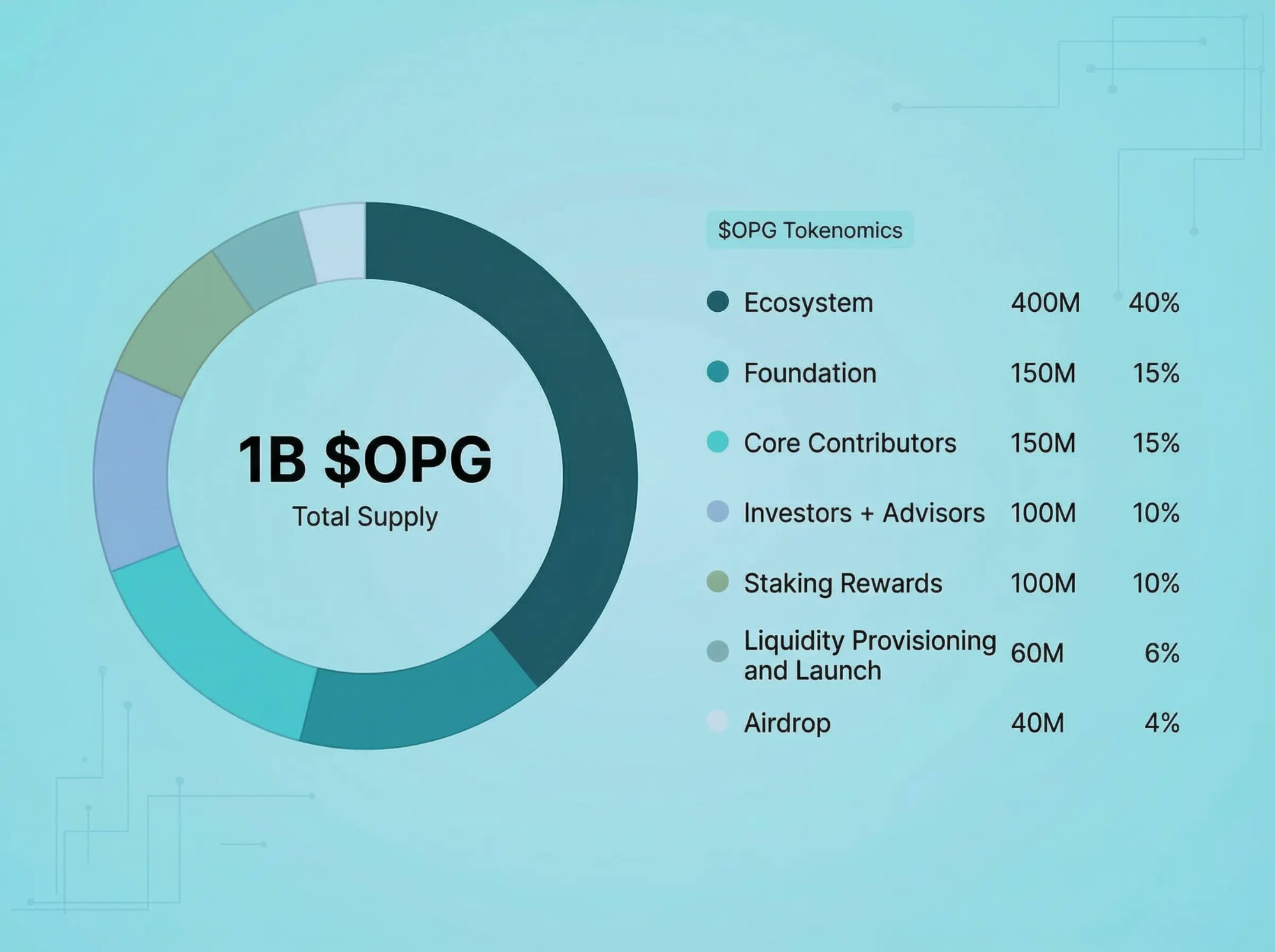
What is the role of the OPG token? Incentives and payment mechanism in OpenGradient

Last Updated 2026-04-23 03:14:46
Reading Time: 5m
The OPG token is used within the OpenGradient network to pay for computation, incentivize node participation, and maintain system security and governance.

As decentralized AI networks continue to evolve, attention is shifting beyond raw computing power toward deeper questions: how are resources allocated, why do nodes participate, and how does the system remain stable over time? These questions point directly to token design. In real-world usage, developers must pay for inference, while nodes need to be rewarded, making OPG the core medium that keeps the network running.

This topic typically spans three key areas: fee mechanisms, incentive models, and security constraints. Together, these elements define the role of OPG within OpenGradient.

What Is the OPG Token

OPG is the native token of the OpenGradient network, designed to connect demand for computation with the supply of resources.

At the mechanism level, OPG acts as a unit of value for pricing and settling AI inference services, allowing users to pay for compute in a standardized way. Nodes receive rewards based on the services they provide.

Structurally, OPG sits at the center of the economic model, linking users, inference nodes, and verification nodes. Users pay tokens to access services, and nodes earn tokens by contributing resources.

The significance of this design lies in establishing a stable supply and demand relationship, enabling decentralized computing to function sustainably.

What is the function of the OPG token? Analysis of the incentive and payment mechanisms in OpenGradient

How OPG Is Used for Inference Fees in OpenGradient

Inference fees represent the most fundamental use case of the OPG token.

At the mechanism level, when users submit AI inference requests, they pay in OPG. Fees vary dynamically based on factors such as model complexity, computation time, and resource consumption.

From a structural perspective, these fees are distributed across inference nodes and verification nodes. Inference nodes receive the majority as compensation for computation, while verification nodes earn rewards for validating results.

This mechanism uses pricing signals to regulate resource usage, ensuring that compute capacity is allocated to real demand while reducing the risk of misuse.

How Incentive Mechanisms Drive Node Participation

Node participation depends on a well-designed incentive structure.

At the mechanism level, the network distributes OPG rewards to encourage both inference and verification nodes to contribute resources. Nodes that provide more computational power or higher-quality service can earn greater rewards.

Structurally, the incentive system often includes two components: base rewards, which support continuous node operation, and performance-based rewards, which encourage efficiency and accuracy improvements.

This alignment between rewards and network needs helps improve overall performance and reliability.

How Staking Affects Network Security

Staking plays a key role in enforcing responsible node behavior.

At the mechanism level, nodes are required to lock a certain amount of OPG as collateral to participate in the network. If a node produces incorrect results or behaves maliciously, its stake may be partially or fully slashed.

From a structural standpoint, staking and penalties form a closed-loop system. Nodes earn rewards but also take on risk, which discourages harmful behavior.

This design strengthens network security by introducing economic consequences for misconduct, reducing fraud and incorrect computation.

What Role OPG Plays in Governance

Governance determines how the network evolves over time.

At the mechanism level, OPG holders can participate in voting on protocol upgrades, parameter changes, and rule adjustments. Voting power is typically proportional to the amount of tokens held or staked.

Structurally, the governance system turns token holders into active participants in decision-making, allowing the network to evolve without centralized control.

This ensures that changes reflect the collective interests of participants rather than a single authority.

How Supply and Demand Shape OPG Value

The value of OPG is closely tied to its utility within the network.

At the mechanism level, increased demand for AI inference raises demand for OPG, while the availability of computational resources provided by nodes influences the supply side. Together, these forces shape pricing dynamics.

Structurally, supply and demand are influenced by user activity, node participation, and overall network scale, creating a constantly adjusting equilibrium.

Factor Impact Direction Role
Rising inference demand Increases demand Drives token usage
More nodes joining Increases supply Expands compute capacity
Network growth Dual impact Reshapes supply-demand balance
Higher staking ratio Reduces circulating supply Increases scarcity
Higher usage frequency Strengthens demand Supports value stability

This structure shows that OPG’s value is not isolated, but directly linked to the level of activity within the network.

Limitations of the OPG Economic Model

No economic model is without constraints.

At the mechanism level, poorly designed incentives may lead to node centralization or inefficient resource allocation. Similarly, excessively high fees could discourage user participation.

From a structural perspective, the model must balance cost, incentives, and security. Failing to do so can reduce overall network efficiency.

This highlights the need for ongoing adjustments to the economic model as the network grows and usage patterns evolve.

Conclusion

By integrating payment, incentives, staking, and governance, the OPG token establishes the economic foundation of OpenGradient. It enables decentralized AI computing to operate within a balanced system of supply, demand, and security.

FAQ

What is the main use of the OPG token? It is used to pay for AI inference, incentivize node participation, and support governance.

How is OPG used to pay for computation? Users pay OPG when submitting inference requests, with fees calculated dynamically based on resource usage.

Why is staking OPG necessary? Staking enforces accountability by discouraging malicious behavior and improving network security.

How does OPG function in governance? Token holders can vote on protocol upgrades and parameter changes, influencing network decisions.

What determines the value of OPG? Its value is primarily driven by the relationship between inference demand and the supply of computational resources.

Author: Carlton
Translator: Jared
Disclaimer
* The information is not intended to be and does not constitute financial advice or any other recommendation of any sort offered or endorsed by Gate.
* This article may not be reproduced, transmitted or copied without referencing Gate. Contravention is an infringement of Copyright Act and may be subject to legal action.

Related Articles

The Future of Cross-Chain Bridges: Full-Chain Interoperability Becomes Inevitable, Liquidity Bridges Will Decline
Beginner

The Future of Cross-Chain Bridges: Full-Chain Interoperability Becomes Inevitable, Liquidity Bridges Will Decline

This article explores the development trends, applications, and prospects of cross-chain bridges.
2026-04-08 17:11:27
Solana Need L2s And Appchains?
Advanced

Solana Need L2s And Appchains?

Solana faces both opportunities and challenges in its development. Recently, severe network congestion has led to a high transaction failure rate and increased fees. Consequently, some have suggested using Layer 2 and appchain technologies to address this issue. This article explores the feasibility of this strategy.
2026-04-06 23:31:03
Sui: How are users leveraging its speed, security, & scalability?
Intermediate

Sui: How are users leveraging its speed, security, & scalability?

Sui is a PoS L1 blockchain with a novel architecture whose object-centric model enables parallelization of transactions through verifier level scaling. In this research paper the unique features of the Sui blockchain will be introduced, the economic prospects of SUI tokens will be presented, and it will be explained how investors can learn about which dApps are driving the use of the chain through the Sui application campaign.
2026-04-07 01:11:45
Navigating the Zero Knowledge Landscape
Advanced

Navigating the Zero Knowledge Landscape

This article introduces the technical principles, framework, and applications of Zero-Knowledge (ZK) technology, covering aspects from privacy, identity (ID), decentralized exchanges (DEX), to oracles.
2026-04-08 15:08:18
What is Tronscan and How Can You Use it in 2025?
Beginner

What is Tronscan and How Can You Use it in 2025?

Tronscan is a blockchain explorer that goes beyond the basics, offering wallet management, token tracking, smart contract insights, and governance participation. By 2025, it has evolved with enhanced security features, expanded analytics, cross-chain integration, and improved mobile experience. The platform now includes advanced biometric authentication, real-time transaction monitoring, and a comprehensive DeFi dashboard. Developers benefit from AI-powered smart contract analysis and improved testing environments, while users enjoy a unified multi-chain portfolio view and gesture-based navigation on mobile devices.
2026-03-24 11:52:42
What Is Ethereum 2.0? Understanding The Merge
Intermediate

What Is Ethereum 2.0? Understanding The Merge

A change in one of the top cryptocurrencies that might impact the whole ecosystem
2026-04-09 09:17:06