How Does Dogecoin Work? From Meme Culture to Decentralized Payments
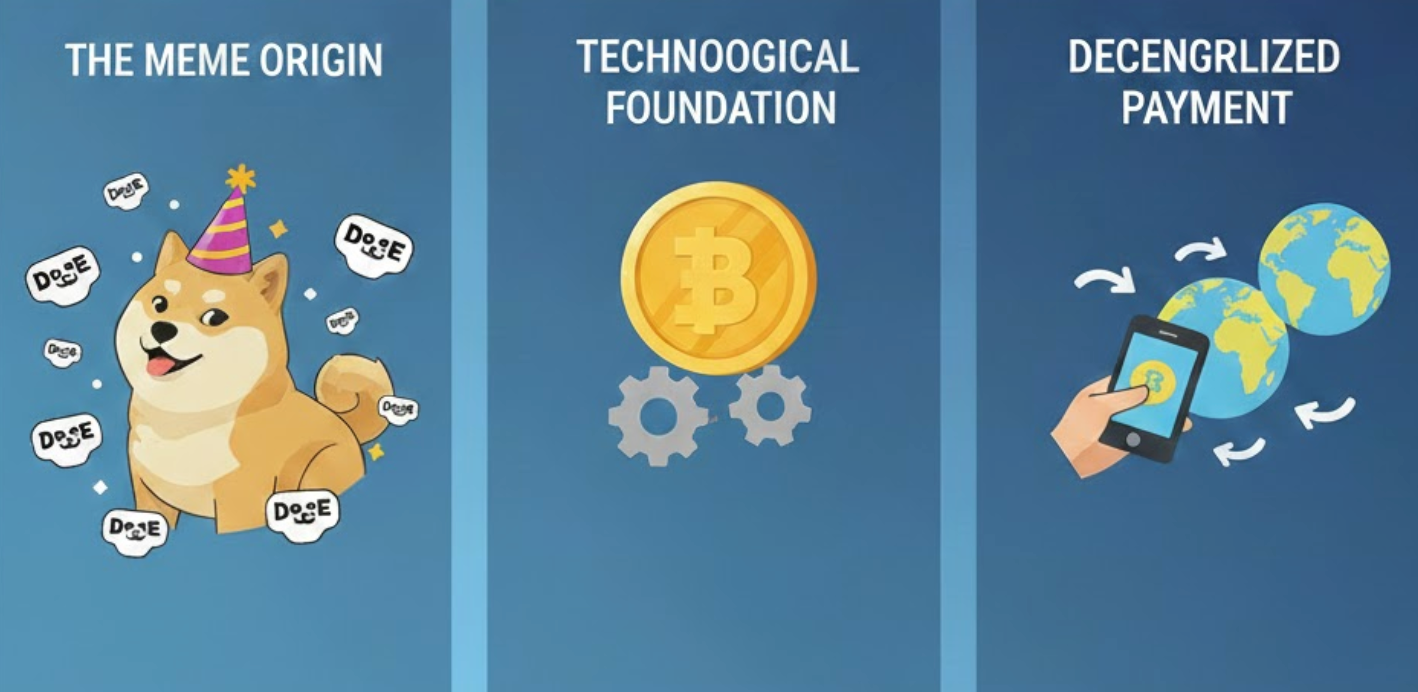
As the original meme coin, Dogecoin was created in 2013 by software engineers Billy Markus and Jackson Palmer. Using the Shiba Inu dog as its visual symbol, Dogecoin established a community culture centered on humor, tipping, and charitable giving.
Although it originated from internet satire, Dogecoin has evolved from a social asset into a representative tool for decentralized payments, supported by strong community consensus, low transaction costs, and its merged mining mechanism with Litecoin through Auxiliary Proof of Work.
A structured overview of Dogecoin’s core processes—from transaction initiation and network operation to ledger synchronization—covers its technical foundations, including its consensus mechanism and algorithm design, Auxiliary Proof-of-Work (AuxPoW), as well as its token model structure and the primary use cases and functions of DOGE. This helps build a comprehensive understanding of how the network operates.
How Does Dogecoin Work? Core Operational Process
Understanding how Dogecoin works requires viewing it as a confirmation process within a distributed ledger system. Its operation can be divided into three stages:
- Initiation Stage: Transaction Creation and Broadcasting
When user A plans to send DOGE to user B, the request is created and signed digitally before being transmitted to the network.
- Network broadcasting: The transaction is broadcast to Dogecoin’s peer to peer network.
- Mempool waiting: The unconfirmed transaction enters the mempool of network nodes, where it waits for miners to include it in a block through computational work.
- Execution Stage: Consensus Verification and Block Production
Dogecoin uses the Proof of Work mechanism to secure its ledger.
- Scrypt algorithm: Unlike Bitcoin’s SHA 256, Dogecoin uses the Scrypt algorithm. This algorithm has higher memory requirements, which initially lowered the barrier for specialized ASIC mining dominance and allowed ordinary hardware to participate more easily.
- Block production speed: The Dogecoin network produces a new block approximately every one minute. Miners compete to solve complex mathematical problems, and the first miner to solve the problem gains the right to record the block.
- Merged mining (AuxPoW): To defend against 51 percent attacks, Dogecoin shares hash power with Litecoin. Miners can mine DOGE simultaneously while mining LTC using the same equipment and electricity.
- Finalization Stage: Ledger Synchronization and Token Issuance
- Transaction confirmation: Once a block is added to the blockchain, the transaction is considered completed and irreversible.
- Token incentives: The miner who successfully produces a block receives a fixed reward of 10,000 DOGE. These newly issued tokens enter circulation and sustain the network’s inflationary model.
Technical Foundations: The Underlying Logic Supporting Dogecoin
Consensus Mechanism: PoW and the Choice of Scrypt
Dogecoin’s underlying logic traces back to Luckycoin, which itself was derived from Litecoin. The choice of Scrypt rather than SHA 256 was fundamentally driven by the pursuit of faster transaction confirmation and broader mining participation.
Although modern ASIC miners are now capable of efficiently processing Scrypt, this design choice established Dogecoin’s fast and lightweight technical orientation.
Auxiliary Proof of Work (AuxPoW)
In 2014, Dogecoin introduced the Auxiliary Proof of Work mechanism, which serves as a parasitic security enhancement.
Rather than relying on an independent and massive hash rate, Dogecoin secures its network by accepting hash power from the Litecoin network. As a result, the cost of attacking Dogecoin becomes equivalent to attacking Litecoin, significantly improving the robustness of the network.
Inflationary Token Model Design
Unlike Bitcoin’s hard cap of 21 million coins, Dogecoin adopts an uncapped inflationary supply model.
- Design intent: Approximately 5 billion new DOGE are issued each year. This design mirrors the natural depreciation and issuance of fiat currencies and encourages DOGE to function as a medium of exchange rather than a store of value.
- Liquidity advantages: Continuous issuance ensures that transaction fees remain extremely low, making Dogecoin well suited for micropayment use cases.
Token Use Cases and Functions
The value of DOGE stems from its practical utility as a tool. To date, DOGE has demonstrated usefulness in social tipping, small payments, and charitable donations.
- Social tipping: On platforms such as Reddit, DOGE is commonly used to reward high quality content creators.
- Small payments: With a block time of only one minute, DOGE offers greater immediacy than Bitcoin for retail payments such as purchasing coffee or merchandise.
- Charitable donations: The community has supported various public welfare initiatives, including Olympic teams and water well construction projects in Africa, giving the token a distinctive cultural character.
Summary
Dogecoin demonstrates how the combination of technology and culture can generate powerful decentralized momentum. It is not only an efficient payment network built on the Scrypt algorithm, but also a social experiment centered on how community consensus can drive value.
By securing the network through Auxiliary Proof of Work and maintaining liquidity through an inflationary model, DOGE occupies a unique position within the cryptocurrency ecosystem.
Share
Content


Related Articles

Exploring 8 Major DEX Aggregators: Engines Driving Efficiency and Liquidity in the Crypto Market

What Is Copy Trading And How To Use It?

What Is Technical Analysis?

How to Do Your Own Research (DYOR)?

What Is Fundamental Analysis?