CUDIS: Redefining the Longevity Economy with Trackable and Rewardable Healthy Living

Beginner
Quick Reads
Last Updated 2026-03-29 13:44:36
Reading Time: 1m
CUDIS is the world’s first Longevity Protocol, combining wearable technology, AI, and blockchain to give users control over their health data and offer incentive mechanisms. It aims to provide users with autonomy and rewards for their health data.

The Dawn of the Longevity Era


Image source: https://www.cudis.xyz/

Society is on the threshold of an unprecedented age of longevity. Driven by breakthroughs in anti-aging research, artificial intelligence, and digital health, the prospect of “living to 140” is no longer mere speculation. Yet, the cost of advanced anti-aging technologies remains prohibitively high, available only to a select few with significant wealth. The challenge now is how to make longevity benefits accessible to everyone.

Why CUDIS Matters

CUDIS was created to solve this fundamental problem. On traditional health platforms, corporations control user data, leaving individuals without ownership or the ability to profit from their own health information. Leveraging blockchain technology, CUDIS grants users complete autonomy over their health data and introduces token-based incentives to transform personal health management into a source of economic reward.

CUDIS: Four Core Pillars

  • CUDIS Wearable: Compatible with over 70 leading wearable brands, and featuring the exclusive CUDIS Ring for real-time tracking of critical biometric data including heart rate, sleep patterns, and stress levels.
  • CUDIS Super App: Seamlessly integrates with Apple Health, Google Health, and more, delivering AI-powered health advice along with rewards.
  • CUDIS Data Network: Facilitates secure sharing and monetization of data through LDID, data aggregators, DataHub, and processing nodes.
  • Longevity Hub: Builds bridges between research institutions, startups, and users to advance longevity research and drive real-world applications.

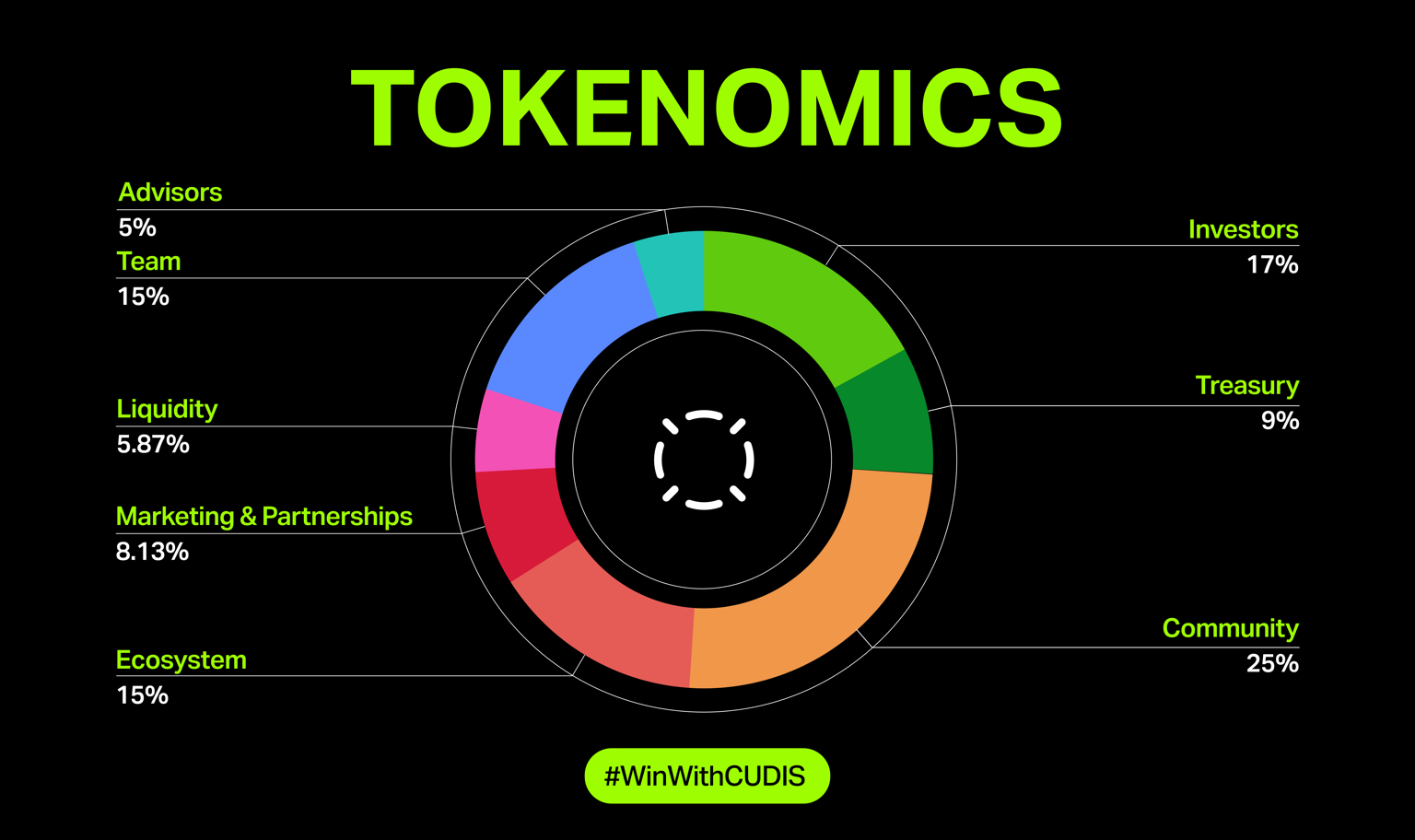
$CUDIS Tokenomics


Image source: https://whitepaper.cudis.xyz/cudis-tokenomics/introducing-usdcudis

The $CUDIS token is the backbone of the ecosystem, with a total supply of 1 billion and an initial circulating supply of 24.75%. This token functions as a medium for data storage and transactions, service payments, governance voting, node staking, and ecosystem incentives. Community distributions, investor allocations, team shares, and advisor rewards all follow transparent unlocking schedules to ensure long-term stability and growth.

How to Engage with the CUDIS Ecosystem

Anyone can participate by simply wearing a compatible device and connecting to the Super App. Users receive AI-driven health guidance and token rewards, and can further benefit by sharing data, joining challenges, and staking tokens—compounding both their earnings and their health outcomes.

Future Outlook and Impact

CUDIS is more than a health management platform; it is a catalyst for the global longevity economy. With the digital health market projected to reach $1.6 trillion by 2033, CUDIS is positioned to lead this transformation. In the years ahead, longevity will become a universal benefit—not just a privilege for the few.

Author: Max
Disclaimer
* The information is not intended to be and does not constitute financial advice or any other recommendation of any sort offered or endorsed by Gate.
* This article may not be reproduced, transmitted or copied without referencing Gate. Contravention is an infringement of Copyright Act and may be subject to legal action.

Related Articles

The ve(3,3) Flywheel Explained: How AERO Tokenomics Powers Aerodrome’s DeFi Economy
Beginner

The ve(3,3) Flywheel Explained: How AERO Tokenomics Powers Aerodrome’s DeFi Economy

In the competition for DeFi liquidity, high-inflation mining alone is no longer enough to build lasting advantages. Aerodrome applies the ve(3,3) economic model to redesign token emissions, voting mechanisms, and revenue distribution, creating a liquidity flywheel centered on governance and cash flow. This article examines AERO tokenomics, the veAERO locking mechanism, and protocol revenue models to explain how Aerodrome builds a sustainable DeFi economic system.
2026-03-25 06:41:58
AI-Native Settlement Layers: How United Stables Is Building the Next Financial Rail
Beginner

AI-Native Settlement Layers: How United Stables Is Building the Next Financial Rail

Stablecoins were originally designed as dollar substitutes within exchanges, primarily used for asset pricing and trade settlement. As on-chain financial ecosystems have matured, their role has expanded beyond simple payments to include collateral assets, cross-chain liquidity mediums, and unified settlement units. In particular, as AI systems and automated agents begin to participate directly in economic activity, demand has risen sharply for programmable value units capable of instant settlement. This shift is pushing stablecoins toward the role of foundational financial infrastructure.
2026-03-25 03:16:17
Aerodrome Tokenomics: How ve(3,3) Powers Base's Most Profitable DEX
Beginner

Aerodrome Tokenomics: How ve(3,3) Powers Base's Most Profitable DEX

AERO is the native token of Aerodrome Finance, a core decentralized exchange and liquidity protocol in the Base ecosystem. It is primarily used for liquidity incentives and ecosystem operations. veAERO is a governance NFT that users receive by locking AERO, representing both voting power and the right to share protocol revenue. Through a dual track structure of AERO as a utility token and veAERO as a governance credential, Aerodrome separates liquidity usage value from long term governance power, allowing participants to act as liquidity providers, governance decision makers, and revenue sharers within the same system.
2026-03-25 06:40:31
How Does PAXG Work? In-Depth Overview of the Physical Gold Tokenization Mechanism
Beginner

How Does PAXG Work? In-Depth Overview of the Physical Gold Tokenization Mechanism

PAXG (Pax Gold) is a tokenized asset backed by physical gold, issued by the fintech company Paxos and traded on the Ethereum blockchain as an ERC-20 token. The core concept is to tokenize physical gold on-chain, with each PAXG token representing ownership of a certain amount of gold. This structure enables investors to hold and trade gold in the form of a digital asset.
2026-03-24 19:12:51
How is the price of PAXG determined? Pegging mechanism, trading depth, and influencing factors
Beginner

How is the price of PAXG determined? Pegging mechanism, trading depth, and influencing factors

PAXG (Pax Gold) is a tokenized asset backed by physical gold reserves, launched by fintech firm Paxos and issued as an ERC-20 token on the Ethereum blockchain. The core concept is to digitally represent real-world gold assets, allowing investors to hold and trade gold via the blockchain network. Because each PAXG token corresponds to a specific quantity of physical gold, its price is theoretically expected to closely track the global gold market.
2026-03-24 19:11:40
DePIN Identity Network and Real World Applications: How Humanity Protocol Brings on-chain Identity Into the Physical World
Beginner

DePIN Identity Network and Real World Applications: How Humanity Protocol Brings on-chain Identity Into the Physical World

Most Web3 identity systems remain confined to on-chain environments and struggle to achieve meaningful adoption in real world settings. Through a DePIN architecture and physical verification hardware, Humanity Protocol aims to bring decentralized identity into access control systems, hospitality, public services, and offline events, allowing on-chain identity to function not just as a digital credential, but as foundational infrastructure for real world access.
2026-03-25 07:40:53