BLESS Surges Over 500% in One Day: Unpacking the High-Risk, High-Reward Token

Beginner
Quick Reads
Last Updated 2026-03-28 12:23:58
Reading Time: 1m
BLESS has soared by over 500% in a single day, experiencing significant price volatility. Learn about the driving factors and risk management strategies before considering entering a position. This is a quick guide for beginners.

What Is BLESS?

BLESS is a new cryptocurrency token project that focuses on decentralized computing power sharing and Web3 infrastructure development. It incentivizes users to share idle computing resources, creating a distributed computing network. Although the project introduces an innovative concept, it is still in its early stages, with ecosystem development and real-world applications in progress.

What Drove the 500% Single-Day Surge?
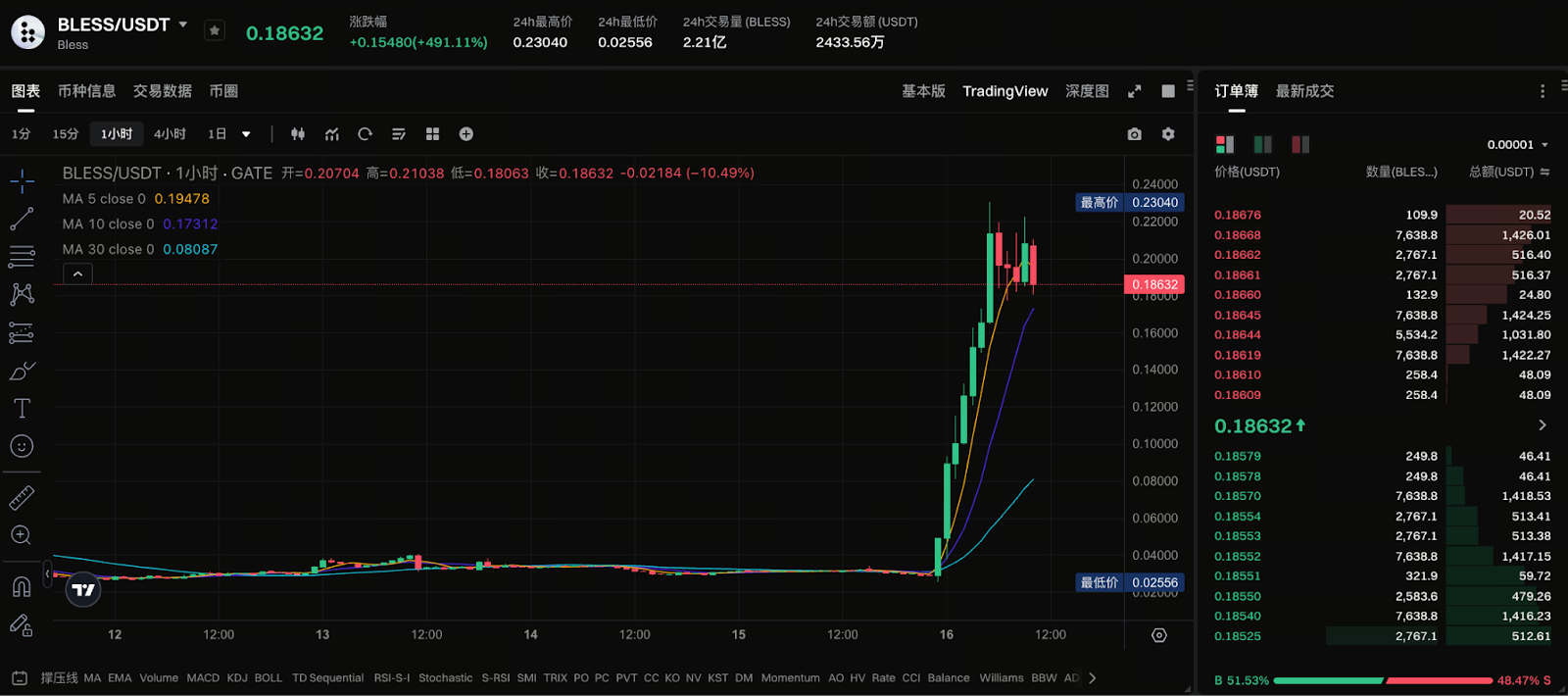

Source: https://www.gate.com/zh/trade/BLESS_USDT

BLESS recently saw an explosive single-day rally with gains exceeding 500%. The primary factors behind this extreme price movement include:

  • Exchange Listings: BLESS launched on new exchanges, sparking a surge in market attention through airdrops, promotions, and user rewards.
  • Low Circulating Supply: With few tokens in circulation early on, large buy orders could rapidly push up the price.
  • Speculative Trading: Short-term gains attracted speculators, resulting in concentrated capital inflows that amplified volatility.
  • Positive News or Partnerships: Announcements of technical upgrades, node expansions, or strategic partnerships fueled bullish market sentiment.

These factors combined to drive prices sharply higher in a short period.

High Volatility: Risk and Opportunity

BLESS is characterized by extreme price volatility. Its price can skyrocket within a day and correct within hours.

High volatility means the market offers both opportunity and risk.

  • Short-term traders find ample arbitrage opportunities in these conditions.
  • Inexperienced investors are prone to emotional trading, which can quickly lead to losses.

Furthermore, BLESS’s liquidity is still unstable, and concentrated sell-offs can trigger swift price declines.

Latest Updates: Contract Changes and Promotional Incentives

Recent market news indicates that some trading platforms have adjusted the minimum price tick for BLESS perpetual contracts. This change could affect trading rhythm and market activity. Additionally, platform promotions—such as trading competitions, airdrop tasks, and fee rebates—can act as short-term catalysts for price appreciation.

Meanwhile, the BLESS team is advancing its ecosystem by launching computing nodes, enabling cross-chain support, and expanding partnerships. These developments have increased market interest in the short term, but sustained growth will depend on successful project implementation.

Guidance for New Investors: Risk Management Strategies

Given BLESS’s high volatility, new investors should prioritize risk management:

  • Limit Position Size: Avoid going all-in or making large one-time purchases. Start with just 5%–10% of your capital.
  • Set Take-Profit and Stop-Loss Levels: Define your target prices in advance. Lock in profits when targets are hit. Cut losses decisively if prices drop below your thresholds.
  • Stagger Transactions: Buy or sell in tranches to smooth out market risk.
  • Avoid High Leverage: Leveraged trading magnifies losses, especially in highly volatile markets.
  • Monitor Official and Community Channels: Stay updated on project announcements, ecosystem progress, and exchange events to respond proactively.

Summary and Outlook

BLESS’s “500% Single-Day Rally” has spotlighted both the risks and appeal of highly volatile tokens. This episode underscores the speculative nature and short-term capital flows driving today’s crypto market. If the project can deliver steady ecosystem growth and expand real-world use cases, its price could stabilize over time.

At present, however, BLESS remains a high-risk asset. New investors should approach it with caution and avoid chasing rallies blindly.

Author: Max
Disclaimer
* The information is not intended to be and does not constitute financial advice or any other recommendation of any sort offered or endorsed by Gate.
* This article may not be reproduced, transmitted or copied without referencing Gate. Contravention is an infringement of Copyright Act and may be subject to legal action.

Related Articles

AI-Native Settlement Layers: How United Stables Is Building the Next Financial Rail
Beginner

AI-Native Settlement Layers: How United Stables Is Building the Next Financial Rail

Stablecoins were originally designed as dollar substitutes within exchanges, primarily used for asset pricing and trade settlement. As on-chain financial ecosystems have matured, their role has expanded beyond simple payments to include collateral assets, cross-chain liquidity mediums, and unified settlement units. In particular, as AI systems and automated agents begin to participate directly in economic activity, demand has risen sharply for programmable value units capable of instant settlement. This shift is pushing stablecoins toward the role of foundational financial infrastructure.
2026-03-25 03:16:17
The ve(3,3) Flywheel Explained: How AERO Tokenomics Powers Aerodrome’s DeFi Economy
Beginner

The ve(3,3) Flywheel Explained: How AERO Tokenomics Powers Aerodrome’s DeFi Economy

In the competition for DeFi liquidity, high-inflation mining alone is no longer enough to build lasting advantages. Aerodrome applies the ve(3,3) economic model to redesign token emissions, voting mechanisms, and revenue distribution, creating a liquidity flywheel centered on governance and cash flow. This article examines AERO tokenomics, the veAERO locking mechanism, and protocol revenue models to explain how Aerodrome builds a sustainable DeFi economic system.
2026-03-25 06:41:58
Aerodrome Tokenomics: How ve(3,3) Powers Base's Most Profitable DEX
Beginner

Aerodrome Tokenomics: How ve(3,3) Powers Base's Most Profitable DEX

AERO is the native token of Aerodrome Finance, a core decentralized exchange and liquidity protocol in the Base ecosystem. It is primarily used for liquidity incentives and ecosystem operations. veAERO is a governance NFT that users receive by locking AERO, representing both voting power and the right to share protocol revenue. Through a dual track structure of AERO as a utility token and veAERO as a governance credential, Aerodrome separates liquidity usage value from long term governance power, allowing participants to act as liquidity providers, governance decision makers, and revenue sharers within the same system.
2026-03-25 06:40:31
How Does PAXG Work? In-Depth Overview of the Physical Gold Tokenization Mechanism
Beginner

How Does PAXG Work? In-Depth Overview of the Physical Gold Tokenization Mechanism

PAXG (Pax Gold) is a tokenized asset backed by physical gold, issued by the fintech company Paxos and traded on the Ethereum blockchain as an ERC-20 token. The core concept is to tokenize physical gold on-chain, with each PAXG token representing ownership of a certain amount of gold. This structure enables investors to hold and trade gold in the form of a digital asset.
2026-03-24 19:12:51
How is the price of PAXG determined? Pegging mechanism, trading depth, and influencing factors
Beginner

How is the price of PAXG determined? Pegging mechanism, trading depth, and influencing factors

PAXG (Pax Gold) is a tokenized asset backed by physical gold reserves, launched by fintech firm Paxos and issued as an ERC-20 token on the Ethereum blockchain. The core concept is to digitally represent real-world gold assets, allowing investors to hold and trade gold via the blockchain network. Because each PAXG token corresponds to a specific quantity of physical gold, its price is theoretically expected to closely track the global gold market.
2026-03-24 19:11:40
DePIN Identity Network and Real World Applications: How Humanity Protocol Brings on-chain Identity Into the Physical World
Beginner

DePIN Identity Network and Real World Applications: How Humanity Protocol Brings on-chain Identity Into the Physical World

Most Web3 identity systems remain confined to on-chain environments and struggle to achieve meaningful adoption in real world settings. Through a DePIN architecture and physical verification hardware, Humanity Protocol aims to bring decentralized identity into access control systems, hospitality, public services, and offline events, allowing on-chain identity to function not just as a digital credential, but as foundational infrastructure for real world access.
2026-03-25 07:40:53





