Summary
-
The World Cup is emerging as a key catalyst for bringing prediction markets into the mainstream. During the tournament’s opening week, nominal sports trading volume across major prediction platforms surpassed $7 billion, with Kalshi and Polymarket accounting for more than 98% of total market share.
-
Sports prediction markets have evolved into a three-layer trading structure consisting of championship markets, advancement-path markets, and single-match markets. Among them, single-match markets generate the highest trading activity, while championship markets serve as vehicles for long-term narratives and social engagement.
-
Unlike traditional fixed-odds betting, prediction markets trade probabilities rather than outcomes. Participants can continuously buy, sell, hedge, and arbitrage around changing prices, turning probability itself into a tradable asset that reflects information, sentiment, and market expectations.
-
AI models can generate pre-match probability estimates based on historical performance, player form, and match data, while prediction markets continuously incorporate news, sentiment, and new information through real-money trading. The combination of AI priors and market-driven posteriors is emerging as an important area of research in sports prediction markets.
The World Cup is becoming a key arena for prediction markets to move toward mainstream trading. Political prediction markets have demonstrated the power of probability prices to shape public narratives, while sports prediction markets have shown that probability prices can absorb high-frequency information, real-time sentiment, and continuous trading demand. With global attention, long-cycle narratives, frequent matches, strong emotional participation, stable rules, a continuous news flow, and a natural probability language, the World Cup is arguably one of the best categories for bringing prediction markets to a mass audience.
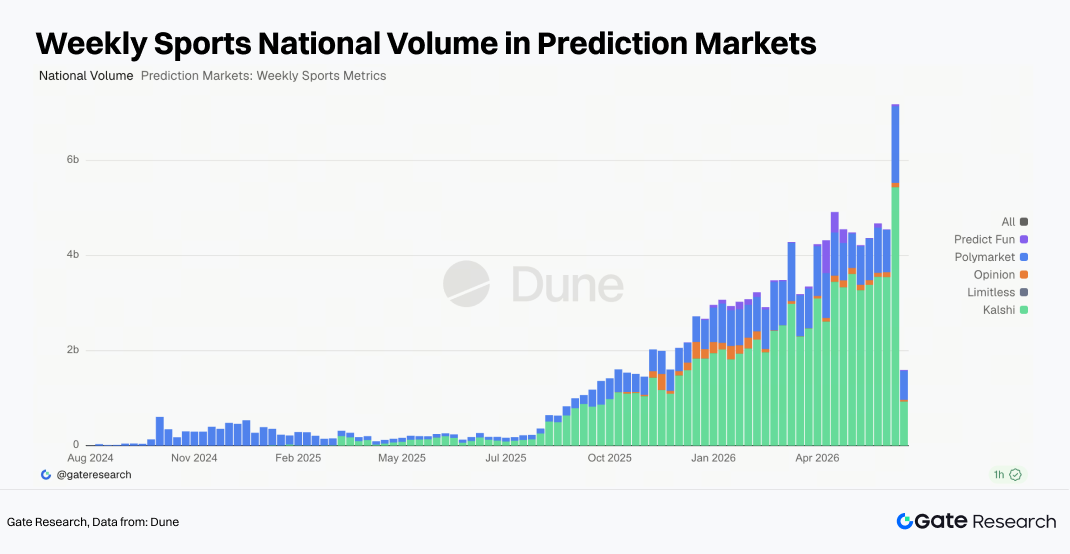
After entering the World Cup cycle, the sports segment within prediction markets has moved into a clear phase of volume expansion. During the first week of the tournament, weekly nominal sports trading volume across major prediction markets surpassed $7 billion. Kalshi accounted for approximately $5.438 billion, while Polymarket recorded around $1.612 billion, with the two platforms together contributing more than 98% of total volume. The sports segment sits at the intersection of odds-style trading, information trading, and social finance within the broader prediction market landscape.
The trading structure of World Cup markets can be divided into three layers: championship outcomes, tournament paths, and single-match lines. Championship markets represent long-term consensus pricing, reflecting team strength, squad depth, draw paths, and broader market sentiment. Tournament-path markets break down group-stage, knockout-stage, and qualification probabilities, enabling continuous repricing as the schedule progresses. Single-match markets are the most intensively traded layer, with prices highly sensitive to starting lineups, injuries, weather, in-game tactics, and market capital flows. Popular market data from Polymarket and Kalshi shows that single-match or near-single-match football markets can generate tens of millions, or even hundreds of millions, of dollars in volume within 24 hours.
Traditional betting relies on a fixed-odds mechanism, where users lock in odds at the time of placing a bet, and subsequent odds movements are mainly driven by bookmaker risk management and capital balancing. Prediction markets use a tradable-share mechanism, where price itself represents probability, allowing traders to continuously buy, sell, exit, hedge, and arbitrage. The essence of a fixed-odds market is buying an outcome, while the essence of a prediction market is trading a probability. This difference defines the research value of World Cup prediction markets. They do not merely answer which team will win the tournament; they also record how information enters prices, how prices absorb disagreement, and how disagreement is released through trading volume.
In addition, AI models provide structured priors for sports prediction. They can absorb historical results, player form, ELO ratings, xG, squad value, schedule density, injury records, and tactical data to generate baseline pre-match probabilities. Prediction markets, by contrast, provide real-time, capital-weighted posteriors. Traders express their views with real financial cost: wrong views are punished by losses, while superior information is rewarded with profits. Over the long term, crowd wisdom with monetary incentives is often more robust than a single AI output or a single expert model. The next stage will center on the systematic integration of AI priors, market prices, news flow, capital flows, and risk control.
1. The Scale Expansion of Sports Prediction Markets
Prediction markets were once primarily viewed as tools for trading probabilities around political and macroeconomic events. Sports markets have changed that perception. Sports naturally combine high-frequency events, clear settlement outcomes, quantifiable historical data, strong emotional engagement, and an intuitive odds-based language. Users do not need to be educated on what probability trading is. The outcome of a match, the percentage chance of winning a championship, or the price of a player scoring a goal are all concepts that ordinary users can immediately understand. As a result, sports have become the gateway through which prediction markets lower their cognitive barriers and reach a broader audience.
Looking at the development of sports markets across major prediction platforms, Polymarket was the dominant source of sports trading activity around September 2024. After October 2024, weekly sports trading volumes began reaching the hundreds of millions of dollars. Entering 2025, sports-related markets on Kalshi started to gain momentum. By the second half of 2025, Kalshi had begun establishing a leading position. From 2026 onward, sports prediction markets entered a new scale altogether, with full-week trading volumes frequently reaching several billion dollars. Following the kickoff of the 2026 FIFA World Cup, weekly nominal sports trading volume exceeded $7 billion, a clear signal of a structural step change in the market.
Importantly, this surge is not the result of growth on a single platform. Kalshi’s expansion demonstrates that regulated prediction exchanges can successfully support large-scale sports markets and high-frequency trading activity. Polymarket’s continued strength shows that on-chain prediction markets still benefit from global user participation, open market access, social distribution, and long-tail event coverage. Smaller platforms such as Predict Fun, Opinion, and Limitless remain valuable testing grounds for multi-chain infrastructure, alternative market formats, and niche product experimentation. The competitive landscape of sports prediction markets is increasingly taking on a two-tier structure, with leading platforms concentrating mainstream liquidity while smaller platforms focus on product innovation and category experimentation.
From a market-share perspective, sports prediction markets in 2026 have effectively entered a dual-leader phase dominated by Kalshi and Polymarket. Kalshi recorded approximately $5.438 billion in weekly nominal trading volume, representing around 75.7% of total volume across major platforms. Polymarket generated approximately $1.612 billion, accounting for roughly 22.4%. Opinion, Predict Fun, and Limitless together contributed only about 1.9%. This distribution suggests that mainstream sports prediction trading is increasingly concentrating on platforms with deeper liquidity and stronger market depth.
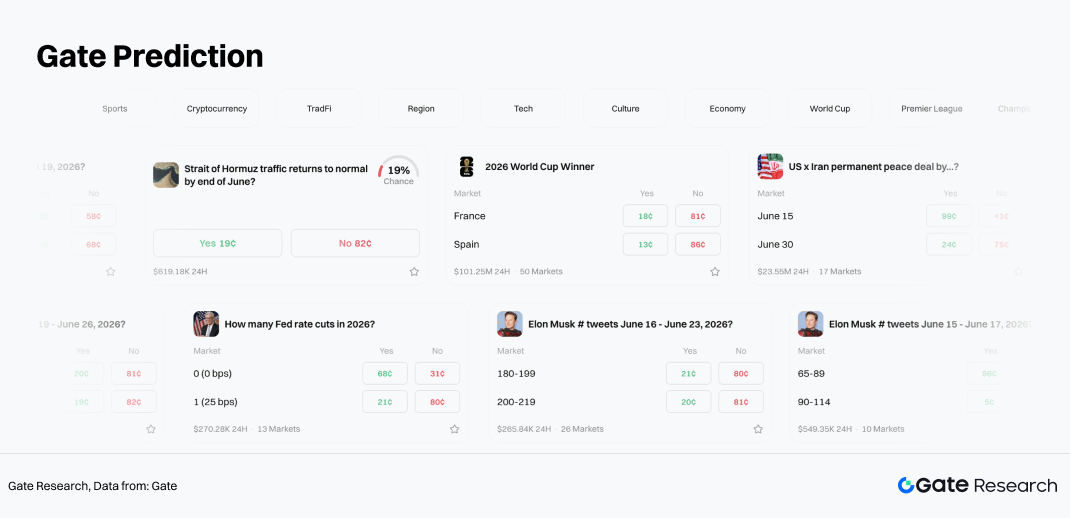
However, market concentration does not mean innovation has come to an end. Sports markets offer far greater product depth than any single political event. World Cup championship markets, match outcome markets, total goals, handicaps, qualification markets, Golden Boot markets, Best Player markets, group standings, penalty shootouts, yellow and red cards, and corner kicks can all be traded. While mainstream liquidity may be concentrated on a handful of platforms, significant room remains for innovation in niche market design and front-end user experience. Gate’s entry into prediction markets is focused on building a probability trading terminal centered around event trading, allowing users to access information, assess probabilities, manage positions, and execute portfolio strategies within a single interface.
2. Kalshi: The High-Frequency Financialization of Sports Markets
Kalshi holds a clear lead in sports-related nominal trading volume within the prediction market sector in 2026. Sports trading activity on Kalshi entered a rapid growth phase in mid-2025 and has since scaled to billions of dollars in weekly volume by 2026. Kalshi’s advantage stems from its regulated exchange structure, standardized contracts, order-book-style trading experience, and stronger ability to attract and retain traditional finance users.
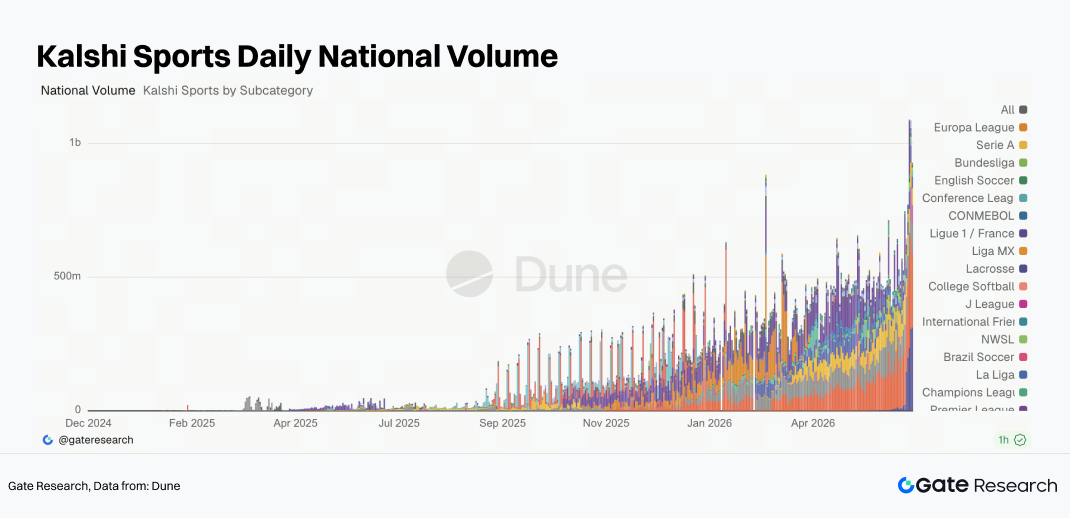
Kalshi’s list of top markets highlights two distinct categories of World Cup-related trading activity: single-match or odds-style markets, and the broader World Cup 2026 championship markets. Since the start of the tournament, multiple individual matches have generated nearly or more than $10 million in trading volume within a 24-hour period.
Notably, the highest trading density in World Cup prediction markets often comes from single-match markets rather than championship markets. Single-match markets have shorter durations, higher information density, and faster settlement cycles, making them well suited for high-frequency traders, odds traders, and short-term participants. Championship markets, by contrast, have longer time horizons and slower price movements, making them better vehicles for expressing medium- to long-term views, social discussion, and portfolio positioning. A mature World Cup prediction market product should accommodate both forms of demand. A platform focused only on championship markets may generate attention but struggle to sustain high-frequency trading activity. A platform focused only on single-match markets may generate volume but fail to establish long-term narratives. The most effective product structure links championship pathways, match-level trading, and portfolio construction into a unified user experience.
In addition, Kalshi’s most active markets show World Cup contracts appearing alongside established sports categories such as UFC, MLB, and tennis. The World Cup is not an isolated event; it becomes part of the platform’s broader sports trading ecosystem. Users can compare UFC, MLB, tennis, individual World Cup matches, and World Cup championship markets within the same interface, allowing attention and liquidity to flow across different sporting events. As a result, new users attracted by the World Cup are not necessarily confined to World Cup-related markets and may ultimately participate in other sports trading opportunities available on the platform.
3. Polymarket: The Intersection of Global Narratives and On-Chain Liquidity
Polymarket’s sports market structure differs somewhat from Kalshi’s. The platform had already established a strong foundation in sports-related trading by 2024 and remains highly active in 2026. Its advantages extend beyond trading volume alone, encompassing global event coverage, on-chain composability, social distribution, and open participation from a worldwide user base.
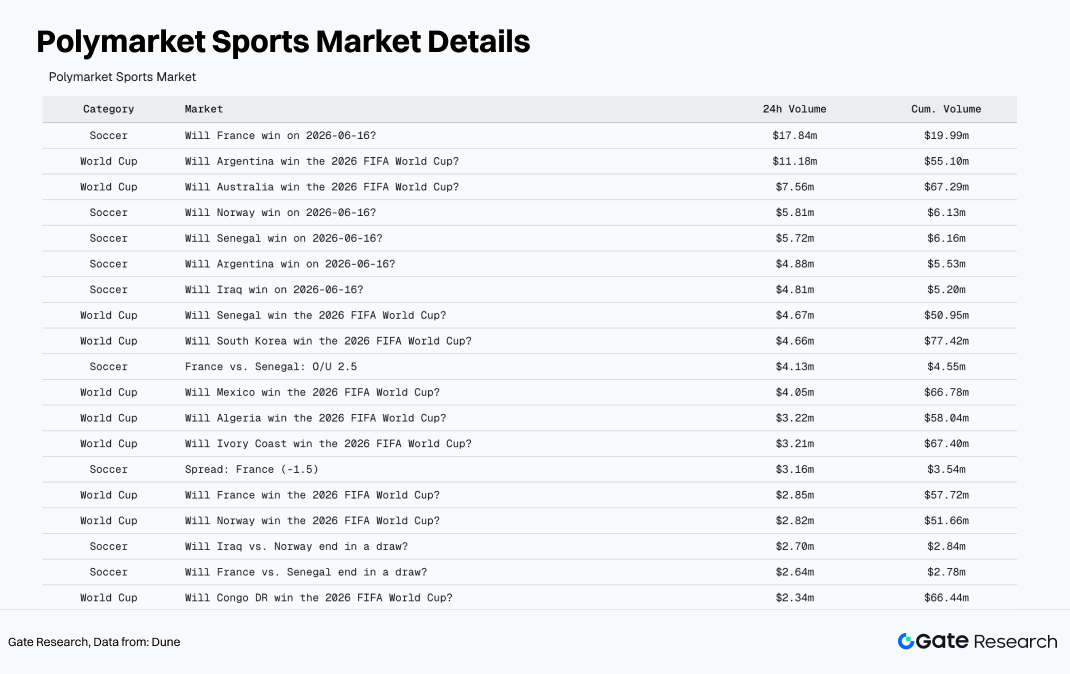
Among Polymarket’s most active markets, World Cup championship contracts display a distinctly global distribution of teams. Markets such as Argentina to win the World Cup, Australia to win the World Cup, and South Korea to win the World Cup have each generated trading volumes in the tens of millions of dollars.
It is important to note that trading volume is not the same as championship probability. Traditional football powerhouses generally command higher implied probabilities, yet non-traditional contenders can still attract substantial trading activity. This can be driven by regional fan interest, odds elasticity, the speculative appeal of low-priced contracts, social media distribution, tournament-path narratives, arbitrage opportunities, and market-maker inventory management. While the highest championship probabilities may be concentrated among a handful of established football powers, the highest-volume markets may simultaneously include favorites, host nations, regional fan favorites, and teams with highly volatile odds.
Compared with Kalshi, Polymarket’s World Cup markets are particularly well suited to capturing global social discussion. Championship markets can be repeatedly referenced by media outlets, KOLs, communities, fans, and traders. A probability moving from 8% to 12% is often easier to share and discuss than a lengthy expert analysis. Prediction markets compress complex judgments into a single tradable probability figure, which can then be redistributed, challenged, and traded again. During the World Cup, every lineup rumor, upset result, tactical debate, or injury update circulating on social media can ultimately flow back into market prices.
4. The Three-Layer Structure of World Cup Prediction Markets
World Cup prediction markets are not simply about identifying the eventual champion. They form a multi-layered probability network.
4.1 Championship Markets
Championship markets have the longest duration and are best suited for building global narratives. Traditional football powers such as France, Spain, England, Argentina, Portugal, Brazil, Germany, and the Netherlands typically occupy the top tier of implied probabilities. Prices are influenced by team quality, squad age structure, player health, coaching stability, tournament pathways, and historical reputation. Trading volume in championship markets reflects long-term attention and the global distribution of conviction.
4.2 Advancement Path Markets
Markets covering group-stage qualification, quarterfinal appearances, semifinal appearances, finals qualification, group rankings, and progression to the next round effectively decompose championship probability into a series of intermediate paths. These markets often provide greater analytical value because they break a single championship price into identifiable sources of path risk. A team’s low championship probability may reflect a difficult knockout bracket rather than weak underlying quality. Likewise, an increase in championship probability may result not from improved team strength, but from injuries to competitors or a more favorable tournament path.
4.3 Single-Match Markets
Match outcomes, handicaps, total goals, both teams to score, corner kicks, halftime results, exact scores, and player-performance markets form the high-frequency trading layer. The defining characteristic of single-match markets is speed. Once starting lineups are announced, prices rapidly absorb roster information. During the match itself, goals, red cards, injuries, VAR decisions, weather conditions, and tactical adjustments all influence market pricing. Traditional bettors observe changes in odds; prediction market traders interact with probability assets that can be traded, hedged, and combined into broader strategies.
Together, these three layers form the complete trading framework of World Cup prediction markets. Championship markets provide long-term narratives and social engagement, advancement-path markets enable path-based analysis and medium-term positioning, while single-match markets drive high-frequency trading activity and user retention.
5. The Fundamental Difference Between Fixed-Odds Betting and Prediction Markets
The core of traditional sports betting is fixed odds. Users place bets at a given moment and accept the odds offered by the bookmaker. Those odds incorporate bookmaker margins, risk-management models, capital-balancing considerations, and operating strategies. After placing a bet, users generally wait for the final outcome unless the platform offers cash-out or early-settlement options. Profit depends on correctly predicting the result.
Prediction markets are fundamentally different. Their core product is a tradable probability. Users purchase shares representing a specific outcome, with prices fluctuating between 0 and 1. The higher the price, the higher the market-implied probability. Users do not need to wait for final settlement to realize gains or losses. They can sell after prices rise or reverse their position when new information emerges. Profits come from two sources: correctly predicting the final outcome and correctly trading price movements before the outcome is known.
Fixed-odds betting resembles retail wagering, while prediction markets resemble probability asset trading. This distinction has the potential to reshape user behavior during the World Cup. Traditional bettors ask, “Which side should I back?” Prediction market participants ask, “Is the current price different from the true probability?” For example, if a user believes a team has a 12% chance of winning the tournament while the market implies only 8%, they can buy the contract. If the market later reprices the probability to 10%, the trader can take profits even before the team wins the tournament. Prediction markets transform sports judgment from a one-time wager into ongoing price management.
In fixed-odds betting, price adjustments are primarily controlled by bookmakers, and users observe the resulting odds. In prediction markets, prices are determined by trading activity, and users participate directly in price formation. Bookmakers optimize for balanced exposure and profit margins, whereas prediction markets seek to discover capital-weighted probabilities through continuous trading. Bookmakers manage risk through odds adjustments, while prediction markets reveal risk through spreads, depth, and trading volume. Transparency in fixed-odds betting comes from published rules and odds, while transparency in prediction markets comes from order books, trade histories, and on-chain data.
The World Cup amplifies these differences. Hours before kickoff, traditional sportsbooks may adjust odds based on starting lineups. Prediction markets reflect the same information immediately through order flow and executed trades. During matches, sportsbooks offer in-play betting odds, while prediction markets provide tradable real-time probability shares. For both professional traders and ordinary users, prediction markets offer a more flexible framework for strategy construction and understanding how probabilities evolve.
6. AI Sports Prediction: The Value and Limits of Static Priors
AI has clear strengths in sports forecasting. It can process large volumes of structured data, including historical win rates, ELO ratings, expected goals (xG), shot quality, possession profiles, pressing intensity, set-piece efficiency, player minutes, injury probabilities, squad depth, travel distance, rest days, climate adaptation, and historical head-to-head records. AI systems can rapidly generate pre-match forecasts, establish baseline probabilities, and perform sensitivity analysis across multiple variables.
AI outputs are best understood as prior probabilities. They answer the question: given historical data and model assumptions, what is the expected likelihood of a particular outcome? For World Cup championship markets, AI can generate an initial probability distribution based on team strength, squad valuation, age structure, world rankings, tournament pathways, and major-tournament experience. For individual matches, AI can estimate win, draw, and loss probabilities based on recent form, lineups, tactics, weather conditions, and home-field effects.
However, AI also has limitations. Models depend heavily on input data quality. Events that are underrepresented in training data may be incorporated slowly. Sudden injuries, internal team conflicts, tactical surprises, player psychology, media leaks, betting flows, and regional sentiment are difficult for static models to fully capture. AI can process news, but it must still determine the credibility and market relevance of that information. AI can update probabilities, but it cannot always determine whether the market has already priced in the information.
Prediction markets help fill this gap. Markets are imperfect—they make mistakes, become distorted by sentiment, and are constrained by liquidity. Yet they possess a mechanism that a standalone AI model lacks: incorrect views incur financial losses, while superior information is rewarded with profits. This creates a self-correcting process over time. The more participants, information sources, and real capital involved, the more likely prices are to converge toward dynamic posterior probabilities.
Importantly, AI and prediction markets are not substitutes. AI provides stable priors; prediction markets provide capital-weighted posteriors. What researchers should focus on is the gap between the two. If an AI model assigns a team a 14% championship probability while the market implies only 9%, the discrepancy may indicate either model overconfidence or market underpricing. If trading volume expands, news flow shifts, and prices continue to rise, the divergence may signal an opportunity. Conversely, if market prices increase while AI lowers its probability estimate due to injury-related data, the market may be reflecting sentiment rather than fundamentals. The value of AI lies in identifying deviations between market prices and structured probability estimates.
Crowd wisdom is not simply the average opinion of a large group. In prediction markets, crowd wisdom is a collective judgment constrained by capital. Costless voting is easily influenced by emotion, identity, and noise. Trading with real financial stakes changes participant behavior. A user expressing an opinion on social media faces little consequence. A user buying a prediction market contract risks losing money. That cost encourages more disciplined decision-making and rewards superior information.
The weakness of a single AI model is its fixed perspective. Every model is shaped by its training data, feature selection, assumptions, and update frequency. Expert models face similar limitations. An expert may understand football tactics but not market flows. Another may understand injuries but not whether that information is already reflected in prices. Prediction markets aggregate all of these information sources into a single market price. Professional traders, fans, data analysts, journalists, market makers, arbitrageurs, regional specialists, and high-frequency traders can all participate.
Long-term accuracy does not require every participant to be highly informed. Rather, the market mechanism gradually reallocates influence. Traders with poor information lose capital and influence, while traders with superior information gain both. Prices are not simple averages of opinions; they are the capital-weighted result of marginal transactions. During the World Cup, this mechanism becomes particularly valuable. Different countries and regions possess different information networks. Training-ground developments, local media narratives, player fitness conditions, and coaching preferences may first emerge within regional communities before being reflected in market prices. AI models must collect, translate, evaluate, and model this information, whereas market prices can often react immediately.
That said, prediction markets can fail. In illiquid environments, prices may be moved by relatively small amounts of capital. During extreme sentiment-driven events, markets may overreact. Popular teams may trade at sentiment premiums, while less popular teams may become undervalued. Long-duration championship markets often experience periods of sparse information, allowing narratives to dominate pricing. Researchers should not view prediction markets as absolute truth, but rather as one of the most valuable real-time signals available. Their value lies in continuous updating and real financial accountability, not in being perfectly correct at every moment.
8. Conclusion
As the World Cup progresses, prediction markets are being pushed into increasingly mainstream use cases. Sports fans naturally understand odds, traders naturally understand prices, and World Cup audiences naturally want to express opinions. Prediction markets bring these three forces together within a single mechanism: probabilities are expressed through prices, disagreement is expressed through trading, and information discovery is incentivized through capital.
Sports prediction markets entered the multi-billion-dollar weekly volume era in 2026, with Kalshi and Polymarket serving as the primary liquidity hubs. World Cup-related single-match and championship markets have already demonstrated substantial trading depth. Traditional betting offers fixed odds and a mature user experience, while prediction markets offer dynamic probabilities and tradable prices. AI models provide structured priors, while prediction markets generate capital-weighted posteriors. During the World Cup, the most valuable insight is not whether a single prediction is correct, but how information continuously enters and reshapes prices.
Gate’s vision is to turn prediction markets into a fully integrated trading terminal. Championship probability rankings, single-match markets, capital-flow data, AI signals, news interpretation, and portfolio positioning can all be combined within a single interface. As sports prediction markets mature, probability itself may become a new market data format. Users will not only watch scores; they will watch probabilities. They will not only debate which team is stronger; they will debate which assumptions are wrong. And they will not only bet on outcomes; they will trade the speed at which information is incorporated into prices.
Source:
Gate Research is a comprehensive blockchain and cryptocurrency research platform that provides deep content for readers, including technical analysis, market insights, industry research, trend forecasting, and macroeconomic policy analysis.
Disclaimer
Investing in cryptocurrency markets involves high risk. Users are advised to conduct their own research and fully understand the nature of the assets and products before making any investment decisions. Gate is not responsible for any losses or damages arising from such decisions.