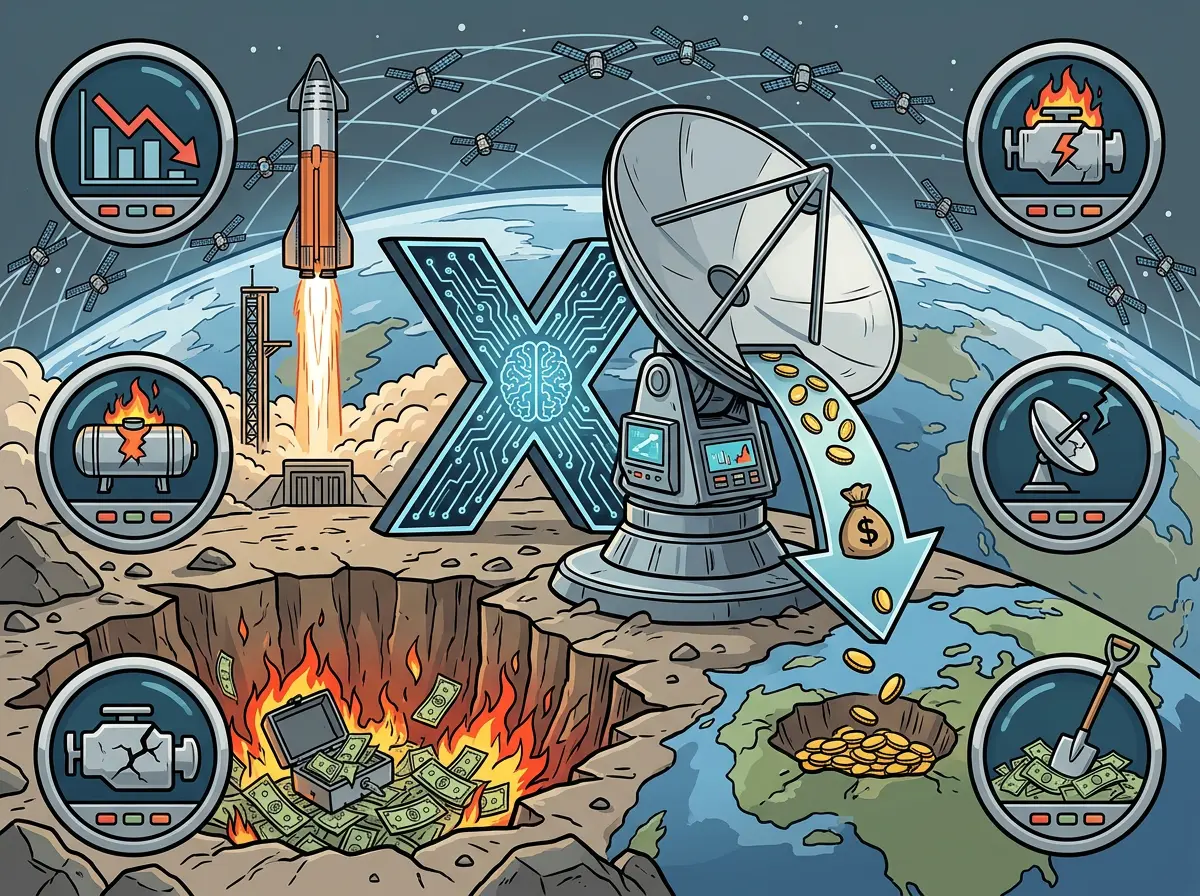
On June 4, user @DamiDefi posted a long thread on X stating that he submitted SpaceX’s 300-page S-1 registration statement to Claude Opus 4.8 for analysis, asking the model to find what was “handled quietly” in the document. He found that Starlink’s average revenue per user (ARPU) fell 23% on average, and that xAI’s net loss was $4.9 billion after integration.
Five Confirmed S-1 Disclosures and Claude’s Framework Assessment
Sources of the 94-107x revenue multiple
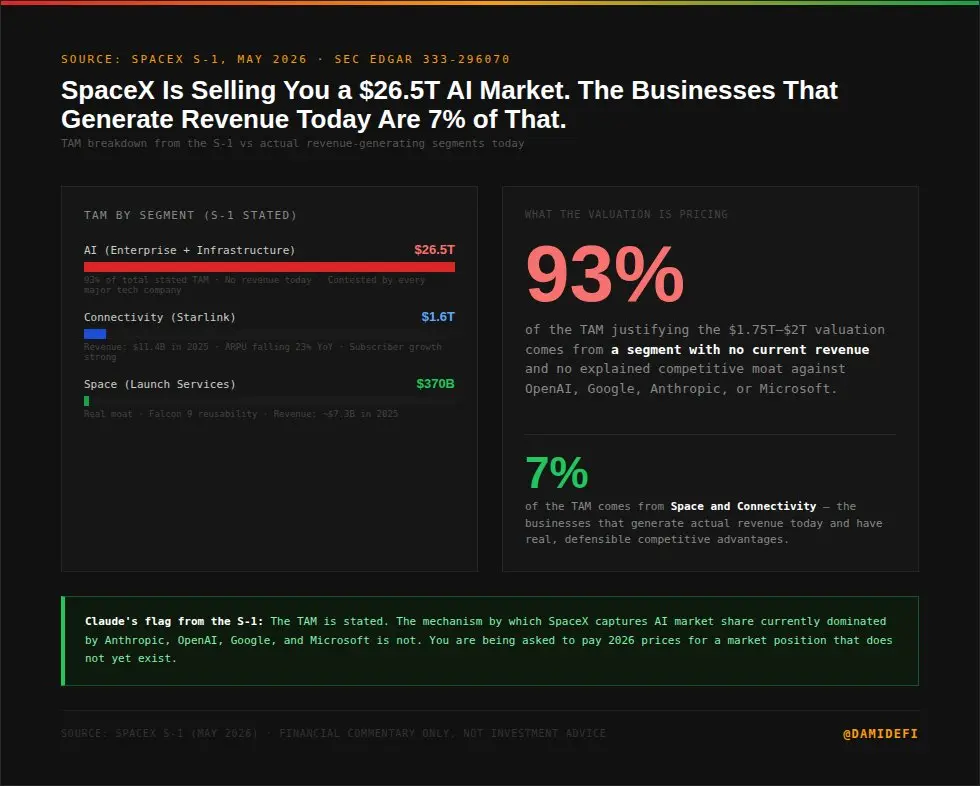
According to the S-1, the TAM claimed by SpaceX includes: Space ($370 billion), Connectivity ($1.6 trillion), and AI ($26.5 trillion), of which enterprise AI alone reaches $2.27 trillion. The actual revenue-generating space and connectivity businesses together account for less than 7% of total TAM, while the remaining 93% comes from AI. Claude’s assessment: the S-1 provides AI TAM figures, but does not explain what specific differentiating “moats” SpaceX has when competing with Anthropic, OpenAI, Google, and Microsoft.
From profit to loss within a single year after xAI integration
S-1 historical financial statement figures: full-year 2024 net profit of $791 million → full-year 2025 full-year net loss of $4.94 billion → net loss of $4.28 billion for Q1 2026 (quarterly); cumulative deficit of $41.3 billion. The timing aligns with the xAI integration. Claude’s assessment: the S-1 describes this as a “strategic investment phase,” but does not model when this phase ends.
Starlink subscriptions double, ARPU drops 23%
S-1 confirmed numbers: Starlink subscription users rise from 5 million in 2025 Q1 to 10.3 million in 2026 Q1 (doubling year over year); however, ARPU (average revenue per user) declines 23% year over year. Claude’s assessment: subscription growth figures appear in the executive summary, while the ARPU decline figures appear only in the segment financial statements. “A large number of subscribers × shrinking gross margins” and “a large number of subscribers × healthy gross margins” are two fundamentally different business models.
Retail IPO allocation at 30%—three times the norm
S-1 confirms the retail allocation is 30%, while mega IPOs typically follow about 10%. Sales channels include retail platforms such as Schwab, Fidelity, Robinhood, SoFi, and E-TRADE. Claude’s assessment: the 30% retail allocation is clearly disclosed in the S-1, but it provides no explanation of the implications of this framework—i.e., that VC and private investors exit to retail at three times the usual scale.
Musk’s 85% voting power plus class-action lawsuit exemption
S-1 confirmed numbers: Musk holds about 42% equity and about 85% voting power. The S-1 also includes both an arbitration clause and a class-action lawsuit exemption clause: shareholders with claims can only pursue individual arbitration and cannot bring a class action. Claude’s assessment: while the S-1 discloses this in the risk factors section, it presents it as a “characteristic of how the company operates” rather than a “risk to investor compensation”; the core risk—that “if capital allocation decisions destroy value, there is no mechanism for shareholders to hold management accountable”—is not clearly framed.
Frequently Asked Questions
What AI TAM assumptions correspond to the $1.75-$2 trillion SpaceX valuation?
According to the S-1, SpaceX’s AI business TAM is listed at $26.5 trillion (including $2.27 trillion for enterprise AI). This figure is a key underpinning for the current valuation. @DamiDefi and Claude’s analysis indicate that the S-1 provides this number, but does not explain how SpaceX obtains meaningful market share in competing with OpenAI, Google, Anthropic, and Microsoft.
What impact does the 23% drop in Starlink ARPU have on long-term cash flows?
According to the S-1, Starlink’s subscription users double year over year to 10.3 million, but ARPU declines 23% annually because Starlink expands into lower-priced international and consumer markets. Claude’s analysis notes that long-term cash flow narratives are usually based on “a large number of subscribers × healthy gross margins,” while the actual trend presented in the S-1 is “a large number of subscribers × shrinking gross margins”—and these represent different valuation logics.
What is the practical significance of the class-action exemption clause in the S-1 for shareholders?
According to the S-1, shareholders with claims can only seek enforcement through individual arbitration rather than a class action. Combined with Musk’s 85% voting power, this means that on major decisions, aside from Musk, all shareholders collectively hold only 15% voting power—and even when disputes arise, they cannot coordinate collective action. @DamiDefi and Claude’s analysis believe this combination is disclosed in the S-1 but not sufficiently framed in terms of its risk implications for investors.


