What Is a Bitstream?
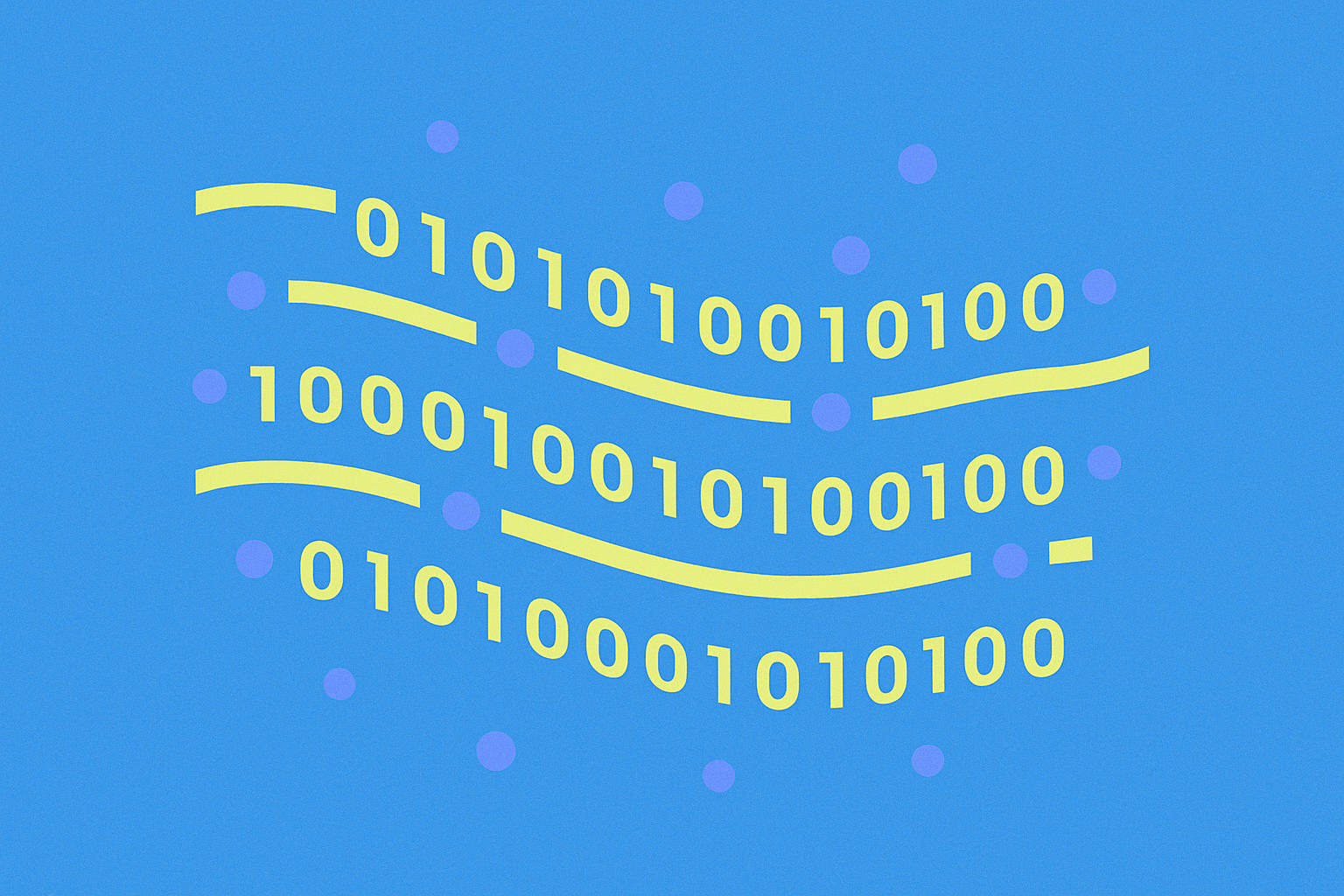
A bitstream is a continuous flow of data composed of 0s and 1s, much like water flowing through a pipe—but in this case, the “water” is digital signals. In blockchain networks, transactions, blocks, smart contracts, and other data are all packaged into bitstreams for transmission across the network.
Understanding bitstreams involves two main dimensions. The first is encoding: converting text, numbers, and rules into sequences of 0s and 1s. The second is transmission: these sequences are sent, received, and stored between network nodes. Grasping the idea of “encoding into bits and transmitting in sequence” helps demystify many technical details of blockchain.
How Are Bitstreams Transmitted in Blockchain?
Bitstreams travel across blockchain networks via peer-to-peer (P2P) connections, where participants interact directly—much like everyone forwarding messages in a group chat.
When you initiate a transfer using your wallet, the wallet encodes the recipient address, amount, and memo into a bitstream. It then attaches your signature—a mathematical proof confirming that you authorized the transaction.
The transaction bitstream is broadcast to nearby nodes. Nodes are computers running blockchain software. They check if the format is correct, the balance is sufficient, and the signature is valid. Approved transactions enter a candidate block pool, awaiting packaging by designated participants.
These packagers are called different names on different chains: miners or validators. They collect batches of transactions, generate new blocks, and broadcast the block’s bitstream to the network. Other nodes receive, validate, and save this data to their local databases.
What Is the Relationship Between Bitstreams and Hashes?
A hash is a method for compressing a bitstream into a unique “fingerprint.” Similar to creating a short code for a piece of text, hashes facilitate quick comparisons. Even a single-bit change in a bitstream produces a completely different hash.
Each block’s hash is recorded in the next block, forming a chain of interlinked blocks. Any alteration can be easily detected since changing one block disrupts the hashes for all subsequent blocks. This hash linkage underpins blockchain’s “immutability.”
During data transmission, nodes use hashes to quickly verify data integrity. When you see a “block hash” in a block explorer, it’s a summary of the block’s bitstream.
How Do Bitstreams Represent Transactions and Blocks?
A transaction’s bitstream includes several key elements: the recipient address (like an account number), the transfer amount, and your digital signature as proof of authorization. These elements are encoded within the bitstream, allowing nodes to validate and record transactions.
A block’s bitstream functions like an archive file, recording the transaction list, timestamps, and a reference to the previous block’s hash. Once added to the chain, anyone can decode it using standard rules to yield consistent results.
This approach of “public rules and unified encoding” ensures interoperability between different wallets and explorers. No matter which tool you use, the transaction details remain consistent because they’re derived from the same bitstream format.
Smart contracts are programs deployed on blockchains. Both the program code and its inputs must be converted into bitstreams for node execution. When you call a contract, the function name and parameters are encoded according to set rules so nodes can interpret your intent.
After execution, contracts generate event logs—result records also written as bitstreams into the block. Explorers decode these logs into readable text for users (e.g., “an address minted a new token”).
This “encode–execute–log” flow ensures verifiable operations and traceable outcomes. You can revisit any historical block and reach the same conclusions.
On Gate, you can access market and trading data derived from structured bitstreams for analytics and trading purposes.
Step 1: Visit Gate’s official website to find API documentation. Subscribe to spot trade or order book channels via WebSocket—a persistent connection ideal for receiving real-time data streams.
Step 2: Configure heartbeat signals and reconnection strategies to avoid disruptions from network instability. This ensures stable millisecond-level updates for trades and quotes.
Step 3: Parse incoming data according to official field specifications to convert it into your preferred format (such as time, price, quantity). Parsing reverses the bitstream into structured information.
Step 4: For on-chain data, combine block explorers or node RPCs to read transaction and event logs. Explorers decode on-chain bitstreams into web pages so you can view transaction details and block information.
Behind Gate’s trading interface—where order books and trade histories update rapidly—is the continuous refresh of bitstreams. Integrating this data enables backtesting, risk management, or alerts in your tools.
What Are the Security Risks of Bitstreams?
Bitstreams can carry risks—most critically with private keys. A private key authorizes transfers and must be stored securely offline. If leaked as a bitstream, your funds are highly vulnerable to theft.
Front-running is another risk: someone may see your transaction early and submit their own with better terms to profit at your expense. Solutions include delayed broadcasting, batch processing, or safer transaction workflows.
Network-level threats also exist. Malicious nodes might inject spam messages to disrupt communication. Mitigate risks by using trusted nodes, encrypted connections, and validating all received data via format and hash checks.
For fund security: always test with small amounts, apply layered authorizations, enable two-factor protection, and remain cautious with unknown links or files.
What Is the Outlook for Bitstreams in Web3 Applications?
Bitstreams are becoming more real-time. In recent years, major public chains have adopted Layer 2 scaling and batch processing solutions—allowing higher throughput per second and denser data streams for greater analytical and monitoring opportunities.
For compliance and risk management, bitstreams support address risk profiling and anomaly detection. Continuous stream pattern recognition enables platforms to detect suspicious transfers or behavior more quickly.
There’s also ongoing innovation balancing privacy with transparency—for example, proving facts without revealing sensitive content—enabling verifiability while reducing exposure of raw bitstreams.
How Should You Start Learning and Practicing with Bitstreams?
Step 1: Open a mainstream block explorer, select a transaction, and examine its raw data alongside decoded results to experience how bitstreams become readable information.
Step 2: Use a testnet wallet to initiate a small transfer. Observe how the transaction propagates, confirms, and is written to a block—helping you understand transmission paths.
Step 3: On Gate, subscribe to WebSocket feeds for a small trading pair; parse trade/order book data to build basic real-time charts.
Step 4: Try listening to event logs from a common contract; explore encoding rules versus decoded outputs to establish end-to-end understanding from input to result.
Always practice safely: don’t store private keys in untrusted environments; never sign unknown messages; avoid mixing test and production settings.
What Are the Key Takeaways About Bitstreams?
Bitstreams are the foundational form of blockchain data—serving as the backbone for encoding, transmission, and validation. Understanding them reveals how transactions are packaged, how blocks are linked together, and how contracts are executed. Hashes ensure integrity; signatures provide authorization; nodes guarantee propagation and storage. Whether viewing on-chain explorers or Gate’s market APIs, what you see is always structured representations of underlying bitstreams. Keeping bitstreams central to your Web3 learning helps you build stronger knowledge—and safer operational habits.
FAQ
What’s the Difference Between 1 Bit and 1 Byte?
A bit is the smallest unit of information; a byte is a larger storage unit equal to 8 bits. On blockchain networks, transaction data, private keys, hashes—all are stored and transmitted as bitstreams. Understanding this relationship helps clarify blockchain data encoding methods.
Why Are Wallet Addresses and Private Keys Represented as Bitstreams?
Bitstreams (sequences of 0s and 1s) are the only language computers understand. Wallet addresses and private keys are essentially long numbers—they must be converted into bitstreams for storage, transmission, and verification. This approach ensures that data cannot be tampered with during transit and enhances security.
What Role Do Bitstreams Play in Mining?
Miners process bitstreams in search of hashes that meet specific conditions—a process known as Proof of Work (PoW). In simple terms: miners repeatedly adjust the bitstream representing transaction data until they find one that produces a hash passing the difficulty check—earning them the right (and reward) to add a new block.
Is There Any Difference Between How Mobile Wallets and Desktop Wallets Store Bitstreams?
The storage principle is identical—but security differs. Mobile wallets store bitstreams in phone chips, making them more susceptible to malware theft; desktop wallets can offer offline cold storage with higher security. The safest solution is using a hardware wallet, keeping bitstreams entirely offline to prevent online attacks.
How Do Bitstream Compression Techniques Affect Block Size?
Bitstream compression reduces storage requirements per block—enabling more transactions per block and improving network throughput. This is why innovations like Segregated Witness (SegWit) or Lightning Network enhance Bitcoin’s performance: they scale by using more efficient bitstream encoding methods.