Unlike conventional AI narratives that focus solely on hashrate, chips, and energy, this one zeroes in on the "hidden consumption structure" of infrastructure. As AI models scale rapidly, data center cooling systems are becoming a critical bottleneck in hashrate deployment efficiency, redefining the role of water in the AI value chain.
From a digital asset perspective, this shift means AI infrastructure is no longer just a computing power contest. It has entered a triple-constraint model: Energy + Water + Hashrate. Within this framework, USWR uses on-chain mechanisms to map the real-world variable of water into a market-tradable narrative asset, integrating it into the Web3 financial ecosystem.
Why AI Data Centers Need So Much Cooling Water
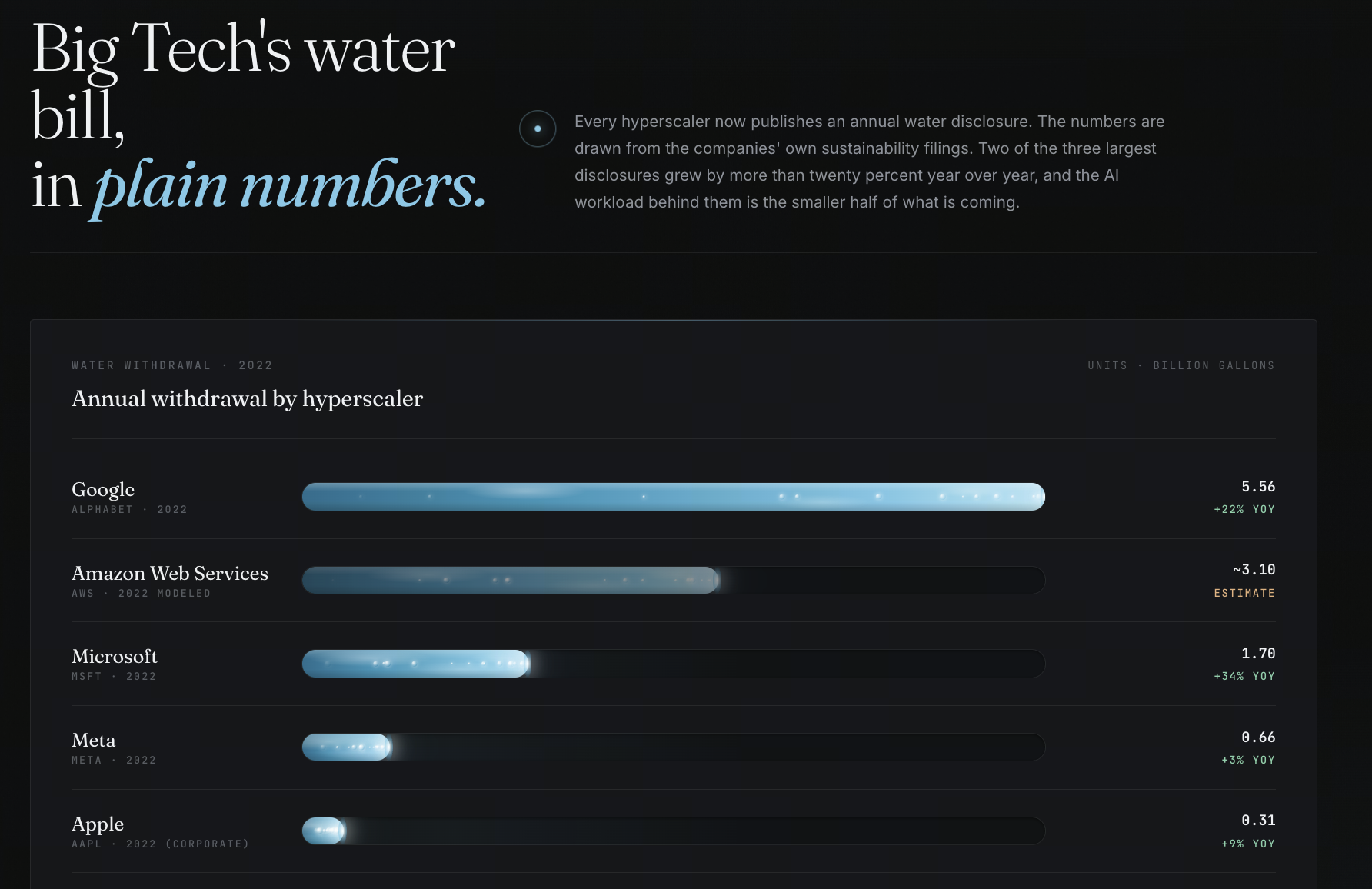
The core function of an AI data center is to support large-scale model training and inference, a process that generates continuous, high-intensity heat. To keep computing equipment stable, cooling systems are indispensable, and water cooling is the most common solution in today's high-density computing environments.
In modern data centers, water doesn't just cool servers directly—it's also used in heat exchange and circulation systems. As GPU clusters grow, energy density per unit of hashrate keeps rising, placing a greater burden on cooling. This structural shift creates a strong link between water consumption and hashrate growth.
With AI training scales expanding, water consumption has gone from a supporting need to a core operational variable. In high-performance computing clusters especially, cooling efficiency directly affects hashrate utilization and cost structure, further elevating water's strategic position in AI infrastructure.
How Water Became a Key Part of AI Infrastructure
Water's entry into the AI infrastructure system isn't just a technological change—it's the result of the evolving hashrate economy. In the past, energy was the main constraint on data centers. In the AI era, water is emerging as a second-layer constraint.
The essence of this change is the rapid increase in computing density. Larger AI models generate more heat per rack, requiring more powerful cooling. Water cooling is more efficient than air cooling, but it also means greater dependency on water.
Structurally, water is now embedded in the operational logic of AI infrastructure, from data center location and energy management to maintenance costs. Water is no longer just a natural variable; it's a fundamental input in the AI economic system.
How AI Hashrate Growth Will Affect Future Resource Demand
AI hashrate growth is exponential. This isn't just about more computing power—it's also about a proportional increase in infrastructure resource consumption.
As large model training cycles lengthen and inference demand grows, data centers run longer and under heavier loads, driving up both energy and water use. Under this trend, resource constraints will become a key limiting factor for AI expansion.
Future AI infrastructure competition won't just be about chip performance. It will center on "resource access + infrastructure efficiency + cooling system optimization." Water, as a key variable, will only grow in strategic importance.
How USWR Builds Its Narrative Around AI and Water
USWR (United States Water Reserve) is built on Solana. Its core narrative tackles the structural issue of "AI infrastructure's dependence on water," aiming to financialize that relationship.
USWR treats water as a critical constraint on AI data center operations and uses an on-chain token to express the link between resource scarcity and demand. This is essentially a "resource narrative asset," not a traditional asset-backed token.
On a narrative level, USWR connects AI hashrate expansion, water consumption, and infrastructure costs, making water a hidden pricing variable in the AI economy. Market trading activity reflects this structural change.
Why the Water Narrative Attracts Market Attention
The rise of the Water Narrative is a spillover effect from the AI narrative. After hashrate, chips, and energy, the market is now looking at deeper infrastructure constraints—and water sits right at that structural node.
The narrative gains traction because of three traits: strong real-world constraints, high relevance to AI, and ease of financialization. This positions water as the next macro-narrative vehicle after energy.
At the same time, interest in "resource narrative assets" is rising, especially as the RWA concept expands. Water is becoming a potential bridge between the real economy and on-chain assets.
How USWR Differs from Other AI Narrative Tokens
The biggest difference between USWR and traditional AI narrative tokens is its focus—not on computing power itself, but on the resource consumption structure behind it.
Traditional AI tokens typically revolve around hashrate networks, decentralized GPUs, or AI model services. USWR, by contrast, focuses on the "physical constraint layer" of AI infrastructure: water and cooling systems.
This makes USWR more of a macro resource narrative asset than a tech application token. Its value depends more on narrative consensus and market expectations of resource scarcity than on a single product feature.
Challenges Facing the AI and Water Narrative
Despite its market appeal, the Water Narrative faces several structural challenges.
First, data standardization is difficult—there's no unified system for measuring water consumption in AI computing. Second, the narrative is highly sentiment-driven, making prices closely tied to market mood. Third, real-world variables are complex, including policy, climate, and regional resource differences.
These factors create significant uncertainty for water narrative assets in practice, and their long-term stability remains unproven.
Future Directions for the Water Narrative
The Water Narrative could develop in three directions.
First, deep integration with RWA to create a real-world resource mapping system.
Second, integration with AI infrastructure monitoring to serve as a resource scheduling data layer.
Third, continued function as a macro narrative asset, driving thematic rotation in crypto market cycles.
If AI infrastructure keeps expanding, water's importance will likely increase, strengthening the narrative's long-term foundation.
Summary
The Water Narrative represented by USWR is more than just a crypto asset concept. It's a financialized expression of the changing resource structure of AI infrastructure. By bringing water resources into an on-chain narrative framework, it attempts to bridge real-world infrastructure constraints with the digital asset market.
In this new AI-driven technology cycle, water is shifting from a background variable to a structural constraint. USWR is one of the narrative models to emerge from this transformation.







