Market Background and Why It Matters: As Ethereum Layer 2s, Solana, Sui, and other blockchains develop in parallel, DeFi liquidity is being sliced into countless isolated pools. Users often find themselves hopping between wallets, cross-chain bridges, lending platforms, and DEXs repeatedly, incurring extra Gas costs, slippage, and operational risk. What Yei Finance stands for is not just building another lending or trading product on a single chain—it’s about merging "cross-chain movement" with "on-chain yield generation" through a clearing layer logic, letting capital flow under a single set of rules. This direction directly tackles the most critical efficiency bottleneck of the multi-chain era.
Extended Value from a Blockchain and Digital Asset Perspective: From the lens of technology and industry evolution, Yei Finance represents a path for DeFi to migrate from "single-chain application stacking" to a "cross-chain operating system." By combining a global Clearing Layer with lightweight Vaults on each chain, the protocol seeks to bring DEXs, lending markets, and cross-chain bridges into one unified liquidity ledger. Paired with messaging layers like LayerZero and Wormhole, and a future self-developed cross-chain DEX and yield Vaults, Yei Finance is building a composable, governable, and incentivizable multi-chain capital infrastructure. The sections below will walk through project background, token model, technical architecture, product features, competitive differentiation, investment risks, and future roadmap, giving readers a systematic understanding of Yei Finance (CLO).
What Is Yei Finance (CLO)? Project Background and Development History
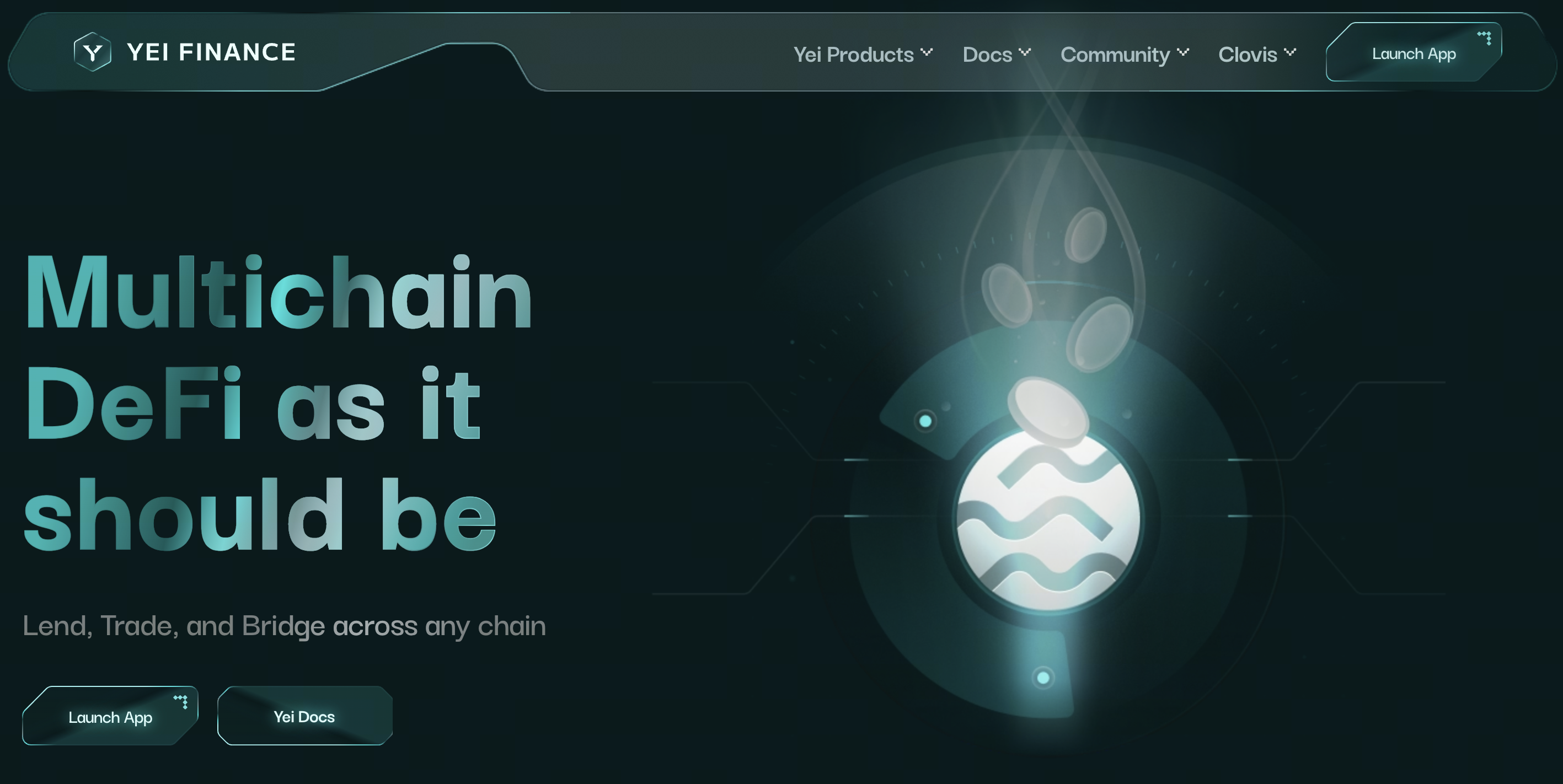 Source: Official Page
Yei Finance is a decentralized, non-custodial money market protocol developed by the Yei Labs team. It originally launched on the Sei network, leveraging Sei’s sub-second finality and parallelized EVM capabilities to deliver efficient lending and trading. The protocol brings together YeiLend (lending), YeiSwap (decentralized exchange), and YeiBridge (cross-chain bridge) into a unified product stack, quickly building up users and TVL (Total Value Locked) within the Sei ecosystem.
According to public data, YeiLend liquidity once exceeded $300 million, YeiSwap processed over $240 million in monthly trading volume, YeiBridge handled roughly $147 million in monthly cross-chain flow, and annualized protocol revenue stood at around $5.5 million. These on-chain results provide a verifiable foundation for subsequent cross-chain expansion.
In late 2024, Yei Finance raised $2 million in a seed round. In September 2025, the team officially launched Clovis—a cross-chain clearing and settlement layer—marking the project’s evolution from a "Sei single-chain DeFi app" to a "multi-chain DeFi operating system." On October 14, 2025, the CLO token completed its TGE (Token Generation Event) and simultaneously went live on Binance Alpha and Binance Futures (with up to 50x leverage). The IDO sold out within minutes on the Salior platform, becoming a major milestone for the project.
It’s worth noting that Yei Finance and Clovis are not two separate projects: Clovis is the flagship cross-chain extension of Yei Finance, and the CLO token serves both, forming a unified governance and incentive system.
CLO Tokenomics and Ecosystem Incentive Mechanism
CLO is the native token of the Clovis protocol, functioning as a vehicle for governance, ecosystem alignment, and value capture. The total supply is fixed at 1 billion tokens with no inflation mechanism. At TGE, approximately 12.91% (129.1 million tokens) entered circulation, while the remaining 87.09% will be linearly unlocked over four years, with full distribution expected by September 2029.
The token distribution structure is as follows:
| Category |
Percentage |
Primary Use |
| Ecosystem |
30% |
LP incentives, developer grants, strategic partnerships |
| Treasury |
20.50% |
DAO operations, strategic investments |
| Team |
15% |
Core contributors; 12-month lock-up + 24-month linear unlock |
| Investors |
10% |
Early funding; 12-month lock-up + 24-month linear unlock |
| Marketing |
6.50% |
Brand and user growth |
| Airdrop |
5% |
Early user rewards |
| Advisors |
5% |
Strategic advisors; 12-month lock-up |
| Liquidity |
4% |
On-chain pools and protocol liquidity |
| Exchange |
3% |
CEX liquidity reserves |
| IDO |
1% |
Public sale |
Ecosystem incentives are at the heart of CLO’s design: 30% of the supply is dedicated to attracting LPs, builders, and partners. Combined with the Clovis Points system, users are rewarded for actions like participating in Pre-Deposit Vaults, cross-chain deposits, lending, and trading. Some sources indicate that the protocol will also use a portion of transaction fees to buy back and burn CLO, creating a deflationary mechanism—though specific ratios and execution timing are subject to on-chain governance decisions.
How Yei Finance Solves DeFi Liquidity Fragmentation
The root cause of DeFi liquidity fragmentation is that each chain and each protocol maintains its own independent liquidity pools, preventing capital from being efficiently reused across borders. A user who wants to lend on Arbitrum, trade on Sei, and hold their main assets on Ethereum typically has to cross chains multiple times, authorize multiple times, and switch interfaces repeatedly—each step adding cost and delay.
Yei Finance’s solution can be broken down into three layers:
-
Capital Aggregation. Through its global Clearing Layer, Clovis aggregates assets from Vaults on each chain into a unified ledger, allowing the same deposit to simultaneously earn lending interest, Swap fees, and cross-chain routing rewards—what they call "Stacked Yield."
-
Operational Abstraction. Pre-Deposit Vaults and one-click Strategy Vaults let users batch deposit from networks like Ethereum, Arbitrum, HyperEVM, and Sei without manually bridging, as the protocol handles routing and allocation behind the scenes.
-
Cross-Chain by Design. Unlike post-hoc cross-chain solutions, Clovis structurally integrates clearing, execution, and settlement from the architecture layer, aiming to deliver cross-chain liquidity allocation at near-CEX speeds while remaining non-custodial.
The team positions this model as DeFi’s "cross-chain prime brokerage layer"—not just moving assets, but turning liquidity into a globally allocable unified system.
How the Clovis Architecture and Cross-Chain Liquidity Layer Work
Clovis’s core architecture consists of two components: a global Clearing Layer and lightweight Vaults deployed on each connected chain.
The Clearing Layer handles cross-chain position accounting, risk calculation, and settlement coordination—essentially the "central ledger" for multi-chain DeFi. Each chain’s Vault manages local asset custody, user deposits and withdrawals, and on-chain interactions. The structure is lightweight, making it easy to deploy on new chains. When a user deposits assets on a given chain, the Vault reports that liquidity to the Clearing Layer, which then allocates it to lending pools, Swap pools, or cross-chain routes—achieving "one pool, multiple uses."
For cross-chain communication, in Q4 2025 Clovis integrates established messaging protocols like LayerZero and Wormhole, supporting asset and state synchronization between Ethereum, Arbitrum, BNB Chain, and other major EVM chains. Starting in Q1 2026, the team plans to launch a self-developed cross-chain DEX and proprietary messaging layer, and expand to non-EVM ecosystems like Solana and Sui.
The product mapping is straightforward: YeiBridge evolves into Clovis Transport (cross-chain movement), YeiLend corresponds to Clovis Market (base liquidity layer), and YeiSwap corresponds to Clovis Exchange (trading and LP layer). This modular design lets the logic proven on Sei be replicated chain by chain rather than rebuilt from scratch.
Analyzing Yei Finance’s Lending, Trading, and Cross-Chain Features
YeiLend / Clovis Market (Lending)
YeiLend is the protocol’s core money market, supporting the supply and borrowing of assets such as USDC, SEI, WETH, WBTC, USDT, and SolvBTC. Interest rates adjust dynamically based on pool utilization, with no lock-up period. Advanced features include Flash Loans (starting at 0.1% fee), E-mode (leveraged borrowing for correlated assets), and over-collateralized borrowing. Sei’s fast block production enables quicker liquidations and rate adjustments, reducing bad debt risk during extreme market conditions.
YeiSwap / Clovis Exchange (Trading)
YeiSwap lets users swap directly within the protocol without needing to go to an external DEX. Its unique advantage is that LPs can earn both Swap fees and YeiLend lending interest simultaneously—"one liquidity provision, dual yield." For users who need to adjust collateral or rebalance positions, the built-in Swap significantly cuts down operational friction.
YeiBridge / Clovis Transport (Cross-Chain)
YeiBridge integrates Stargate and Circle CCTP, supporting transfers of USDC and other assets from Ethereum, Arbitrum, Optimism, Base, Polygon, Avalanche, and other chains to Sei. Average settlement times range from about 3 to 32 minutes. In the Clovis phase, a native decentralized cross-chain bridge will be introduced, aiming to reduce confirmation times and lower cross-chain slippage.
Pre-Deposit Vault and One-Click Strategies
For cross-chain users, Pre-Deposit Vaults support one-click deposits from multiple chains, immediately earning APY and Clovis Points. One-click Strategy Vaults automatically optimize yield paths—ideal for users who want a passive experience without manually managing multi-chain positions.
The Role of CLO in Governance, Staking, and Protocol Value Capture
CLO’s value capture logic is built on multiple channels tied to protocol usage.
Governance: CLO holders can vote through the DAO on key matters such as protocol parameter upgrades, fee adjustments, new chain deployments, and incentive allocations, directly influencing how Clovis and Yei Finance operate.
Staking: Users can stake CLO to earn protocol revenue shares and additional incentives. As YeiLend generates lending interest, YeiSwap collects trading fees, and the cross-chain bridge charges routing fees, stakers have the opportunity to share in the protocol’s cash flow.
Incentive Alignment: The Clovis Points system ties user actions (deposits, lending, swaps, cross-chain activity) to CLO rewards, creating a positive "use-to-earn" loop that drives TVL and trading volume growth.
Deflationary Mechanism: Some sources indicate the protocol will use a portion of fees to buy back and burn CLO. With a fixed total supply, if on-chain activity continues to rise, this could theoretically support token supply-demand dynamics. However, the actual frequency and scale of this mechanism need to be monitored through on-chain data and governance proposals.
How Yei Finance Differs from Traditional Cross-Chain Bridges and DeFi Aggregators
To understand Yei Finance’s positioning, it helps to compare it with two common product categories:
| Dimension |
Traditional Cross-Chain Bridge |
DeFi Aggregator |
Yei Finance / Clovis |
| Core Function |
Asset transfer across chains |
Route to best yield/quote |
Integrated clearing + lending + trading + cross-chain |
| Liquidity Ownership |
Leaves protocol after bridging |
Routes to third-party protocols |
Allocated within unified Clearing Layer |
| Yield Model |
Typically no on-chain yield |
Single optimization, no liquidity holding |
Stacked Yield |
| Capital Efficiency |
Low (must redeploy after bridging) |
Medium (depends on external pool depth) |
High (single pool, multiple uses) |
| Custody Model |
Non-custodial but single-function |
Non-custodial but fragmented |
Non-custodial + global ledger |
Traditional cross-chain bridges (like Stargate or Wormhole Portal) solve point-to-point transfers from "Chain A to Chain B." After bridging, users still need to find DeFi opportunities on their own. DeFi aggregators (like 1inch or Yearn) excel at comparing prices and optimizing yields, but they don’t own the underlying liquidity and can’t do unified cross-chain accounting.
Yei Finance / Clovis is different because it is both a liquidity holder and a coordinator of clearing and settlement. Once users deposit, their capital stays within the same protocol system—no need to jump between bridges, DEXs, and lending platforms. This "DeFi operating system" positioning is closer to the prime brokerage model in traditional finance rather than a simple tool product.
Key Risks in Investing in CLO Tokens
Despite Yei Finance’s strong showing on the Sei ecosystem, investing in CLO requires careful consideration of the following risks:
-
Token Unlock Pressure: Approximately 87% of tokens remain locked or in linear release after TGE. From 2026 to 2029, team, investor, and ecosystem shares will gradually enter the market, potentially putting downward pressure on the price.
-
New Chain Expansion Uncertainty: Clovis’s cross-chain DEX, proprietary messaging layer, and Solana/Sui integrations are still on the roadmap, carrying execution risks in both technology and market adoption.
-
Smart Contract and Security Risks: Cross-chain protocols involve multi-chain contract interactions, creating a larger attack surface than single-chain DeFi. While Yei Finance claims to have undergone audits and partners with security firms, DeFi history shows that complex cross-chain architectures remain prime targets for hackers.
-
Growing Competition: LayerZero, Chainlink CCIP, Stargate, and various omnichain lending protocols are all competing for cross-chain liquidity market share. Yei Finance must consistently prove the real appeal of its stacked yield model.
-
Regulatory and Compliance Risks: CLO is listed on centralized platforms like Binance Alpha and Futures. Regulatory policies for DeFi tokens and derivative trading are still evolving across jurisdictions, potentially affecting liquidity and project operations.
-
Dependence on Sei Ecosystem: While the project is expanding to multiple chains, its current TVL and revenue are still heavily tied to the Sei network. A slowdown in Sei ecosystem growth could impact CLO’s fundamental outlook.
-
Market Volatility: As a newly listed token, CLO typically experiences high volatility in the early TGE phase. Binance Futures’ 50x leverage product may amplify short-term price swings, making it unsuitable for risk-averse investors.
Future Development Direction and Market Potential of the Yei Finance Ecosystem
According to the official roadmap, Yei Finance / Clovis development is split into two main phases:
Q4 2025 (Completed / In Progress): CLO TGE and IDO, cross-chain lending market launch, native decentralized cross-chain bridge release, mainnet deployment on major EVM chains, integration of LayerZero and Wormhole messaging layers.
Q1 2026 and Beyond: Launch of Clovis cross-chain DEX and proprietary messaging layer, expansion to non-EVM ecosystems like Solana and Sui, rollout of Yield Vaults to automatically generate yield on idle capital, and release of SDK and API for third-party developers to build dApps.
From a market potential standpoint, if Clovis successfully replicates the $300 million liquidity model validated on Sei into larger markets like Ethereum and Arbitrum, the TVL ceiling could rise significantly. If the cross-chain DeFi operating system achieves network effects—more chains connected, more assets supported, more developers building on Clovis—demand for CLO as a governance and value capture token may also grow.
Additionally, Yei Finance’s deep ties with the Sei Foundation, the endorsement from the Binance ecosystem listing, and early traction from Pre-Deposit Vaults in cross-chain incentives give the project certain first-mover advantages. But whether it ultimately becomes a "multi-chain DeFi infrastructure layer" will depend on product delivery speed, security, and real user retention data.
Summary
Yei Finance (CLO) is a representative project evolving from a successful single-chain DeFi case on Sei to a cross-chain liquidity operating system. Its core innovation lies in the Clovis clearing layer—by combining a global Clearing Layer with Vaults on each chain, it brings lending, trading, and cross-chain functions into a unified liquidity ledger, letting users "deposit once, earn everywhere."
The CLO token, with a fixed total supply of 1 billion and a distribution structure weighted toward ecosystem incentives, serves governance, staking, and value alignment purposes. The project completed its TGE in October 2025 and landed on Binance Alpha, marking a new phase of multi-chain expansion beyond infrastructure building.
For readers following the DeFi cross-chain track, Yei Finance is worth monitoring for key indicators like Clovis mainnet launch progress, cross-chain TVL growth, CLO unlock schedule, and governance proposals. At the same time, the complexity of cross-chain protocols and market competition should not be overlooked; any participation decisions should be based on a thorough understanding of the risks.
FAQs
-
Q1: What is the relationship between Yei Finance and Clovis?
Yei Finance is the project’s founding protocol and product brand, initially offering lending, trading, and cross-chain services on the Sei network. Clovis is the cross-chain clearing and settlement layer built by Yei Labs on top of Yei Finance’s infrastructure, extending the original product stack to multi-chain scenarios. They share the same team, economic model, and CLO token. Clovis is the flagship cross-chain product of Yei Finance, not an independent competitor.
-
Q2: What are the uses of the CLO token?
CLO is primarily used for DAO governance voting, ecosystem incentive distribution, liquidity mining rewards, and (according to the roadmap) staking to earn protocol revenue shares. Additional mechanisms include Clovis Points redemption and fee-based buyback/burn. Specific functions are subject to official documentation and on-chain governance decisions.
-
Q3: Which blockchains does Yei Finance currently support?
Currently, it supports the Sei network and connects to EVM chains such as Ethereum, Arbitrum, Optimism, Base, Polygon, and Avalanche via YeiBridge. In the Clovis phase, more EVM mainnets are being deployed, with plans to expand to Solana and Sui in 2026.
-
Q4: What does "Deposit once, earn everywhere" mean?
This is the core concept of Yei Finance / Clovis: users make a single deposit on any supported chain or Vault, and the protocol, via the Clearing Layer, automatically allocates that capital to multiple yield sources including lending, swaps, and cross-chain routing—no manual bridging or repeated steps required, achieving stacked yield.
-
Q5: What is the TVL scale of Yei Finance?
According to 2025 public data, YeiLend TVL once exceeded $300 million, representing nearly half of the total DeFi liquidity on the Sei ecosystem. After the Clovis mainnet launch, Pre-Deposit Vaults also filled rapidly, reaching tens of millions of dollars driven by incentives.
-
Q6: Is investing in CLO suitable for beginners?
CLO is a DeFi infrastructure token with volatility and technical complexity higher than mainstream assets. Beginners should understand the basics of cross-chain DeFi, token unlock schedules, and smart contract risks before participating, and only allocate funds they can afford to lose.
-
Q7: How is Yei Finance different from lending protocols like Aave and Compound?
Aave and Compound are mature single-chain (or gradually cross-chain) lending protocols focused on money markets. In addition to lending, Yei Finance natively integrates a DEX, cross-chain bridge, and clearing layer, aiming to become a multi-chain DeFi operating system rather than a pure lending platform.