As stablecoins evolve from the crypto market into global payment and cross-border finance, attention is shifting to the blockchain infrastructure capable of supporting large-scale payment demands. Tempo emerged in this context, focusing on stablecoin payments, corporate settlements, and cross-border remittances—attracting Stripe, MoneyGram, and other leading companies to its ecosystem. This article covers Tempo’s core positioning, technical features, and how it leverages blockchain to boost global payment efficiency while driving stablecoin adoption in real-world business use.
What Is Tempo?
Tempo is a Layer 1 blockchain built specifically for stablecoin payments and fund settlement, co-developed by Stripe and Paradigm. Unlike many public chains centered on DeFi or NFTs, Tempo focuses on real-world payment scenarios—cross-border remittances, retail payments, corporate treasury management, and stablecoin settlement. Its primary goal is to make stablecoins a core part of global payment infrastructure, improving capital flow efficiency and cutting cross-border costs.
Why Did MoneyGram Join Tempo?
 (Source: MoneyGram)
Global remittance firm MoneyGram recently joined the Tempo ecosystem as an Anchor Remittance Validator. In the future, MoneyGram will help verify cross-border transactions, support stablecoin settlements, and strengthen trust in on-chain payment processes. This move reflects how traditional financial companies are increasingly engaging with blockchain payment infrastructure, pushing stablecoins further into real-world payment systems.
What Problems Does Tempo Solve?
Global payment systems today still face issues like slow cross-border transfers, high fees, incompatible settlement systems across countries, and heavy reliance on intermediaries. Tempo aims to reduce these frictions using stablecoins and blockchain, enabling faster, more efficient global capital movement. Stablecoins offer 24/7 operation, instant transfers, global reach, and low-cost settlement—making them an attractive next-generation payment tool for more enterprises.
What Are Tempo's Core Features?
Purpose-Built for Payments
Tempo is not a general-purpose blockchain—it is specifically designed for payment and settlement needs.
Its main applications include:
This positioning makes Tempo more of a financial infrastructure than a crypto trading network.
Supports Enterprise-Grade Stablecoin Use
One of Tempo's key focus areas is enterprise-grade stablecoin payments.
Businesses can use Tempo for:
Compared to traditional banking, blockchain enables faster cross-border capital flow.
Introducing the Zones Privacy Architecture
 (Source: Tempo)
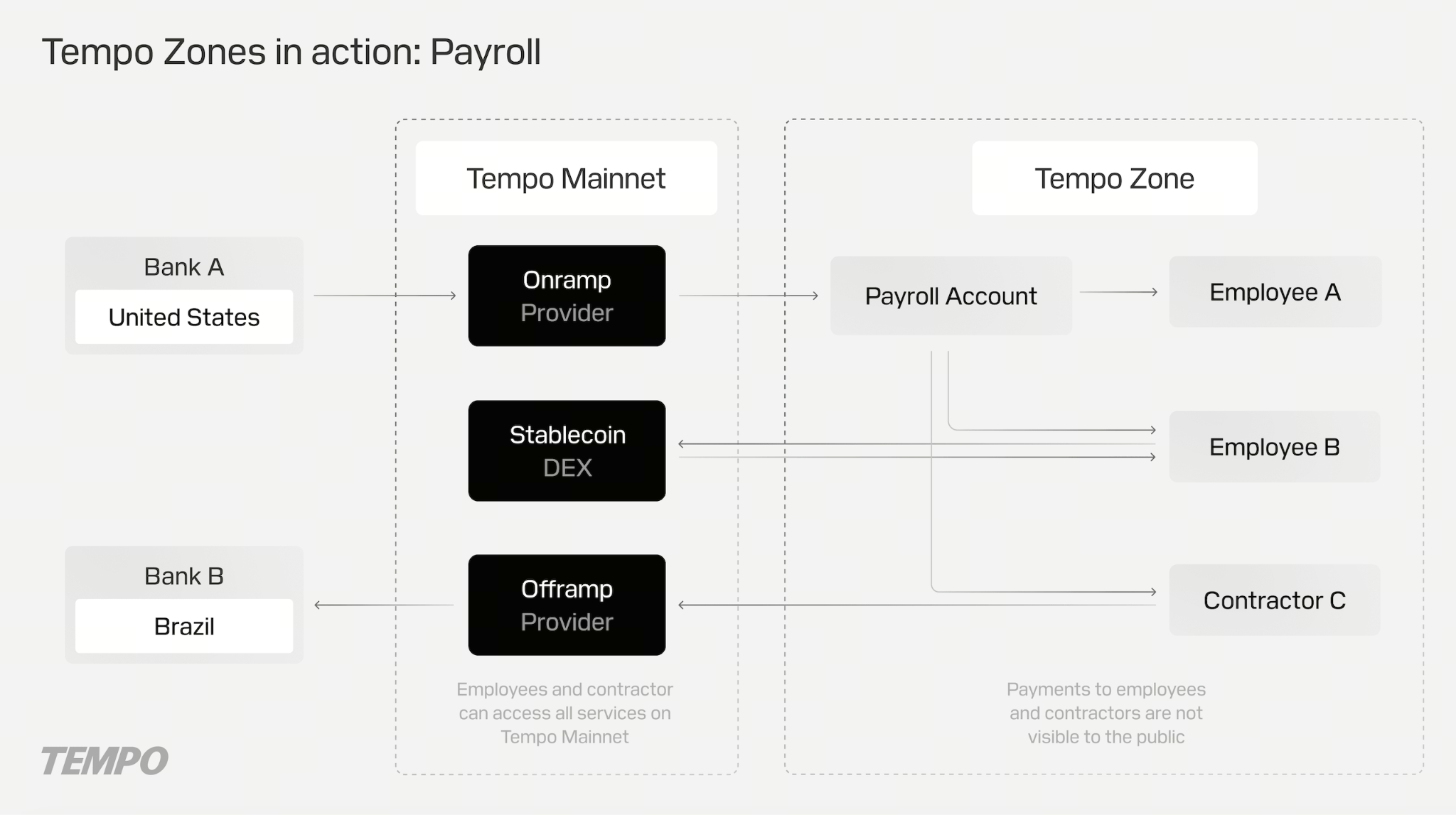
Tempo also launched a privacy framework called Zones—a permissioned blockchain mechanism built on the main chain that lets enterprises create private payment and fund management environments. Potential use cases include corporate payroll systems, internal settlement, financial data isolation, and compliant stablecoin payments. This design enhances enterprise control over data security and compliance, making Tempo more attractive to institutions and large corporations adopting blockchain.
What Is the Relationship Between Tempo and Stripe?
Stripe, a global payment giant, has been actively exploring stablecoins and Web3 payments. Tempo is seen as a key extension of Stripe’s blockchain payment infrastructure. Through Tempo, Stripe aims to boost stablecoin payment efficiency, build a global payment network, and integrate more enterprise financial services to drive on-chain commerce. This signals that major payment companies increasingly view blockchain as part of the future financial infrastructure.
Which Companies Have Joined the Tempo Ecosystem?
Tempo has already attracted several major enterprises and financial institutions, including MoneyGram, Visa, Stripe, and Zodia Custody. Market rumors also suggest Tempo is testing applications with OpenAI, Shopify, Anthropic, and Deutsche Bank, indicating continued expansion of its blockchain payment ecosystem.
What Are Tempo’s Potential Future Directions?
Tempo may expand into:
-
Global stablecoin payments
-
Commercial settlement networks
-
Institutional-grade financial applications
-
Compliant on-chain payments
-
Web3 commercial infrastructure
As stablecoins enter mainstream finance, payment-focused blockchains like Tempo could become a key direction for the next fintech wave.
Summary
Tempo is not a speculative blockchain—it is a financial infrastructure built for real payment needs. Through partnerships with MoneyGram, Stripe, Visa, and others, Tempo is working to bring stablecoins into global payment and remittance markets. As more companies embrace blockchain payments, public chains centered on stablecoin settlement—like Tempo—have the potential to become a vital bridge between Web3 and traditional finance.
FAQ
Q1: What is Tempo?
Tempo is a Layer 1 blockchain designed for stablecoin payments and cross-border settlement. It focuses on corporate payments, remittances, commercial settlement, and global capital management, aiming to improve payment efficiency and reduce cross-border transaction costs.
Q2: Why did MoneyGram join Tempo?
MoneyGram joined the Tempo ecosystem as a core remittance validator, helping verify cross-border transactions and support stablecoin settlement, enhancing the security and credibility of on-chain payments.
Q3: What are Tempo's main use cases?
Tempo applies to cross-border remittances, merchant payments, corporate treasury management, payroll distribution, stablecoin transfers, and global commercial settlement—building a more efficient global payment infrastructure.







