Request Network (REQ) is a decentralized protocol designed for on-chain payments and crypto invoicing. Its core value lies in standardizing "payment intent" as a verifiable, programmable, and auditable data object, allowing both parties to complete fund settlement and financial record-keeping without a centralized intermediary.
As stablecoin cross-border settlement accelerates and enterprise financial systems demand real-time capabilities, competition among payment networks now hinges on whether payment data is composable—not just transfer speed. Whoever can unify payments, invoices, tax fields, approval workflows, and audit evidence into a single structure is better positioned to become the foundational layer for the next generation of Web3 finance.
From an industry evolution standpoint, Request Network's focus has shifted from "can crypto payments happen?" to "how can on-chain payments become scalable, compliant, and enterprise-ready?" The following sections cover project history, technical architecture, tokenomics, use cases, governance, risks, and future outlook—to help you fully assess REQ's fundamentals and potential boundaries.
What Is Request Network (REQ)? Project Background and Development History
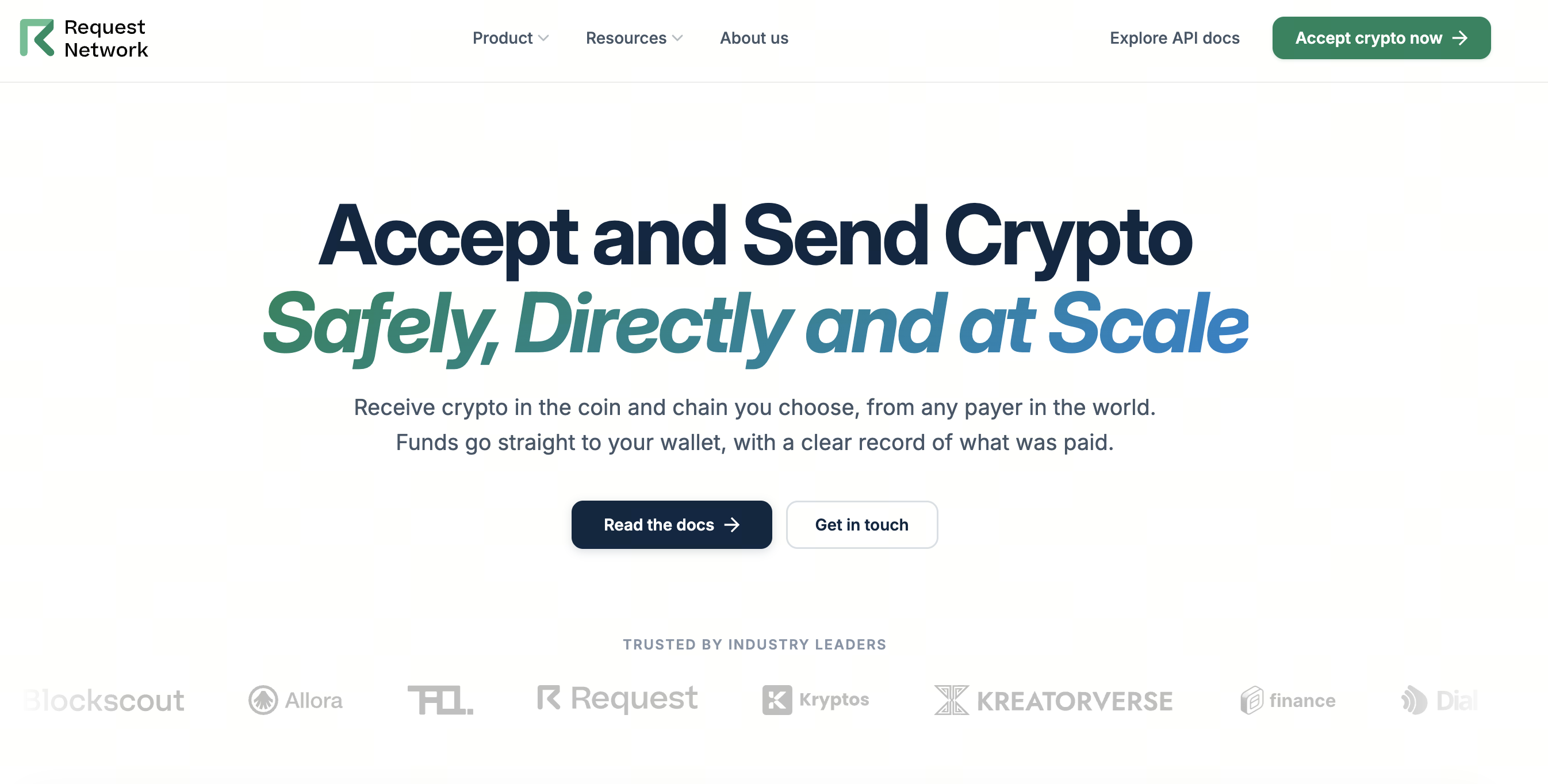 Source: Request Network Official Website
Request Network was originally positioned as a "decentralized payment request protocol"—first generating a verifiable payment request, then triggering an on-chain payment. This design naturally fits invoice and receivables/payables management, not just peer-to-peer transfers.
The project was built on the Ethereum ecosystem with an open protocol approach, emphasizing three points:
- Anyone can initiate a standardized payment request
- Request data can be read and extended by third-party applications
- Transaction records can be used for auditing and financial automation
Recent development shows a parallel "protocol layer + application layer" strategy: the protocol layer continues refining payment and data standards, while the application side drives adoption through enterprise financial products. Public ecosystem updates indicate that since 2025, key areas of focus include recurring payment capabilities, improved developer portal and API usability, and a better multi-chain payment tracking experience. This signals a strategic shift from "conceptual feasibility" to "enterprise-grade usability."
REQ Tokenomics and Ecosystem Incentive Mechanism
REQ is the native utility token of Request Network, primarily serving governance and fee-related functions in network operations—not as the main currency for daily payments.
Its token logic can be summarized into three layers:
- Network Function Layer: Covers fees and anti-spam costs for specific request creation, extended calls, or advanced features
- Governance Participation Layer: Holders can vote on ecosystem proposals, community incentives, and directional decisions
- Deflationary Auxiliary Layer: The protocol has fee recovery and burn mechanisms, creating a long-term link with network usage
It's important to note that token value does not automatically equal protocol usage. Even with a burn mechanism, price performance may still decouple from fundamentals if business growth, on-chain activity, and capital flows don't synchronize. For REQ, a three-dimensional framework of "protocol revenue quality + real payment demand + governance activity" is more relevant than short-term price action.
Request Network's Core Technical Architecture and Payment Protocol
Request Network's technical advantage lies not in "single-chain throughput" but in "payment data standardization + multi-chain composability." Its architecture consists of the following modules:
- Request Layer: Defines the data structure of a payment request—amount, currency, payee, deadline, and additional metadata
- Extensions Layer: Supports business logic hooks for tax rates, split payments, milestone payments, discount rules, etc.
- Settlement Layer (Payment Detection/Settlement): Monitors the target chain and matches actual payments to complete request status updates
- Interface Layer (API/SDK): Provides integration capabilities for wallets, financial systems, and enterprise backends
This design gives Request Network two real-world advantages:
- Payments become interpretable business objects, not isolated transaction hashes
- Different applications share the same payment semantics, reducing integration costs
How Request Network Enables On-Chain Payments and Crypto Invoicing
In practice, Request Network follows a closed loop of "request first, pay later, then reconcile":
- Create an invoice or payment request: Include amount, currency, payee address, invoice number, etc.
- Send the request link or data object: The payer confirms in their wallet or enterprise system
- Execute on-chain payment: Use stablecoins or other supported assets
- The protocol detects the payment: Automatically matches the on-chain transaction to the request
- Status update and audit trail: Facilitates financial archiving, reporting, and audit evidence collection
Compared to traditional crypto transfers, the key difference is "semantic completeness before and after the transaction." A regular transfer only shows "who sent how much to whom," but Request's invoice-based payment can include the reason, corresponding business, and tax treatment—exactly what enterprise financial systems value most.
Use Cases for Request Network in Web3 Finance and Enterprise Payments
Request Network's use cases are expanding from crypto-native teams to cross-border businesses. Typical scenarios include:
- DAO and project payroll: Pay contributors in stablecoins periodically, with automatic record-keeping
- Cross-border supplier settlements: Reduce intermediaries and delays, improve transparency
- Accounts receivable/payable management: Bind invoices, payment status, and on-chain evidence together
- Crypto-native subscriptions and recurring payments: Periodic requests reduce manual collection efforts
- Audit and compliance preparation: Provide verifiable credentials for accounting, auditing, and tax systems
Based on public ecosystem signals, 2025 application milestones include payment volumes reaching new highs, increased stablecoin share, the launch of recurring payment features, and privacy payment collaborations. Together, they point to a shift: Web3 payment infrastructure is upgrading from "transferable" to "operable."
The difference is not just "decentralization"—it's the underlying structure of rights and responsibilities:
- Ledger Ownership: Traditional platforms maintain the ledger centrally; Request relies on open chains and protocol standards
- Auditability: Traditional systems require platform exports for auditing; Request enables cross-verification via on-chain records
- Programmability: Traditional platform rules are closed; Request supports extension fields and custom business logic
- Interoperability: Traditional systems often create data silos; Request emphasizes API and cross-system integration
- Intermediary Dependency: Traditional chains involve multi-layer clearing; Request favors peer-to-peer or minimal-intermediary settlement
Of course, traditional platforms still hold advantages in compliance, user education, fiat on-ramps, and dispute resolution. The realistic outcome is not "full replacement" but a "hybrid financial stack": fiat handled by traditional institutions, on-chain payments and financial automation enhanced by open protocols.
Decentralized Governance and Data Transparency in Request Network
Request Network's governance emphasizes community participation and ecosystem incentives. REQ holders can influence resource allocation and development direction through proposals and voting. Public ecosystem practices also include periodic rewards for developer contributions and ecosystem projects.
The value of its governance and transparency mechanism lies in:
- Decision traceability: Proposals, votes, and execution are more public
- Incentive quantifiability: The link between contributions and rewards is clearer
- Ecosystem sustainability: Open collaboration continuously improves protocol usability
However, governance efficiency is a double-edged sword. While increasing transparency, open governance can also lead to low participation, longer decision cycles, and high entry barriers. Therefore, evaluating governance quality requires looking at "depth of participation and execution closure," not just whether voting is on-chain.
Key Risks When Investing in REQ Tokens
From an investment perspective, REQ is a "protocol utility token." Its risk profile resembles high-beta assets but is more dependent on adoption quality. Focus on these aspects:
- Market Volatility: Small-to-mid-cap tokens are highly sensitive to liquidity and sentiment; short-term swings can be amplified
- Adoption Progress: If enterprise payment growth falls short, the token narrative may weaken
- Competition: The stablecoin payment space includes native chain solutions, wallet infrastructure, and centralized platforms
- Regulatory & Compliance Risk: Jurisdictions vary greatly in rules for crypto payments, privacy, and tax reporting
- Token Value Capture: Protocol usage growth does not guarantee token price appreciation
- Technical & Security Risk: Smart contracts, cross-chain components, and integration interfaces all have potential attack surfaces
A more robust approach is to view REQ as "payment infrastructure exposure" rather than a trading vehicle, and track on-chain data, product updates, real customer profiles, and governance activity continuously.
Future Directions and Market Potential for Request Network
Based on industry trends and recent ecosystem moves, Request Network has four potential growth paths:
- Deeper Stablecoin Enterprise Payments: Cross-border settlements, payroll, and supplier payments keep migrating to stablecoins
- Multi-Chain & Unified Account Experience: Reduce operational complexity across chains for enterprises
- Privacy + Auditability: Balance commercial privacy with audit needs within a compliance framework
- API-Driven Financial Automation: Further modularize payments, invoices, approvals, and reconciliation as outputs
Market potential isn't about whether there's demand for payments—it's about who can provide the lowest-friction enterprise-grade payment data layer. If Request can improve developer experience, maintain protocol neutrality, and scale real commercial payment volume, its strategic position in Web3 financial infrastructure remains promising.
Conclusion
The essence of Request Network (REQ) is upgrading on-chain transfers into a programmable, auditable, and integrable payment and invoice protocol. It's not about "can payments happen?" but "how can payments be understood and automated by enterprise systems?" Against the backdrop of accelerating stablecoin commercialization, such protocols have long-term infrastructure value.
Don't evaluate REQ solely on price action. Instead, focus on three things: is real payment volume growing? Is the protocol constantly evolving? Are governance and ecosystem forming a virtuous cycle? If all three align, REQ's long-term value logic becomes clearer. If any one stalls, valuation elasticity will contract significantly.
FAQs
1. Are Request Network and Request Finance the same project?
They are closely related but have different positioning. Request Network is protocol/infrastructure; Request Finance is enterprise application/product layer. The latter can be seen as one of the key adoption gateways for financial scenarios within the ecosystem.
2. Is REQ the main currency used for payments?
Not usually. Actual payments typically use stablecoins. REQ is mainly for protocol functions, governance, and some fee mechanisms.
3. Is Request Network for individuals or enterprises?
Both, but its "invoice + reconciliation + audit" capabilities are more valuable for enterprises and DAOs.
4. Who is Request Network's biggest competitor?
Not just other Web3 payment protocols, but also centralized payment platforms, wallet infrastructure, and native chain payment solutions.
5. Will REQ's deflationary mechanism automatically push up the price?
Not necessarily. The burn is only one variable. Price is influenced by liquidity, sentiment, adoption speed, and macro cycles.
6. What is Request Network's core moat?
Its standardized payment data model, cross-system integration capabilities, and the composability that connects payment processes with financial workflows.







