The blockchain industry has evolved through multiple phases, from digital currencies and smart contracts to decentralized finance (DeFi). Throughout this evolution, the overwhelming majority of on-chain assets remain native crypto assets, with their value deriving primarily from the crypto ecosystem itself.
As institutional capital and traditional financial markets increasingly turn their attention to blockchain technology, Real World Assets (RWA) have emerged as a new frontier. Assets such as real estate, government bonds, corporate bonds, private credit, commodities, and intellectual property are entering on-chain markets through tokenization, enabling blockchain to support a much broader range of financial activities.
What is Plume (PLUME)?
As a blockchain network purpose-built for Real World Asset Finance (RWAfi), Plume combines real-world assets with on-chain financial infrastructure to enable asset tokenization, yield generation, and liquidity management.
Plume's design goal is to build a complete RWA lifecycle management platform. From asset issuance to on-chain circulation, yield distribution, and cross-chain usage, the entire process can be completed within a unified network.
Unlike platforms that offer only tokenization services, Plume emphasizes deep integration between real-world assets and DeFi, allowing real-world assets to participate in on-chain financial activities just like native crypto assets.
How Does Plume Work?
Plume has built a modular architecture designed specifically for real-world assets.
Asset issuers first complete asset verification, legal structure design, and compliance review through the platform. Once certified, assets can be mapped into on-chain tokens with corresponding proof of ownership.
These asset tokens then enter the Plume network ecosystem, where they can be used in lending protocols, yield products, liquidity pools, and other DeFi applications.
To ensure on-chain data remains consistent with the status of real-world assets, Plume integrates oracles, custodial services, and off-chain data verification mechanisms, establishing a trusted bridge between real-world assets and the blockchain.
Plume's Core Infrastructure
Nest Yield Ecosystem
Nest is a key component of the Plume ecosystem, primarily designed to connect real-world asset yields with on-chain capital markets.
Through Nest, users can access yield products backed by real-world assets, while asset issuers gain access to a broader pool of funding sources.
Nest's goal is to bring real-world asset yields into the DeFi ecosystem in a standardized way, automating yield distribution and asset management.
SkyLink Cross-Chain Infrastructure
SkyLink is Plume's cross-chain connectivity layer.
Real-world asset tokens are not confined to a single chain. Through cross-chain mechanisms, assets and liquidity can flow across different blockchain networks, improving market coverage and capital efficiency.
On-Chain Compliance Module
Real-world assets often involve securities regulations, anti-money laundering (AML) rules, and investor qualification requirements.
Plume integrates compliance tools directly into its underlying architecture, allowing asset issuers to set access rules, identity verification processes, and permission management mechanisms in line with regulatory requirements.
What is the PLUME Token?
PLUME is the native token of the Plume network and a crucial part of the ecosystem's operation.
PLUME serves four main functions:
First, paying network transaction fees.
Second, participating in network governance decisions.
Third, staking to maintain network security.
Fourth, serving as an ecosystem incentive to support developers, validators, and users in building the ecosystem.
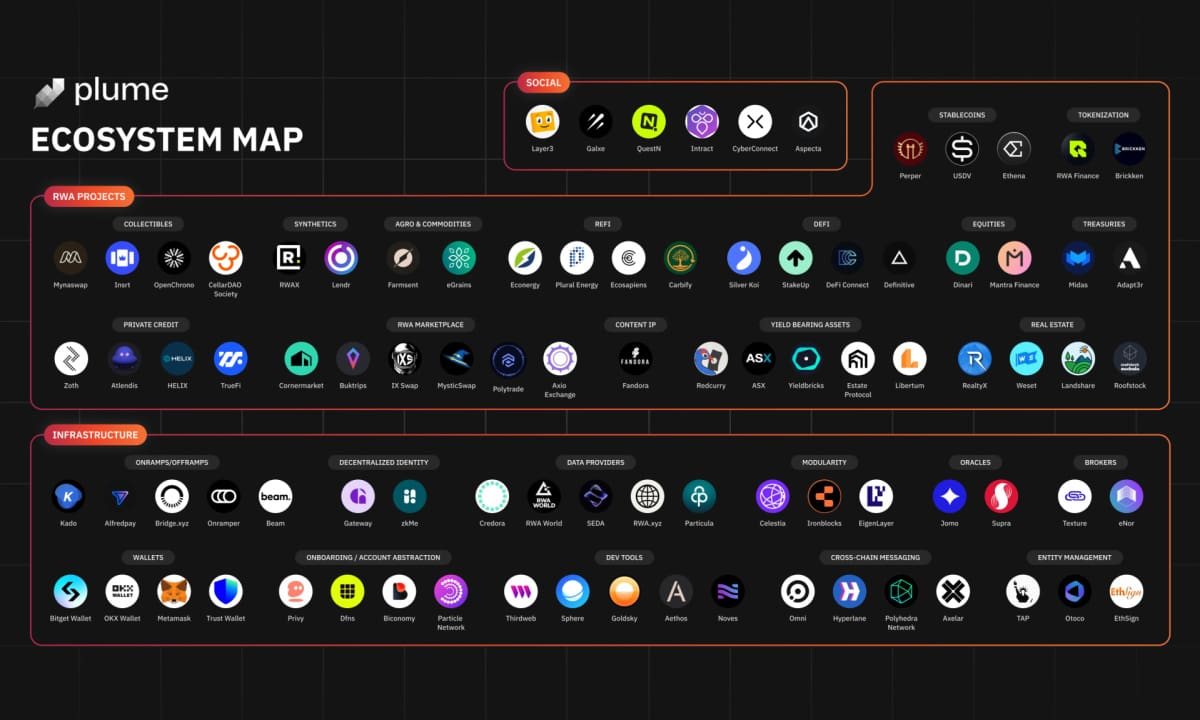
What Are the Components of the Plume Ecosystem?
Plume's ecosystem spans multiple layers.
The infrastructure layer includes on-chain compliance systems, asset issuance tools, and data services.
The protocol layer includes yield protocols like Nest and liquidity products.
The application layer covers lending, trading, asset management, and yield aggregation.
At the same time, Plume partners with asset managers, custodians, data providers, and blockchain development teams to collectively drive real-world assets onto the chain.
How Does Plume Differ from Other RWA Projects?
Several well-known projects exist in the RWA space, but each has a distinct positioning.
| Project |
Core Positioning |
Key Features |
| Plume |
RWAfi Public Chain |
Builds a complete RWA financial ecosystem |
| Ondo Finance |
Asset Issuance Platform |
Focuses on on-chain treasury products |
| Centrifuge |
RWA Financing Protocol |
Serves enterprise financing needs |
| MANTRA |
Compliance-Focused Public Chain |
Emphasizes regulatory framework integration |
Compared to projects like Ondo Finance, Plume stands out by aiming to create an integrated infrastructure covering asset issuance, compliance management, yield generation, and DeFi applications — rather than focusing on a single asset class or business scenario.
Plume's Advantages and Potential Challenges
Plume's main advantages come from its vertically integrated design.
A dedicated infrastructure purpose-built for real-world assets helps improve issuance efficiency, enhance liquidity, and streamline development processes.
At the same time, Plume faces challenges common to the real-world asset industry, including regulatory fragmentation, legal complexity, off-chain data trustworthiness, and the pace of market adoption.
Summary
Plume is an RWAfi blockchain network purpose-built for the financialization of real-world assets. By integrating asset tokenization, on-chain compliance, cross-chain infrastructure, and DeFi applications, Plume aims to create a complete pathway for real-world assets to enter the blockchain financial market.
FAQs
What is the difference between Plume and traditional RWA platforms?
Plume not only supports real-world asset tokenization but also focuses on building the infrastructure for real-world assets to participate in DeFi. Unlike pure asset issuance platforms, Plume emphasizes liquidity, yield generation, and financial composability.
What is RWAfi?
RWAfi stands for Real World Asset Finance — a new financial system that combines real-world assets with decentralized finance. Its goal is to enable real-world assets to participate in on-chain activities such as lending, trading, and yield strategies.
What are the uses of the PLUME token?
The PLUME token is primarily used for paying network fees, participating in governance voting, staking to maintain network security, and supporting ecosystem incentive mechanisms. It is an integral part of the Plume network's operation.
What real-world assets does Plume support?
Plume supports a wide range of real-world asset types, including government bonds, real estate, private credit, commodities, fund shares, and other verifiable financial assets.
Is Plume a Layer 1 or Layer 2?
Plume is positioned as a blockchain network specifically serving the RWAfi ecosystem. Its underlying architecture is purpose-built for the financialization needs of real-world assets and provides comprehensive infrastructure support.