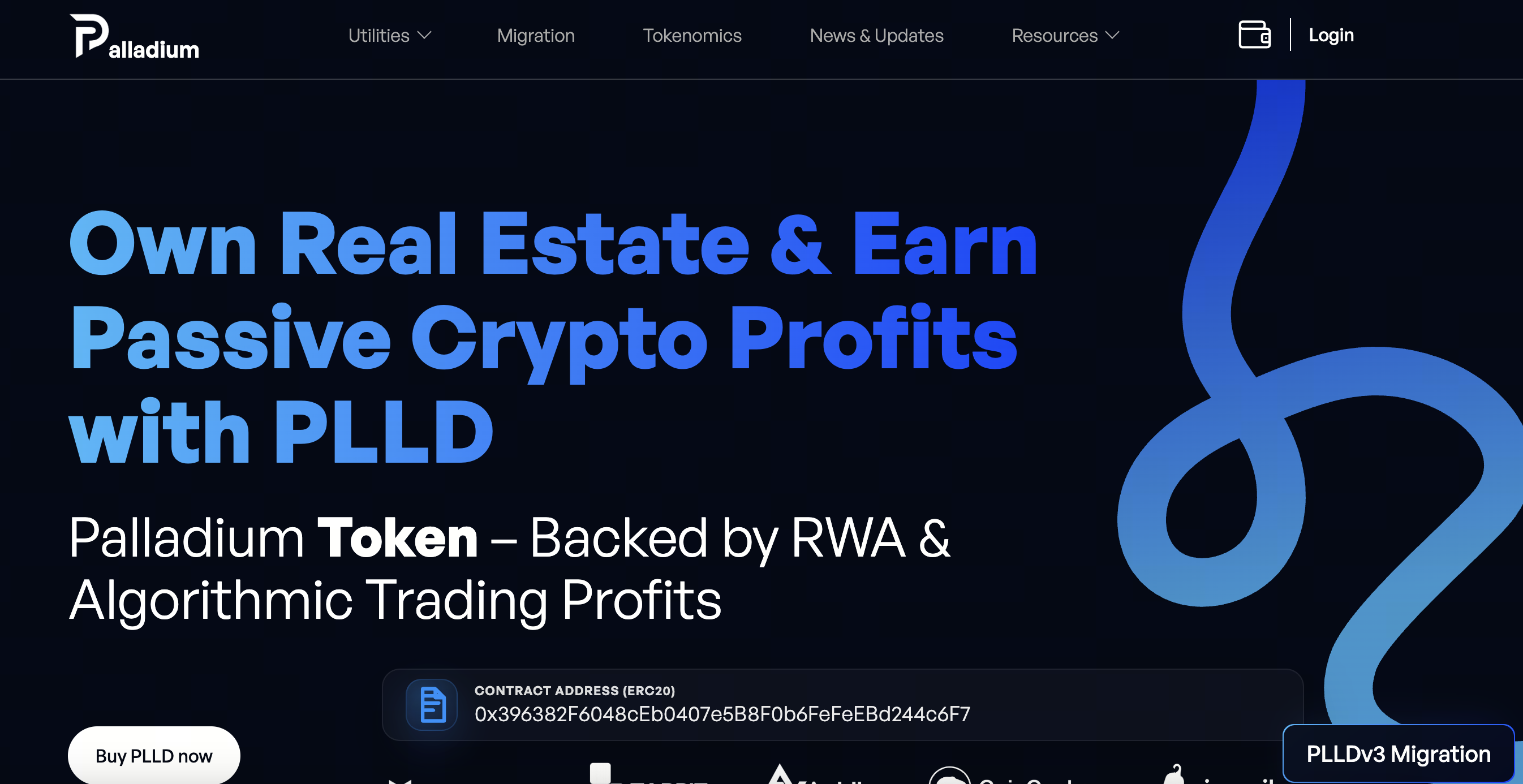
 Source: Palladium Network Official Website
Unlike tokens that rely solely on narrative or short-term liquidity, Palladium Network represents a structural integration of on-chain financial instruments and off-chain productivity. Real estate rental income and appreciation, cross-exchange arbitrage, staking with tiered rights, internal Swap liquidity, and treasury buybacks form a multi-module closed loop, rather than using RWA merely as a marketing label.
From an industry evolution perspective, Palladium Network embodies the convergence of RWA, DeFi automated strategies, and deflationary token design during the 2025–2026 period. In 2025, it completed token issuance, five public market buybacks, and launched staking and Swap; 2026 is the expansion year, advancing real estate RWA NFTs and income distribution, with the PLLDv2 to PLLDv3 migration completed in May 2026. The following sections sequentially outline the project's context, technical architecture, token utility, ecosystem scenarios, competitive differentiation, investment risks, and future potential, enabling systematic understanding and independent evaluation of participation value.
What Is PLLD? Project Background and Development History
PLLD is the native utility token of Palladium Network, an ERC-20 asset deployed on Ethereum. The project integrates RWA (Real World Assets) tokenization, automated arbitrage trading, and on-chain incentives into a unified Web3 ecosystem, rather than a single DEX or meme-type asset.
According to the official Litepaper (v1.2, November 2025), the motivation stems from the complementarity of two market categories: crypto offers high liquidity but high volatility; real estate provides stable income but high barriers and geographic constraints. Palladium uses SPVs (Special Purpose Vehicles) to hold properties, issues Real Estate NFTs representing shares, and operates an automated engine covering 15+ exchanges, using a portion of profits for PLLD buybacks and burns.
Development History: 2025 was the "Infrastructure Year" — completing TGE, scaling trading, launching staking, Ethereum Swap, and five public market buybacks; 2026 is the "Expansion Year" — acquiring RWA properties, NFT pre-sale and on-chain issuance, distributing property income to holders, planning a new round of burns; in May 2026, the official migration from PLLDv2 to PLLDv3 was completed, with the current contract at 0x396382F6048cEb0407e5B8F0b6FeFeEBd244c6F7 (v2 deprecated).
PLLD's genesis supply was 100 million tokens, with approximately 47.357 million burned, leaving a circulating supply of about 52.64 million tokens, and a long-term supply cap of 30 million. Third-party data shows that in early 2026, market cap reached a high, then corrected with the broader market — on-chain data and official narratives should be independently verified against the then-current liquidity environment.
Core Positioning and Objectives of Palladium Network
Core Positioning: "RWA Yield Anchoring + Algorithmic Trading Cash Flows + Deflationary Token Coordination."
The value anchoring layer maps rental income and appreciation to NFT shares through due diligence and SPVs; the cash flow layer captures cross-CEX/DEX spreads via standard and triangular arbitrage, with profits flowing into the treasury; the token layer uses PLLD for Swap, staking, referral incentives, tiered holder rights, and supply management via buyback/burn. In the mid-to-long term, the official roadmap mentions exploring a proprietary chain and cross-chain bridges; currently verifiable deliveries remain concentrated on Ethereum Swap, staking, and RWA NFTs.
PLLD Tokenomics and Utility
Post-burn supply structure: Liquidity and public sale shares saw the largest reduction due to early burns; development, team, treasury, and marketing categories are released via Sablier streams with lock-up and linear vesting, with development share increasing proportionally after burns. Official examples show team and advisors, and treasury each account for approximately 19%, marketing about 14.72%, and liquidity plus public sale combined below 10% — meaning the circulating supply structure heavily depends on subsequent unlock schedules and buyback intensity. The buyback mechanism uses trading profits to purchase PLLD at randomized intervals to mitigate front-running, with quarterly disclosures claimed; burns are sent to the Ethereum Null address, planned at least annually until circulation approaches 30 million. In 2025, the project announced multiple rounds of public market buybacks, and the 2026 roadmap also lists burns as a key action for the expansion year.
Primary PLLD utilities:
- Palladium Swap exchange and liquidity;
- Staking and tiered rights;
- Gateway function for real estate NFT subscriptions and income claims;
- Referral incentives. PLLD is not an equity certificate and does not automatically confer legal ownership of SPV underlying properties; rights are defined by contracts, NFT metadata, and off-chain legal documents.
Core Technical Architecture of Palladium Network
Architecture comprises four layers: RWA/NFT Layer (SPV properties + share NFTs) → PLLD Token Layer (ERC-20 v3 + Sablier unlocks) → Trading Engine Layer (cross-exchange standard arbitrage and triangular arbitrage) → Application Layer (Swap, staking, migration UI, NFT platform).
The PLLDv3 upgrade in May 2026 optimized contract architecture and RWA/staking compatibility; only the official migration tool should be used to exchange v2, and users should beware of DEX counterfeit tokens (official warning in March 2026). The trading engine relies on real-time market data and low-latency execution; property compliance depends on SPV liability isolation. The Palladium NFT platform has announced via official channels that related capabilities will be released around May 29, 2026.
Ecosystem Application Scenarios of Palladium Network
- Staking: Lock PLLD to earn rewards; v2 staking can be unlocked and migrated to v3.
- Swap: Exchange PLLD with other assets on Ethereum.
- RWA NFTs: 2026 roadmap includes pre-sale → on-chain issuance → distribution of property income, suitable for real estate exposure tolerant of on-chain settlement cycles.
- Indirect Benefit: Holders benefit indirectly from buyback/burns through arbitrage profits.
- Referral Growth: Commission-based incentives require attention to regulatory boundaries in each jurisdiction.
Differences Between Palladium Network and Similar Projects
Compared to institutional RWA infrastructure projects like Ondo and Centrifuge, Palladium emphasizes a proprietary arbitrage engine + token deflation internal cycle, with user entry points closer to holding, staking, and Swap, rather than solely serving as on-chain credit or fund channels; compared to pure arbitrage or market-making DAOs, it attempts to use real estate cash flows to dilute pure crypto beta, reducing ecosystem sensitivity to single crypto cycles. The token side integrates buybacks, burns, and staking tiers simultaneously, with more modules than single-narrative projects, but also more dependent on the synchronization of RWA execution pace, engine transparency, and buyback sustainability. For researchers, assessing whether it is "structurally sustainable" hinges not on slogans, but on whether property income is on-chain traceable, trading profits can consistently cover buybacks, and contract permissions are clear and controllable after the PLLDv3 migration.
Risks to Consider When Investing in PLLD
- Market and Liquidity Risk: In a market downturn or insufficient trading depth, burns may not offset selling pressure.
- RWA Execution Risk: Rental rates, legal changes, or SPV governance failures may affect NFT income.
- Strategy Risk: Arbitrage is not guaranteed profit; extreme market conditions or exchange failures can cause drawdowns.
- Contract and Migration Risk: Phishing, counterfeit tokens, incorrect approvals; use only the official PLLDv3 address and migration portal.
- Unlock Selling Pressure: Development, team, and treasury shares are released via Sablier; on-chain data should be tracked.
- Regulatory Risk: Real estate tokenization, securities classification, and referral commissions vary by jurisdiction.
- Transparency Risk: Buyback burns should be self-verified on block explorers; review audits (if any) and contract permissions before participation.
The above does not constitute investment advice.
Future Development Direction and Market Potential of Palladium Network
Short-term 2026: Closed-loop RWA NFT income distribution, execute burns, expand property portfolio, complete PLLDv3 integration on exchanges and wallets. Medium-term: Enhance Swap interoperability, NFT secondary liquidity, and strategy diversification. Long-term: Explore proprietary chain and cross-chain bridges, making PLLD a broader RWA + quantitative yield settlement unit.
If global RWA scale continues to grow and the project verifiably delivers property income and buybacks, PLLD may attract allocation demand within a "utility + deflation" framework; if real estate progress lags or profits decline, the price may reflect speculative liquidity more. Macro interest rates, Gas costs, regulations, and competitive pace are all external variables. Notably, Palladium Network reached its one-year milestone around March 2026 and has continued releasing updates on buybacks, legal progress, and NFT platform schedules via press releases — these public disclosures can serve as windows to track execution, but still require cross-referencing with on-chain data, avoiding equating marketing cadence with fundamental improvement.
Summary
Palladium Network (PLLD) stitches real estate RWA, automated arbitrage, and ERC-20 economics on Ethereum: SPVs and NFTs anchor value, the trading engine provides cash flows, and buyback/burns and staking coordinate the token layer. 2025 laid the infrastructure, 2026 advances RWA NFTs and PLLDv3; evaluation should balance on-chain delivery evidence with multi-dimensional risks. As the market shifts from narrative to verifiable cash flows, this project represents an experimental network infrastructure between DeFi and traditional real estate, worthy of study but requiring diligent due diligence.
FAQs
What is PLLD?
The native ERC-20 utility token of Palladium Network on Ethereum, used for Swap, staking, incentives, and RWA NFT-related scenarios.
What is the difference between PLLDv2 and PLLDv3?
v3 is the new contract activated in May 2026, emphasizing architecture upgrades and subsequent RWA/staking compatibility; v2 is deprecated. Wallet users should exchange via the official migration interface; holders on centralized exchanges may have it processed automatically by the platform, but should still confirm announcements.
Supply and burn target?
Genesis supply of 100 million; approximately 47.357 million burned, circulating about 52.64 million; long-term target of 30 million.
How do real estate NFTs generate income?
SPVs hold properties, NFTs represent shares; after on-chain issuance, rental and other income are distributed according to the official roadmap (frequency and currency as per product specifications).
How to verify buybacks and burns?
Burn transactions should be visible on Etherscan and other explorers as deposits to the Null address; buyback scale should be cross-verified using official quarterly disclosures and on-chain/exchange records.







