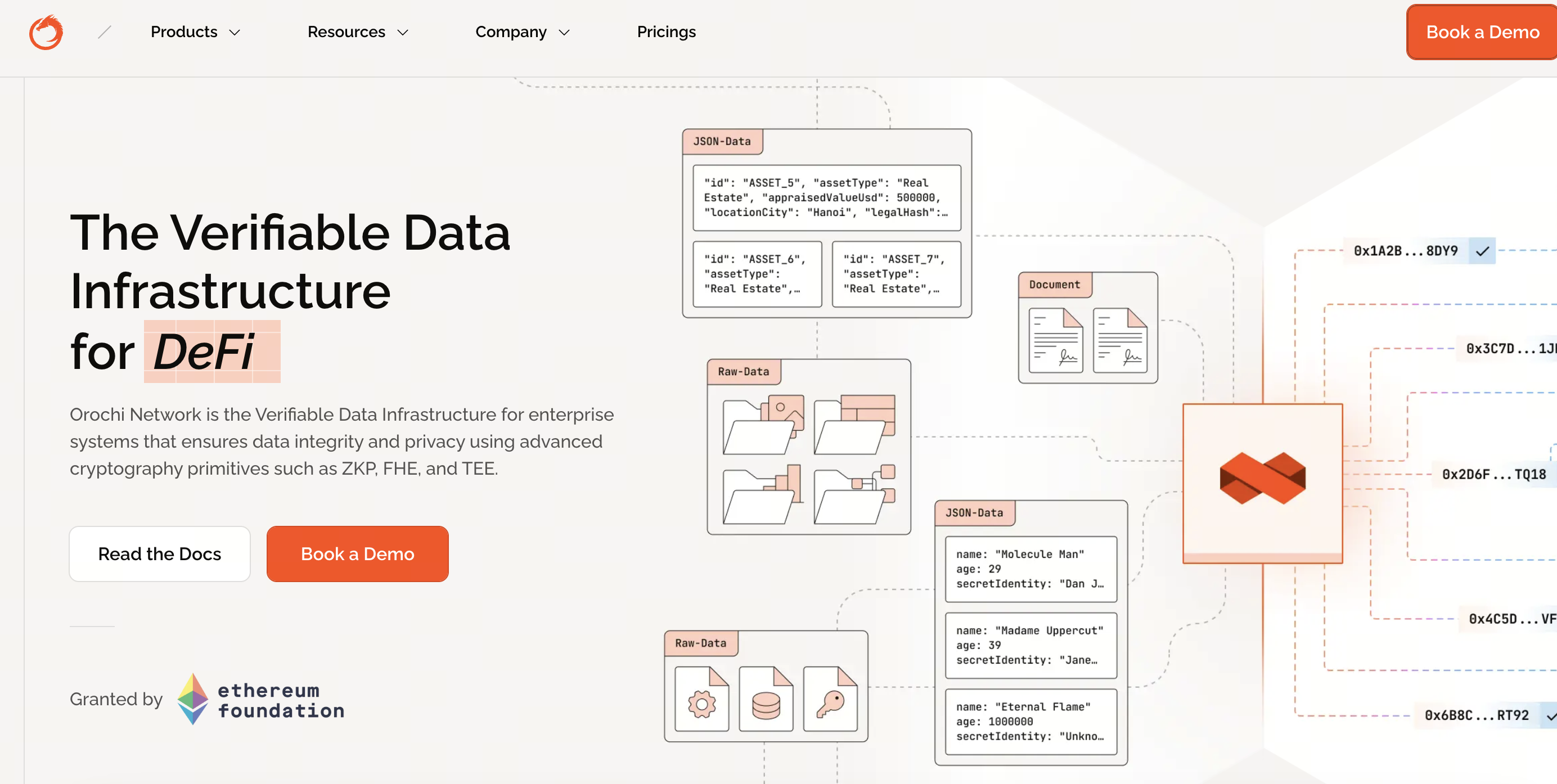
As DeFi, RWA, and on-chain finance continue to scale, demand for trusted data infrastructure is surging. Traditional oracles mainly act as data transmission layers, but they fall short in complex computation, data storage, privacy protection, and proof generation. Orochi Network’s VDI concept aims to unify data acquisition, computation, storage, and proof into a single architecture, allowing on-chain applications not only to fetch data but also to verify its origin and processing—boosting trust across the Web3 ecosystem.
From an industry perspective, verifiable data networks are emerging as a critical direction for blockchain infrastructure. Whether for stablecoin reserve attestations, RWA on-chain asset verification, or trusted data feeds for AI agents, a secure, verifiable, and privacy-preserving data layer is essential. Orochi Network’s zero-knowledge data infrastructure is a key exploration in this evolution toward trustworthy Web3 data.
What Is Orochi Network (ON)? Background and Milestones
Orochi Network was founded within the Asian developer community, initially focusing on zero-knowledge proof technology and cryptographic infrastructure. It has since grown into a complete data network encompassing data acquisition, computation verification, and privacy protection.
In the Web3 ecosystem, most applications rely on external data, including:
- Token prices
- Stablecoin reserve data
- Stock and gold prices
- RWA asset information
- AI model training data
- Cross-chain state data
However, this data often originates from centralized servers, making it hard for users to verify authenticity. Even when oracles upload data on-chain, they cannot fully prove the processing hasn’t been tampered with. That’s why Orochi Network introduced the concept of Verifiable Data Infrastructure (VDI), aiming to make "data trustworthiness" a default property through cryptographic proofs.
With the rapid growth of RWA, AI, and stablecoin markets in recent years, Orochi Network’s technology has attracted increasing attention, and the ON token has become a core part of its ecosystem.
ON Tokenomics and Ecosystem Incentives
ON is the native token of Orochi Network, serving the following functions:
1. Network Fees
Users pay ON to use zkDatabase, Orocle, and Orand services. Examples: querying on-chain proofs; requesting random numbers; performing ZK proof computations; storing verifiable data.
2. Node Rewards
Validation nodes earn ON by: generating ZK proofs; providing data services; verifying computation results; maintaining data states.
3. Governance
ON holders can vote on: network upgrade proposals; parameter adjustments; ecosystem fund management; new product launches.
4. Ecosystem Incentives
Developers building: DeFi apps; AI agents; RWA protocols; stablecoin projects; can receive ON rewards through ecosystem programs.
How Orochi Network Builds Verifiable Data Infrastructure (VDI)
VDI is Orochi Network’s core concept. Its goal is not just to feed data to blockchains but to create a trustworthy data system where every step—acquisition, storage, computation, and verification—can be publicly proven.
In traditional Web3 data architecture, oracles primarily transmit off-chain data on-chain. For example, price feeds, asset reserve data, or macroeconomic indicators are collected by oracle networks and supplied to DeFi protocols. But key questions remain for users: Where did the data come from? Was it altered in transit? Are the computation results reliable? These rely on third-party trust or node reputation.
Orochi Network aims to replace this trust-dependent model with cryptographic verifiability. In the Orochi architecture, data is first collected from various sources and stored in zkDatabase. Unlike traditional databases, zkDatabase not only stores states but also generates zero-knowledge proofs (ZKPs) to attest to data integrity and authenticity. The network then verifies and processes the data, preserving the proof results. When DeFi, RWA, or AI apps need this data, Orocle supplies verified results along with cryptographic proofs. Applications can then verify the data’s source, computation, and current state, reducing reliance on centralized providers.
Orochi Network aims to build more than just an oracle network—it’s creating a full chain of trust: Data Acquisition → zkDatabase Storage → ZKP Generation → Orocle Provides Verified Data → DApp Consumption
In this flow, the data’s origin, storage state, computation process, and final output can all be cryptographically verified without depending on any single institution.
For on-chain finance, this is transformative. Whether for stablecoin reserve attestations, RWA asset mapping, or real-time data for AI agents, a verifiable data infrastructure enhances transparency, reduces information asymmetry risks, and provides a trusted foundation for more complex on-chain financial applications.
How zkDatabase, Orocle, and Orand Work
Orochi Network’s core products consist of three components.
zkDatabase
zkDatabase is a verifiable database. Traditional databases are efficient, but users can’t confirm: whether data has been modified; whether query results are accurate; whether admins have superuser privileges. zkDatabase uses zero-knowledge proofs to generate data proofs. Users not only get results but also receive:
- data authenticity proofs;
- query process proofs;
- state integrity proofs.
This transforms databases from "trusted third parties" to "cryptographically trustworthy."
Orocle
Orocle is Orochi’s oracle network. Unlike traditional oracles, it provides: data source proofs; aggregation algorithm proofs; data update timestamp proofs; computation process proofs. For example, the ETH/USD price comes with a proof showing how it was derived and which nodes contributed.
Orand
Orand is a verifiable random function (VRF) service. Many Web3 apps need random numbers: GameFi; NFT raffles; on-chain lotteries; AI agents; DAO governance. Traditional RNGs can be manipulated. Orand uses cryptographic proofs to ensure randomness is unpredictable, tamper-proof, and publicly verifiable.
How ZKP, FHE, and TEE Secure Data
Orochi Network’s security stack combines multiple cryptographic approaches.
Zero-Knowledge Proof (ZKP)
ZKP allows proving "I know the right answer without revealing it." For example, proving a balance exceeds $10,000 without disclosing the exact amount. This is ideal for: KYC; RWA; stablecoin reserve attestations; on-chain identity.
Fully Homomorphic Encryption (FHE)
FHE enables computation on encrypted data without decryption. This means: users never expose raw data; AI can train on encrypted data; financial data can be analyzed privately. It opens new doors for privacy-preserving computation.
Trusted Execution Environment (TEE)
TEE is a hardware-based secure enclave. Even if the server is compromised, data remains isolated; private keys stay safe; computations can’t be altered externally.
The combination of ZKP + FHE + TEE lets Orochi balance data trustworthiness with privacy.
Orochi Network Use Cases: RWA, Stablecoins, and On-Chain Finance
RWA
RWA’s biggest challenge: how to trustworthily map off-chain assets on-chain? Examples: government bonds; real estate; gold; fund shares. Orochi provides: asset authenticity proofs; reserve data verification; ownership proofs; real-time state updates.
Stablecoins
The stablecoin market has grown fast, but reserve transparency remains a core issue. With Orochi: reserve assets are verifiable; audit processes become verifiable; asset states update in real time; users don’t need to trust centralized auditors.
On-Chain Finance
DeFi protocols need: interest rates; market prices; liquidation data; risk parameters. Orochi delivers data with proofs, reducing systemic risk from faulty data.
AI Agents
AI agents are emerging as a new Web3 trend, but they require trusted data inputs. Orochi’s zero-knowledge data layer helps AI: verify data authenticity; access on-chain historical data; protect user privacy; validate AI outputs.
Orochi Network vs. Traditional Oracles and Data Infrastructure
Traditional oracles focus on: Getting data on-chain. Orochi Network focuses on: Proving data is trustworthy. Key differences:
| Dimension |
Traditional Oracle |
Orochi Network |
| Data Transmission |
Supported |
Supported |
| Data Source Proof |
Weak |
Supported |
| Verifiable Database |
Not supported |
Supported |
| Zero-Knowledge Proof |
Limited |
Native |
| Privacy Computation |
Limited |
Supported |
| Verifiable Random Numbers |
Partial |
Supported |
| AI Data Support |
Minimal |
Supported |
So Orochi is more than an oracle—it’s a foundational trust infrastructure.
Risks to Consider When Investing in ON
While Orochi Network’s technology direction has gained traction, ON carries certain risks.
Technology Implementation Risk: ZKP, FHE, and verifiable databases are complex; performance optimization, development barriers, and commercialization speed still need time to be validated.
Ecosystem Competition Risk: Several data infrastructure projects exist, including Chainlink, Pyth Network, and RedStone. Orochi must continue expanding its ecosystem and developer adoption. Token price may also be affected by: market cycles; macroeconomic conditions; liquidity changes; ecosystem growth pace.
Orochi Network’s Future Direction and Market Potential
As stablecoins, RWA, and AI agents continue to grow, verifiable data infrastructure is becoming increasingly important. In the coming years, demand for: reserve attestations; on-chain identity; AI data verification; privacy computation; verifiable databases; is expected to rise steadily.
Orochi Network aims to build a trusted data layer for Web3 through: zkDatabase; Orocle; Orand; ZKP + FHE + TEE architecture. If more financial protocols, AI apps, and RWA projects adopt verifiable data networks, Orochi could secure a key position in the next generation of Web3 infrastructure.
Summary
Orochi Network (ON) is a zero-knowledge data network built around Verifiable Data Infrastructure (VDI). By integrating zkDatabase, Orocle, and Orand, it unifies data storage, computation, verification, and privacy protection into a single system. As RWA, stablecoins, AI agents, and on-chain finance expand, trustworthy data is becoming a cornerstone of Web3 infrastructure. Orochi Network is leveraging cryptographic proofs to provide a more secure, transparent, and verifiable data layer for future decentralized applications.
FAQs
1. What does Orochi Network do?
Orochi Network is a Verifiable Data Infrastructure (VDI) that uses zero-knowledge proofs, oracles, and verifiable databases to deliver trusted data services for Web3.
2. What is the ON token used for?
ON is used for network fees, node rewards, ecosystem incentives, and community governance.
3. How does zkDatabase differ from a traditional database?
zkDatabase not only stores data but also generates zero-knowledge proofs to prove data integrity and query authenticity.
4. Is Orocle an oracle?
Yes, but Orocle goes beyond data transmission: it provides cryptographic proofs of data sources, computation processes, and results.
5. What are the main use cases of Orochi Network?
Currently, it’s used in RWA, stablecoins, DeFi, AI agents, on-chain identity, and privacy computation.







