The expansion of new energy vehicles, energy storage systems, and AI data centers continues to drive global battery demand. As lithium is a critical raw material for lithium-ion batteries, lithium miners, battery manufacturers, and new energy supply chain companies have become key targets in capital markets.
From an industry structure perspective, what LIT represents represents more than just a new energy ETF—it reflects the long-term demand logic of the global energy transition for lithium resources and the battery supply chain. As the EV market expands, the importance of the lithium battery supply chain continues to grow.
What Is the LIT (Global X Lithium & Battery Tech ETF)?
LIT's core positioning is to track the market performance of companies across the global lithium battery supply chain. Unlike individual stocks, LIT uses an ETF structure to cover multiple segments: lithium mining, battery materials, battery manufacturing, and the broader new energy ecosystem.
Structurally, LIT functions as a "new energy supply chain ETF." Its holdings include not only lithium resource companies but also battery manufacturers and new energy materials firms.
This structure means LIT's volatility is driven not just by lithium prices, but also by EV market trends, battery demand, and shifts in global energy policy.
LIT's market logic essentially reflects the global new energy industry's reliance on lithium resources and energy storage systems.
Why Does LIT Focus on Lithium Batteries and the New Energy Supply Chain?
LIT zeroes in on the lithium battery supply chain because lithium batteries have become a cornerstone of the new energy industry. From EVs and energy storage to mobile electronics, lithium batteries are a core energy component.
Traditional energy systems have long depended on oil and fossil fuels, while the new energy market prioritizes electric storage and battery systems. As a result, lithium has emerged as a critical industrial raw material in the new energy era.
From an industry perspective, growth in EV sales typically drives battery demand. As battery demand rises, lithium mining, material processing, and battery manufacturing all benefit in tandem.
This interconnected dynamic has forged a complete market ecosystem around the lithium supply chain, and LIT seeks to capture its evolution through an ETF structure.
How Is LIT's Holdings Structure Built?
LIT's holdings are typically organized around lithium resources and the lithium battery supply chain. Compared to traditional index ETFs, LIT emphasizes thematic focus and supply chain coverage.
First, LIT allocates to lithium miners, which handle resource extraction and raw material supply. It then covers battery material processors and battery manufacturers. Some EV supply chain companies may also be included in the portfolio.
The table below shows LIT's typical supply chain structure:
| Supply Chain Segment |
Primary Function |
| Lithium Miners |
Supply lithium resources |
| Material Companies |
Process battery materials |
| Battery Manufacturers |
Produce lithium batteries |
| New Energy Companies |
Deploy battery systems |
This structure means LIT does not simply track lithium prices—it reflects changes across the entire lithium battery supply chain.
What Role Do Lithium Resource Companies Play in LIT?
Lithium resource companies are a core component of LIT, as lithium is essential for lithium battery production. As the EV and energy storage markets expand, demand for lithium typically grows in lockstep.
Lithium miners operate by extracting, refining, and supplying lithium. When lithium prices rise, their profitability often improves significantly, making their stocks a key driver of LIT's volatility.
From a supply chain standpoint, lithium resources sit at the upstream end. Battery manufacturers require a stable lithium supply, so the lithium mining market directly affects the cost structure of the entire new energy supply chain.
This mechanism means that global lithium supply-demand dynamics have a direct impact on LIT's market performance.
How Do Battery Manufacturers Affect LIT Volatility?
Battery manufacturers are another major component of LIT. Unlike lithium miners, which are more sensitive to resource prices, battery makers focus on technology, production scale, and downstream customer demand.
As the EV market grows, automakers need large volumes of lithium batteries, creating a strong link between battery company revenues and industry demand.
At the same time, the energy storage market also boosts battery demand. Large-scale storage systems, home batteries, and renewable energy grids all depend on lithium batteries for energy storage.
This structure means LIT's volatility stems not only from lithium prices but also from global battery demand and the pace of new energy market expansion.
The EV market is a key factor driving LIT volatility. EV production is heavily dependent on lithium batteries, so rising EV sales typically boost demand for lithium resources and the battery supply chain.
In the industry flow, EV makers procure power batteries, which require large amounts of lithium and battery materials. Changes in EV sales thus ripple through profit expectations across the entire supply chain.
Global energy transition policies also shape the EV market. As more countries push for EV adoption, demand for lithium and battery supply chains expands accordingly.
This linkage makes the EV market a critical variable for LIT's performance.
How Is LIT Different from Traditional New Energy ETFs?
The key difference lies in industry focus. Traditional new energy ETFs typically cover solar, wind, power grids, and new energy equipment, while LIT concentrates on the lithium battery supply chain.
From an industry perspective, traditional ETFs resemble "comprehensive energy transition ETFs." In contrast, LIT is narrower, focusing on lithium resources, battery materials, and energy storage.
LIT is also more sensitive to lithium prices and the EV market. Changes in lithium supply and demand directly affect supply chain profitability and market expectations.
This higher concentration means LIT tends to be more volatile than broad-based new energy ETFs.
LIT, listed on the US market, can be traded through platforms that support US stocks. Traditionally, users need an offshore securities account to access US ETF markets.
Recently, some regions have tightened cross-border securities regulations, and certain online brokers have adjusted their US stock services. As a result, more users are exploring alternatives to ETFs.
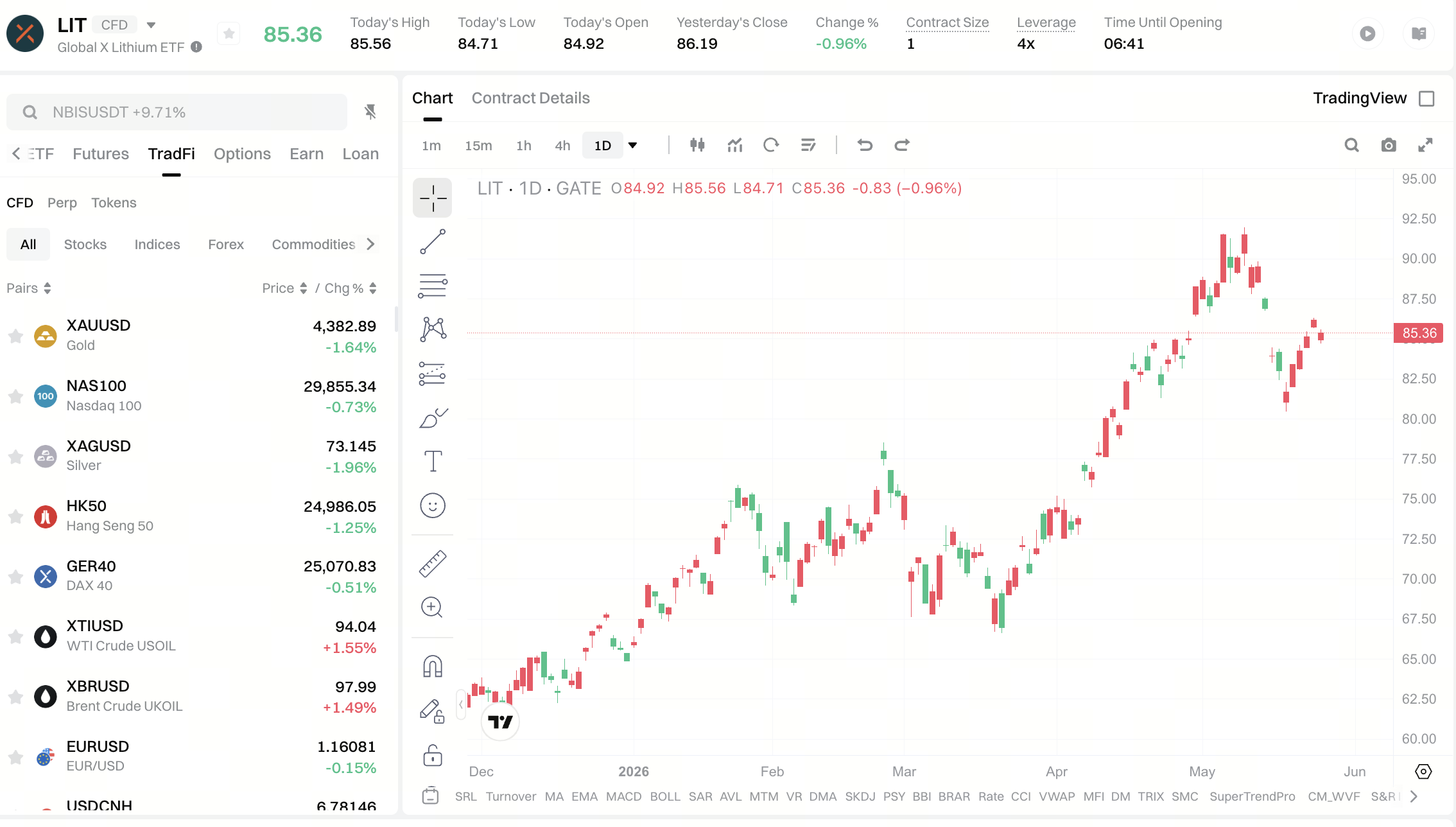
Beyond traditional securities trading, some platforms now offer CFD products or on-chain assets tied to US ETFs. CFDs track ETF volatility through price contracts rather than direct ownership.
Digital asset platforms are also expanding into traditional finance. For instance, Gate CFD now covers global assets including ETFs, letting users monitor both digital assets and offshore market prices in one place.
Before trading LIT or related ETF products, users should consider:
- Platform compliance scope
- Differences between ETFs and CFDs
- Leverage risk
- Liquidity
- Regional regulatory restrictions
Rules for ETFs, derivatives, and cross-border securities vary by region, so available services may differ.
What Are the Advantages and Risks of LIT?
LIT's main advantage is covering lithium resources, battery manufacturing, and the new energy supply chain through a single ETF. Compared to single-stock investments, ETFs reduce individual stock volatility risk.
LIT also serves as a barometer for the entire new energy supply chain. EV sales, lithium prices, and energy storage trends all influence its performance.
However, LIT's high industry concentration is a risk. If lithium prices fall, EV demand slows, or battery competition intensifies, the profitability of portfolio companies may suffer.
Moreover, the new energy sector is inherently volatile, so LIT's fluctuations tend to be larger than those of traditional broad-based ETFs.
Summary
The LIT (Global X Lithium & Battery Tech ETF) is a thematic ETF focused on lithium resources, battery manufacturing, and the new energy supply chain. Its performance is driven by lithium prices, EV sales, and global energy transition trends.
Compared to traditional new energy ETFs, LIT zeroes in on the lithium battery supply chain and energy storage, making it more sensitive to changes in the EV and battery markets.
As the new energy market continues to grow, the importance of lithium resources, battery manufacturing, and energy storage is rising, and LIT has become a key tool for tracking the new energy supply chain.
FAQ
What is the LIT ETF?
LIT is a thematic ETF that invests primarily in lithium resources, battery manufacturing, and new energy supply chain companies, tracking the global lithium battery industry's performance.
Why is LIT affected by the EV Market?
EV production requires large quantities of power batteries, which depend on lithium. Therefore, higher EV sales drive demand across the lithium supply chain.
What's the difference between LIT and regular new energy ETFs?
LIT focuses on lithium and the battery supply chain, while regular new energy ETFs cover broader areas like solar, wind, power grids, and new energy equipment.
Does LIT directly invest in lithium miners?
Yes, LIT typically holds shares in lithium mining companies, as lithium is a key raw material for the battery supply chain.
How can I buy the LIT ETF?
LIT can be purchased through platforms that support US stock trading. Some platforms also offer ETF CFDs or derivatives, though regulatory rules vary by region.