In the traditional internet landscape, data is typically centralized on major platforms, leaving users with minimal control and limited opportunities to benefit from their data. This structure perpetuates longstanding challenges related to data security, privacy, and value distribution. Jasmy aims to address these issues by leveraging blockchain and IoT technology to return data ownership to individuals.
This subject generally covers Jasmy’s approach to data sovereignty, tokenomics, data management, application scenarios, and differentiation from other data-focused projects—together forming Jasmy’s comprehensive architecture.
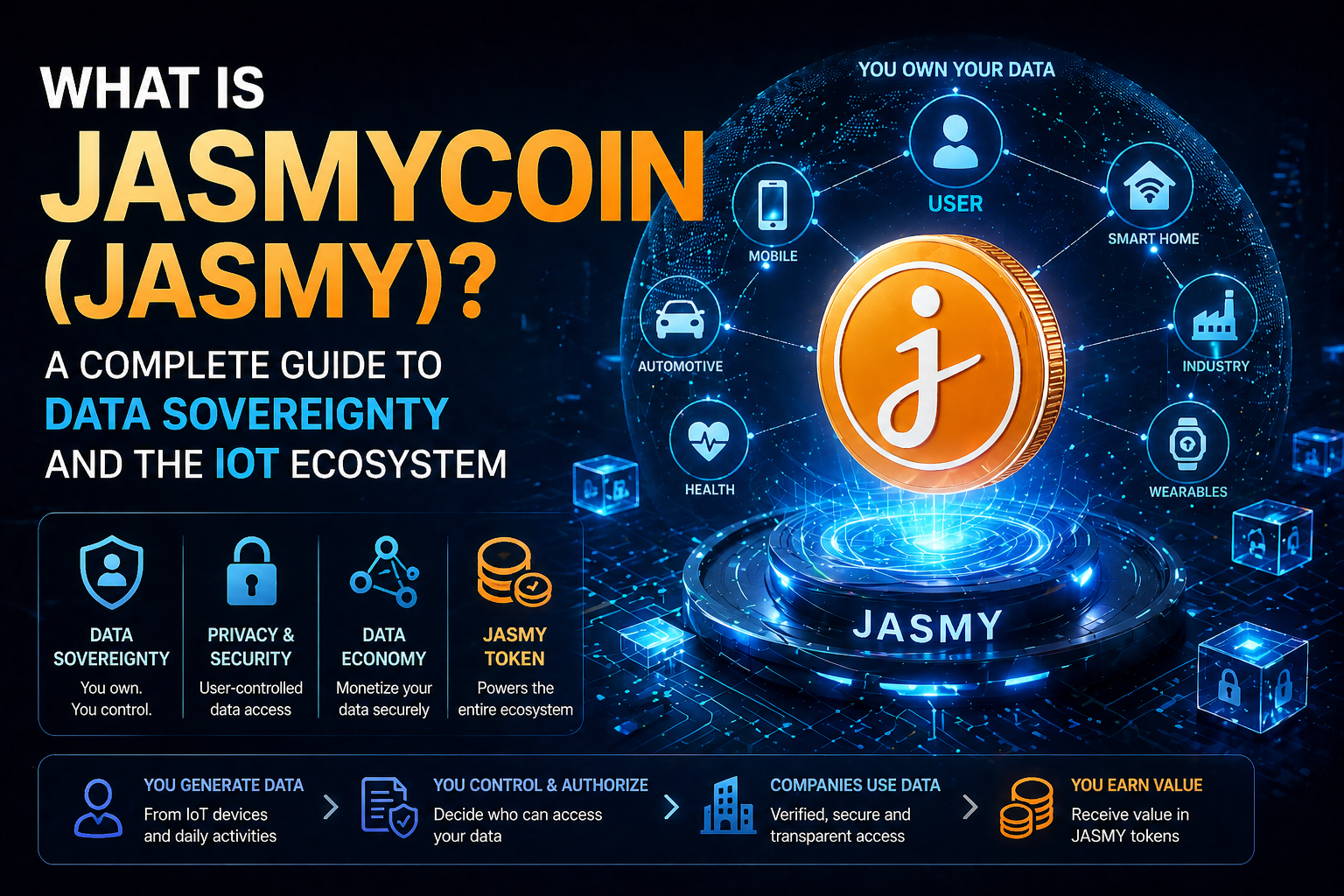
JasmyCoin’s Role in Blockchain and the Data Economy
JasmyCoin serves as a blockchain platform focused on data sovereignty and data transactions, with the goal of building a user-centric data economy.
Essentially, Jasmy acts as an infrastructure that converts personal data into a manageable asset class, giving users control over data access and sharing decisions. Unlike traditional centralized platforms, Jasmy places data ownership in the hands of users.
Functionally, Jasmy leverages blockchain to record data access and authorization, ensuring transparency and traceability. Data generated by IoT devices can be collected and managed by users, then accessed by enterprises only through explicit authorization.
This framework positions Jasmy as core infrastructure for the data economy, bridging data generation, storage, and exchange.
How Jasmy’s Data Sovereignty Mechanism Works
Jasmy’s data sovereignty mechanism is built around user control, with system architecture ensuring that data belongs to individuals.
Jasmy empowers users as the true custodians of their data through personal storage and authorization protocols. Users determine whether their data is accessed and by whom, thereby asserting data sovereignty.
From a structural perspective, Jasmy integrates storage and authorization modules. Data is securely stored under user control, and enterprises must obtain authorization to access it. This design eliminates direct platform control over user data.
The result is a paradigm shift: data moves from being a “platform asset” to a “user asset,” laying the foundation for peer-to-peer data transactions.
The Role and Utility of the JASMY Token
The JASMY token is the central economic instrument in the Jasmy ecosystem, connecting data providers and consumers.
JASMY is used for paying data access fees, incentivizing users to share data, and supporting overall ecosystem operations. When users authorize data sharing, they receive token rewards; enterprises must pay tokens to access data.
The token serves dual purposes: enabling payments for data transactions and providing incentives for user participation, establishing dynamic supply and demand.
This design makes JASMY the underlying value conduit in the data economy, enabling the monetization of data exchange.
How Personal Data Is Managed and Authorized in Jasmy
Jasmy’s data management and authorization system centers on user control.
User data is collected and stored in a secure, user-controlled environment. When enterprises seek access, they must obtain explicit authorization via a formal process.
The authorization mechanism ensures only approved parties can access data, and all activity is recorded on the blockchain for full transparency and immutability.
This approach makes data usage both controllable and auditable, giving users clear insight into how their data is utilized.
Key Use Cases and Applications for Jasmy
Jasmy’s primary use cases are in IoT data management and personal data governance.
For IoT devices, users collect and manage data generated by smart devices. On the enterprise side, companies can lawfully access authorized data for analytics and service optimization. Jasmy also supports data-driven identity verification systems.
Users manage and authorize data access via the platform, and enterprises obtain data resources by paying tokens. Blockchain records the entire process, ensuring transparent settlement.
This architecture connects IoT devices, users, and enterprises, creating a robust data circulation network.
How Jasmy Differs from Other Data Infrastructure Projects
Jasmy stands apart from other data infrastructure solutions in terms of data control, system design, and application focus.
| Comparison |
Jasmy |
Ocean Protocol |
| Data Control |
User-Driven |
Data Assetization |
| Core Mechanism |
Authorized Access |
Data Tokenization |
| Architecture Focus |
IoT & Personal Data |
Data Marketplace |
| Usage Model |
Authorized Sharing |
Data Trading |
| Application Focus |
IoT & Personal Data Management |
Data Services & AI |
Jasmy prioritizes user data control, while Ocean emphasizes data asset liquidity and market mechanisms.
As a result, Jasmy functions more as a personal data management infrastructure, whereas Ocean serves as a data trading platform.
Participants and Value Flow in the Jasmy Ecosystem
The Jasmy ecosystem includes data providers (users), data consumers (enterprises), and the platform infrastructure.
Users generate and authorize data to earn rewards, enterprises acquire data by paying tokens, and the platform handles record-keeping, verification, and settlement.
Value exchange revolves around data supply and demand: users contribute data, enterprises pay tokens, and the system matches and records transactions.
This structure transforms data into a tradable asset, enabling value transfer via tokens.
Jasmy’s Strengths and Potential Limitations
Jasmy’s strengths lie in its user-centric data sovereignty model and seamless IoT integration.
By handing data control to users, Jasmy enhances privacy protections and user engagement. Its integration with IoT devices ensures access to authentic, real-world data sources.
However, limitations include the need for proactive user participation in data sharing, dependency on enterprise demand and ecosystem scale for data liquidity, and system complexity that may impact user experience.
These factors collectively influence Jasmy’s real-world adoption and effectiveness.
Summary
JasmyCoin leverages a data sovereignty framework to turn personal data into a manageable and tradable asset. Its core architecture encompasses user data control, tokenomics, IoT applications, and value circulation among ecosystem participants. Through this design, Jasmy seeks to establish a user-centric data economy.
FAQ
What is JasmyCoin?
JasmyCoin is a blockchain project centered on data sovereignty, empowering users to control and manage their personal data.
What is the function of the JASMY token?
JASMY tokens are used to pay for data access, incentivize data sharing, and support ecosystem operations.
How does Jasmy protect user data?
Jasmy enables users to manage data access permissions and records all usage activity through secure storage and authorization mechanisms.
How does Jasmy differ from Ocean Protocol?
Jasmy focuses on data control for users, while Ocean emphasizes data assetization and marketplace trading.
What are Jasmy’s main use cases?
Key applications include IoT data management, personal data sharing, and enterprise data analytics.







