The use of AI Agents in Web3 initially focused mainly on automated trading bots and data analytics tools. As large language models (LLMs) have become more capable, however, AI has started to handle complex task decomposition, strategic reasoning, and multi-step execution. This has made on-chain finance one of the most important areas for agent-based applications.
As the DeFi ecosystem expands across multiple chains, protocols, and assets, users face growing information complexity and higher operational costs. INFINIT has emerged as one of the representative projects in the Agentic Finance space. Unlike traditional DeFi aggregators, which mainly provide access points to protocols, INFINIT emphasizes a complete loop of “discovery, analysis, and execution,” positioning AI Agents as an important intermediary layer for on-chain financial interactions.
What Is INFINIT?
In the traditional DeFi experience, users often have to handle asset bridging, protocol switching, swaps, lending, and yield management on their own. A complex strategy may involve more than a dozen steps, while also requiring users to continuously monitor interest rates, gas costs, and liquidation risks. This complexity has limited DeFi’s broader adoption.
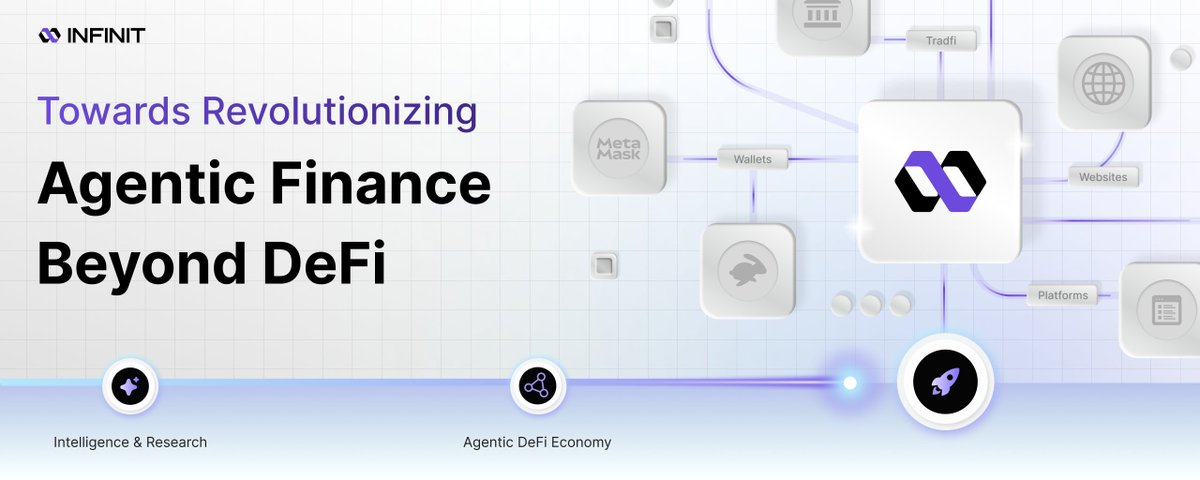
The core idea behind Agentic Finance is to let AI Agents take over part of the financial operation logic on behalf of users. Compared with traditional aggregators, which mainly “aggregate access,” Agentic Finance places greater emphasis on AI’s ability to understand, analyze, and execute. INFINIT is an AI DeFi infrastructure built around this shift.
As a DeFi automation platform centered on AI Agents, INFINIT helps users discover, build, and execute on-chain financial strategies through natural language interaction. Users do not need to manually move across multiple protocols or deeply understand complex smart contract logic. Instead, they can complete multi-step DeFi workflows through prompts.
How INFINIT’s Prompt-to-DeFi Works
Prompt-to-DeFi is one of INFINIT’s core interaction methods. Users can enter natural language directly, such as “find a low-risk stable yield strategy” or “build an ETH leveraged looping position,” and the system will automatically analyze the request and generate the corresponding on-chain execution path.
This process goes far beyond text parsing. The system first identifies the user’s intent, then combines it with real-time on-chain data, protocol status, and yield conditions to reason through and filter possible strategies. After that, the AI Agent automatically breaks down the required steps, including asset conversion, bridging, lending, and liquidity allocation.
INFINIT Agent Swarm Architecture Explained
INFINIT’s underlying system uses an Agent Swarm architecture, where multiple specialized AI Agents work together to complete complex tasks. Different Agents are responsible for protocol analysis, data retrieval, risk validation, transaction execution, and outcome optimization.
Protocol-specific Agents are an important part of this structure. Each Agent focuses on learning the rules and interaction logic of a particular type of DeFi protocol. For example, some Agents specialize in lending protocols, some handle cross-chain bridging, and others are used for yield optimization.
This structure is clearly different from a single AI model. A single model often struggles to manage complex financial reasoning, real-time data updates, and multi-step execution at the same time. An Agent Swarm, by contrast, improves efficiency and accuracy by dividing tasks among specialized Agents.
INFINIT also introduces the ReAct Framework and Agentic RAG mechanism. The former emphasizes a recurring cycle of “reasoning plus action,” while the latter combines real-time on-chain data with protocol information to give Agents dynamic contextual support.
How INFINIT Executes Complex DeFi Strategies
Complex DeFi strategies often involve multiple protocols and on-chain steps. For example, a leveraged looping strategy may include asset bridging, swaps, collateralized borrowing, restaking, yield farming, and several other stages.
In the traditional model, users must complete each step one by one while taking on the risks of operational mistakes, slippage, and gas costs. INFINIT integrates these steps into a single workflow, with AI Agents automatically coordinating the process.
Before execution, the system first simulates the strategy to verify whether the path is feasible and to detect potential risks, including slippage, liquidation risk, and abnormal protocol conditions. Only after validation is complete will the Agent initiate actual on-chain transactions.
INFINIT uses a non-custodial architecture, meaning user assets are not directly controlled by the platform. AI Agents can only execute transactions within the scope authorized by the user, which helps reduce centralized custody risk.
The Role of the IN Token and Its Governance Mechanism
IN is the core token of the INFINIT ecosystem, used across several areas such as governance, ecosystem incentives, and Agent coordination.
At the governance level, IN holders can participate in voting on protocol parameter adjustments, Agent deployment rules, and ecosystem proposals. As the Agentic Finance ecosystem expands, governance is likely to become increasingly important.
IN may also serve an ecosystem incentive function. For example, access to certain Agent services, strategy markets, or advanced features may require IN for payment or access. At the same time, protocol revenue within the ecosystem may also become connected to IN holders.
How INFINIT Differs from Traditional DeFi Aggregators
Traditional DeFi aggregators mainly integrate access to multiple protocols, allowing users to perform different operations from one interface. In most cases, however, users still need to understand the strategy logic and execution sequence themselves.
INFINIT goes one step further. The platform not only aggregates protocols, but also uses AI Agents to automatically generate and execute strategies. User interaction shifts from “manual clicking” to “natural language prompts.”
The core difference between INFINIT and aggregators such as Instadapp lies in whether there is an “intelligent strategy layer.” Traditional aggregators are more like tool platforms, while INFINIT is closer to an AI-driven on-chain financial operating system.
| Comparison Dimension |
INFINIT |
Traditional DeFi Aggregators |
| User Interaction |
Natural language prompts |
Manual operation |
| Strategy Generation |
Automatically generated by AI |
Designed by users themselves |
| Multi-Step Execution |
Automatically coordinated |
Completed step by step by users |
| AI Capability |
Multi-agent collaboration |
Usually absent |
| Data Processing |
Real-time dynamic analysis |
Static protocol aggregation |
| Level of Automation |
Relatively high |
Moderate |
Potential Use Cases for INFINIT
As AI and on-chain finance continue to converge, INFINIT’s use cases are also expanding.
For individual users, the platform can be used for yield aggregation, leveraged looping, cross-chain asset management, and automated strategy execution. Compared with traditional DeFi operations, its advantage lies in reducing complexity and lowering the barrier to entry.
For professional users and institutions, Agentic Finance may further expand into automated asset allocation, risk management, and quantitative strategy execution. In the future, AI Agents may become important infrastructure for on-chain finance.
In addition, as cross-chain ecosystems and modular blockchains develop, the coordination capabilities of AI Agents in multi-chain environments may become a new area of competition.
Conclusion
As one of the representative projects in the convergence of AI Agents and DeFi, INFINIT’s core goal is to reduce the complexity of on-chain financial operations through natural language interaction and a multi-agent collaboration system.
Compared with traditional DeFi aggregators, INFINIT places greater emphasis on AI’s role in understanding, generating, and executing strategies. The platform does more than aggregate protocol access. It is also trying to build an AI-driven operational layer for on-chain finance.
FAQs
What Does INFINIT’s Prompt-to-DeFi Mean?
Prompt-to-DeFi refers to an interaction method where users enter their needs in natural language, and AI automatically generates and executes the corresponding DeFi strategy.
Does INFINIT Custody User Assets?
INFINIT uses a non-custodial architecture. User assets always remain in their own wallets, and the platform does not directly control user funds.
How Is INFINIT Different from Traditional DeFi Aggregators?
Traditional aggregators mainly integrate protocol access points, while INFINIT places greater emphasis on AI Agents automatically generating, analyzing, and executing complex DeFi strategies.
What Is the IN Token Used For?
IN is mainly used for governance, ecosystem incentives, Agent coordination, and access to certain protocol functions.
What Is Agentic Finance?
Agentic Finance refers to a new financial model in which AI Agents participate in on-chain financial activities, using automated reasoning and execution to help users complete complex DeFi operations.