The significance of the CORE token lies in Core DAO's need to simultaneously coordinate EVM smart contracts, the validator system, and Bitcoin ecosystem participants. Traditional Bitcoin networks lack native on-chain governance and smart contract incentive structures, so Core DAO leverages CORE to establish an integrated on-chain economic system and governance logic.
CORE's operational mechanism encompasses Gas payments, DPoS validator delegation, governance participation, reward distribution, and BTCFi ecosystem coordination. These modules collectively form the on-chain economic architecture of Core DAO.
What Is the CORE Token?
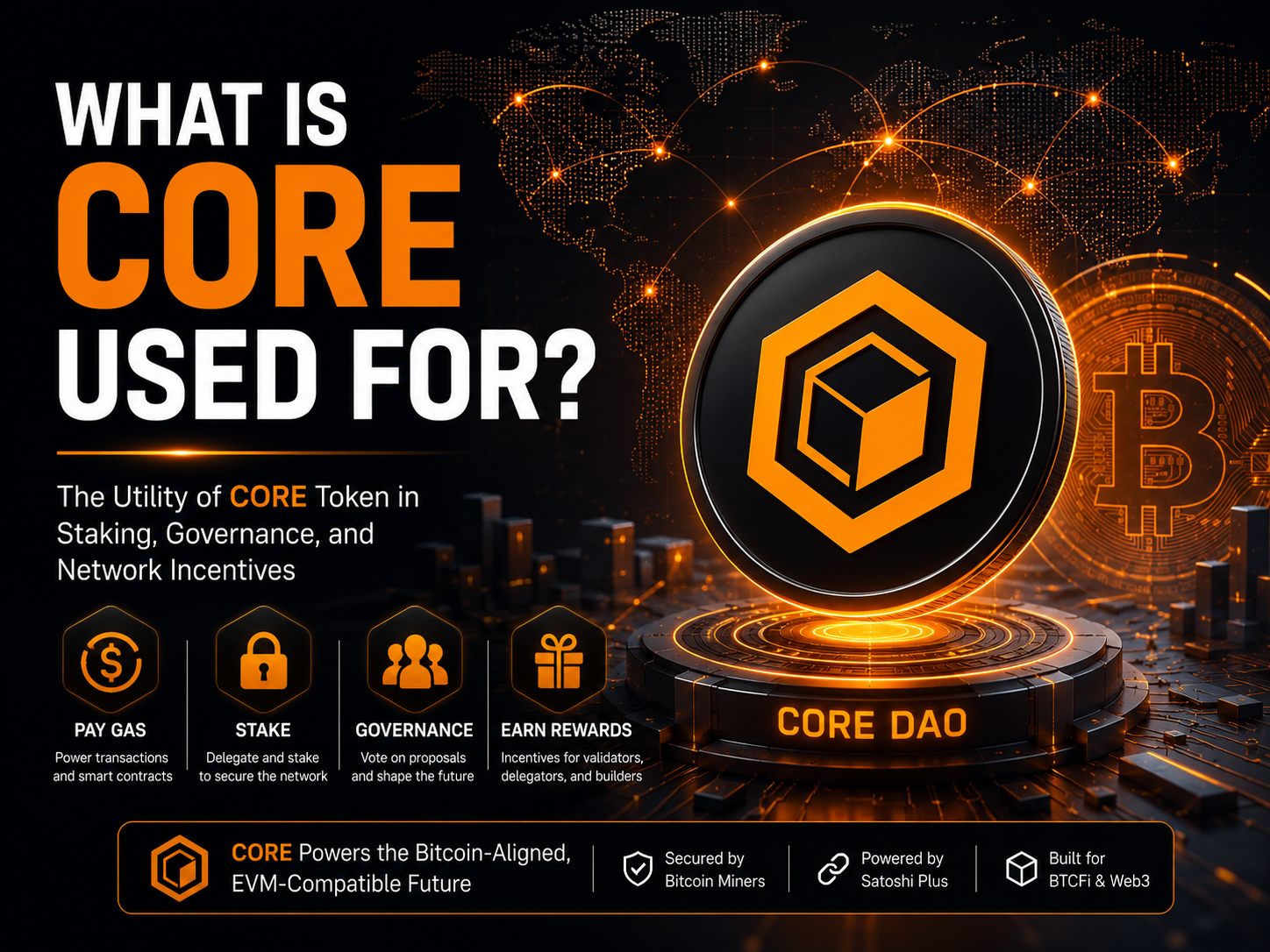
CORE is the native token of the Core DAO network, designed to sustain network operations and on-chain incentives.
Structurally, CORE's positioning resembles that of traditional Layer 1 blockchain tokens, but its network logic is uniquely intertwined with Bitcoin miners, BTC staking, and the Satoshi Plus consensus.
CORE's core functions include:
-
Paying network Gas
-
Enabling validator delegation
-
Supporting on-chain governance
-
Distributing network rewards
Core DAO's network security does not depend on a single token. The Satoshi Plus consensus incorporates Bitcoin miner participation, BTC staking, and a DPoS structure, positioning CORE more as a governance and coordination resource than a sole security asset.
This mechanism implies that CORE functions not only as a medium of exchange but also as a security and governance asset within Core DAO.
How Is CORE Used for Network Fees?
CORE's most fundamental use on the Core network is to pay fees for on-chain transactions and smart contract execution.
Core DAO is EVM-compatible, so its Gas structure mirrors that of Ethereum. Users must pay network fees in CORE when sending transactions or interacting with smart contracts on the Core network.
The Gas flow for CORE begins when a user initiates an on-chain transaction. Core nodes then calculate the resources required to execute that transaction. Validators order transactions based on Gas fees, and CORE ultimately enters the network verification system as a trading fee.
The table below summarizes CORE's role in network fees:
| Use Case |
CORE Role |
Network Impact |
| Transfer Transactions |
Pay Gas |
Maintain network operation |
| Smart Contracts |
Pay Execution Fees |
Support EVM applications |
| DeFi Interactions |
Pay On-Chain Operations |
Drive ecosystem activity |
| Contract Deployment |
Pay Resource Consumption |
Support developer ecosystem |
CORE's Gas mechanism balances resource consumption with network security. Higher transaction complexity typically demands more CORE. This structure ensures that CORE remains actively circulating as Core network activity fluctuates.
How Does CORE Participate in Staking and Validator Elections?
One of CORE's key uses is participating in validator delegation and the network's staking system.
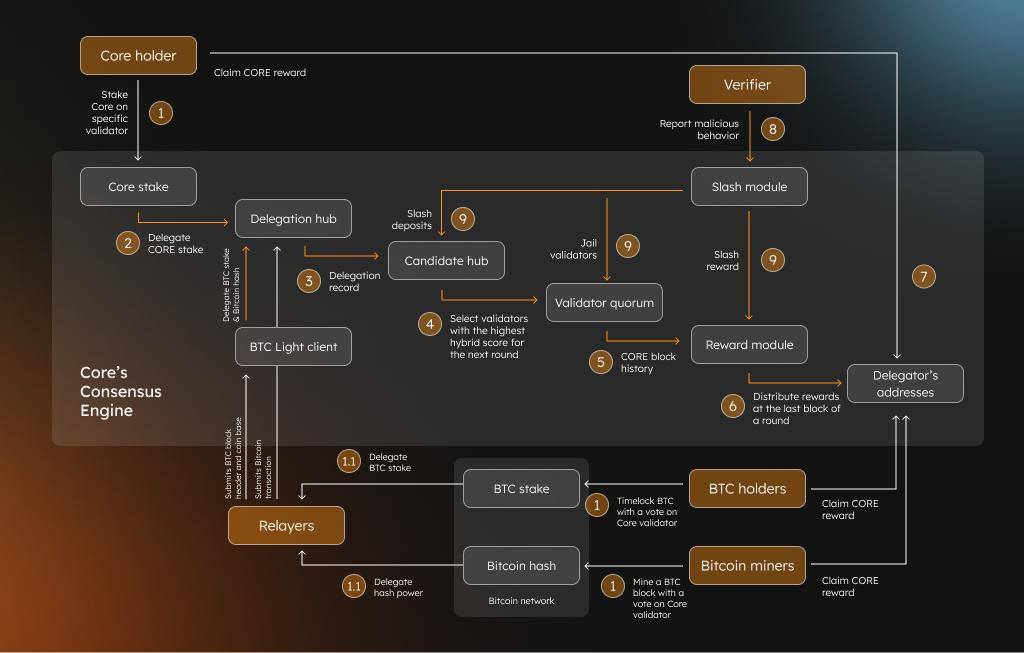
The Satoshi Plus consensus merges DPoS with Bitcoin security, enabling CORE holders to influence validator weight allocation through delegation.
The process of CORE validator participation unfolds as follows: A node applies to become a validator. CORE holders then choose a validator to delegate their tokens to. The network ranks validators based on the delegated amount and consensus rules. Finally, validators produce blocks and verify the network.
Core DAO's staking mechanism differs from traditional PoS blockchains. The Core network also incorporates Bitcoin miner delegation and BTC staking, so CORE is not the sole security resource. This means Core DAO's network security relies on both CORE holders and Bitcoin ecosystem participants working together.
How Does CORE Support Core DAO Governance?
CORE also powers on-chain governance within Core DAO, enabling decisions on network parameters and ecosystem policies.
On-chain governance is critical because Core DAO must align the interests of validators, developers, and ecosystem participants. Traditional Bitcoin governance relies on off-chain consensus, whereas Core DAO adopts a token-based governance model.
CORE's governance process begins when community members submit proposals. CORE holders then vote on-chain. The system tallies the votes, and approved proposals modify network rules or ecosystem parameters.
Governance topics within Core DAO typically include:
-
Network parameters
-
Validation rules
-
Protocol upgrades
-
Ecosystem incentives
This mechanism reinforces that CORE is not merely a utility token but a governance weight resource within Core DAO.
How Does the CORE Reward Mechanism Work?
The CORE reward mechanism aligns incentives among validators, delegators, and Bitcoin ecosystem participants.
Core DAO's reward system is fundamentally tied to network security and block production. Validators must maintain node operations continuously, so the network distributes CORE rewards accordingly.
The reward flow works as follows: Validators complete block verification. The network calculates rewards based on consensus rules. Rewards are then distributed to validators and their delegators. CORE subsequently enters the on-chain circulation system.
Core DAO's reward structure differs from traditional PoS networks because it also incorporates Bitcoin miner delegation and BTC staking, making the incentive model more complex. This design aims to enhance synergy between Bitcoin and EVM networks through a multi-layered participant structure.
What Is the Relationship Between CORE and Bitcoin Ecosystem Participants?
The connection between CORE and Bitcoin ecosystem participants stems from the Satoshi Plus consensus and the BTC staking system.
Core DAO's network architecture allows Bitcoin miners and BTC holders to contribute to network security. CORE bridges these contributions with on-chain governance and reward mechanisms.
The synergy process begins when Bitcoin miners delegate their hashrate. Simultaneously, BTC holders can participate via non-custodial BTC staking. The Core network then calculates validation weight by combining CORE delegation and Bitcoin participation. Finally, CORE participates in reward distribution and governance.
Unlike traditional EVM blockchains, Core DAO emphasizes bringing native Bitcoin participants into the smart contract ecosystem. This structure ties CORE's economic model directly to Bitcoin's network security resources.
What Are the Limitations of the CORE Token Mechanism?
The main limitations of the CORE token mechanism revolve around governance complexity, ecosystem competition, and Bitcoin coordination efficiency.
Core DAO's architecture combines DPoS, Bitcoin miners, and BTC staking, resulting in higher overall complexity than traditional PoS networks.
The limitations stem from multi-layer participant coordination, which can increase network complexity through validation rules and governance structures. Core DAO also faces competition from other BTCFi and EVM blockchains. Ultimately, ecosystem scale will influence CORE's long-term network effects.
Public materials currently explain CORE's network use cases and consensus structure, but some long-term tokenomics data remain undisclosed. Official documentation has not fully revealed the complete token distribution and unlock schedule. As a result, market understanding of CORE's long-term economic structure requires further observation alongside future disclosures.
Summary
CORE is the native token of Core DAO, primarily serving Gas payment, validator delegation, on-chain governance, and network incentive functions.
CORE's mechanism is closely tied to the Satoshi Plus consensus, connecting Bitcoin miners, BTC staking participants, and the EVM smart contract ecosystem.
Core DAO aims to establish an economic coordination mechanism between Bitcoin security and on-chain financial applications through CORE.
FAQ
What does the CORE token do?
CORE is used to pay network Gas, delegate to validators, support on-chain governance, and sustain the Core DAO incentive system.
How can I stake CORE?
CORE holders can delegate their tokens to validator nodes. Validators then use delegated weight to participate in Core network block verification.
What is the relationship between CORE and Bitcoin?
Core DAO combines Bitcoin miner participation, BTC staking, and CORE delegation under the Satoshi Plus consensus, creating a synergy between CORE and Bitcoin's security structure.
Can CORE be used for governance?
Yes, CORE enables participation in Core DAO governance voting. CORE holders can vote on some network proposals and ecosystem rules.
Has Core DAO disclosed its full tokenomics?
Current public materials explain CORE's use cases and network mechanism, but official documents have not fully disclosed the complete long-term token distribution and unlock structure.