Under the MiCA regulatory framework, CASP fulfills a role similar to that of the licensing system for traditional financial institutions. Whether it is a cryptocurrency exchange, custody platform, or digital asset brokerage service provider, any entity providing relevant services to the EU market generally needs to obtain CASP authorization. Thus, CASP is not only a key barrier for enterprises entering the European market but also a core element for understanding the MiCA regulatory system.
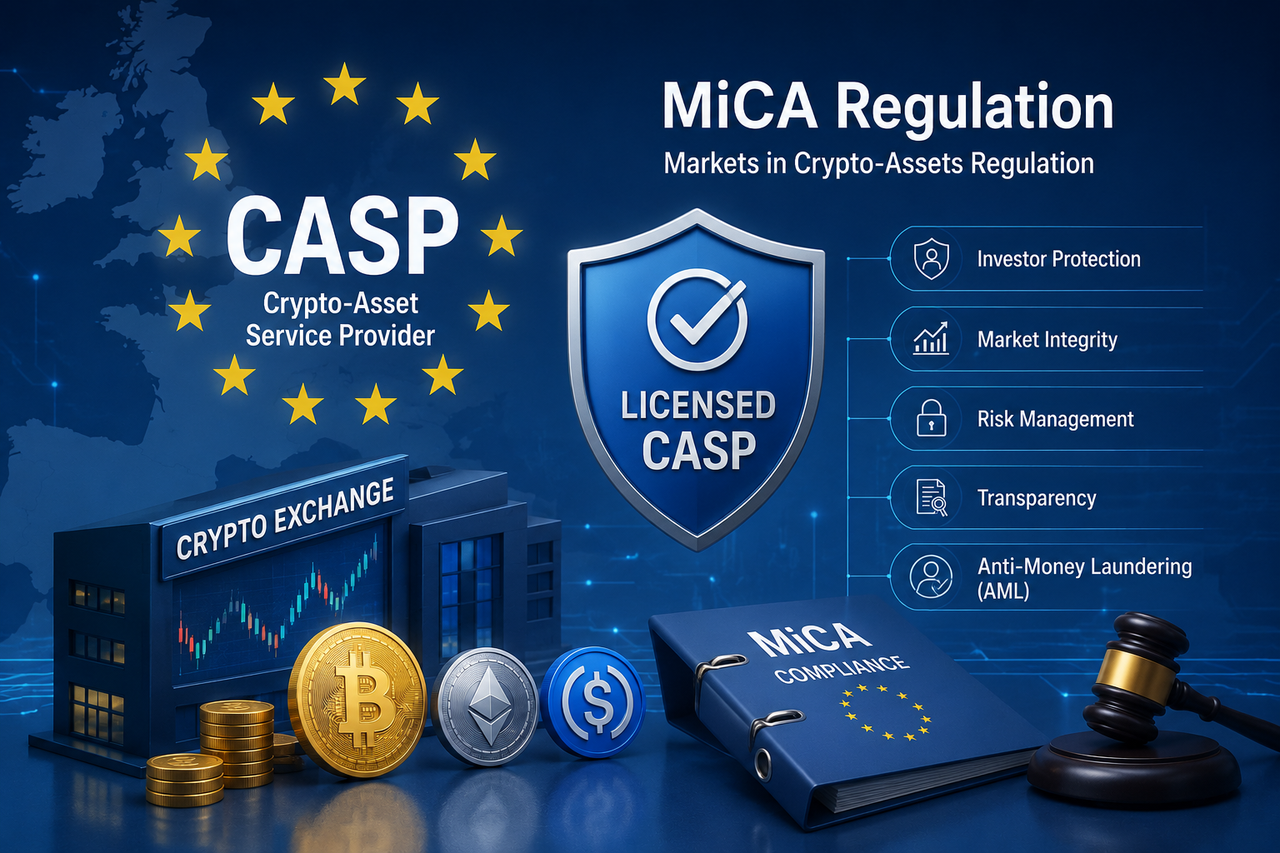
What Is CASP
CASP stands for Crypto-Asset Service Provider, commonly translated as "加密资产服务提供商" in Chinese. Under MiCA regulations, a CASP is an institution or enterprise that provides one or more crypto-asset services to clients.
CASP is not a specific type of enterprise but rather a collective term for a class of regulated market participants. As long as an enterprise engages in digital asset trading, custody, transfer, order execution, or investment advisory activities, it may fall under CASP supervision.
From a regulatory standpoint, CASP represents the EU's unified licensing system for the crypto industry, functioning similarly to securities brokers, payment institutions, or investment service providers in traditional financial markets.
Why Did MiCA Establish the CASP System
A primary reason for MiCA to establish the CASP system is to address the long-standing regulatory fragmentation in Europe.
Before MiCA took effect, different EU member states applied varying regulatory standards to cryptocurrency exchanges and digital asset service providers. Some countries required special licenses, while others lacked clear regulatory frameworks. This divergence increased the difficulty of cross-border operations for enterprises and also affected investor protection levels.
With the CASP system, the entire EU market now has a unified regulatory standard for crypto-asset services for the first time. Enterprises can operate under consistent rules, while users benefit from higher levels of market protection and information transparency.
Which Enterprises Fall Under CASP Supervision
MiCA clearly defines the scope of CASP supervision, covering most institutions that provide digital asset services to users.
The most typical CASPs include cryptocurrency exchanges. These platforms facilitate digital asset trading and order matching, making them key regulatory targets.
Digital asset custody institutions also fall under the CASP category. These entities safeguard user private keys or manage client assets and must bear significant security and compliance responsibilities.
Additionally, brokerage service providers, digital asset transfer service providers, order execution platforms, and investment advisory institutions may be included in the CASP regulatory framework.
As the Web3 industry evolves, an increasing number of platforms offering digital asset services are facing CASP compliance requirements.
How Does MiCA Regulate Cryptocurrency Exchanges
Cryptocurrency exchanges are among the most important primary targets of CASP regulation.
MiCA requires exchanges to establish robust corporate governance structures and ensure that management possesses the necessary professional expertise. Regulators aim to reduce operational risks through governance requirements and enhance the long-term stability of platforms.
In terms of client asset management, exchanges must take measures to protect user funds and implement asset segregation mechanisms to prevent mixing client assets with the enterprise's own assets.
MiCA also mandates transparent information disclosure, including fee structures, trading rules, and descriptions of potential risks, to help users make more informed decisions.
At the same time, platforms must establish monitoring mechanisms to prevent market manipulation, insider trading, and other unfair market practices.
What Is the CASP License Application Process
CASP authorization applications are typically reviewed by the regulatory authority of the member state where the enterprise is based.
First, the applying enterprise must establish a complete corporate structure and internal governance system, and prepare relevant legal documents and operational materials. Regulators typically focus on the enterprise's organizational structure, risk control capabilities, and technical security measures.
After submission, the regulator assesses whether the enterprise can operate sustainably and fulfill its responsibilities for client asset protection and compliance management.
Upon approval, the enterprise receives CASP authorization and can conduct related business in the EU market under MiCA regulations.
While specific processes may vary slightly among member states, the overall review framework is highly standardized.
What Is the Passporting Mechanism
Passporting is one of the most distinctive features of the CASP system.
Under the traditional model, enterprises entering multiple national markets typically need to apply for local licenses separately. For cross-border digital asset platforms, this represents significant time and compliance costs.
With MiCA's unified regulatory framework, enterprises that obtain CASP authorization can secure a license in one member state and expand their operations to other EU member states.
This mechanism significantly lowers the barrier for enterprises entering the European market and promotes the development of a single digital asset market within the EU.
For international exchanges, Passporting is a key reason to apply for a MiCA license.
What Compliance Obligations Must CASPs Fulfill
Obtaining CASP authorization does not mark the end of regulation; rather, it signals the beginning of ongoing compliance obligations.
Enterprises must continuously maintain their internal risk management systems and submit regular reports to regulators. Regulators have the authority to review the enterprise's operating status to ensure compliance with MiCA requirements.
Client asset protection is one of the most critical responsibilities of a CASP. Enterprises must take appropriate measures to safeguard client funds and establish emergency handling procedures.
Information disclosure is also a core requirement. Enterprises must clearly communicate service content, fee structures, and potential risks to users, avoiding misleading publicity.
In addition, CASPs must comply with anti-money laundering (AML) and counter-terrorist financing (CTF) regulations, along with other relevant legal requirements.
What Is the Difference Between CASP and VASP
CASP and VASP are often discussed together, but they are not identical.
The concept of VASP (Virtual Asset Service Provider) was first introduced by the Financial Action Task Force (FATF) and is primarily used within the anti-money laundering regulatory framework.
CASP, on the other hand, is a legal concept established under the MiCA regulation. Its regulatory scope encompasses not only anti-money laundering requirements but also investor protection, market transparency, client asset management, and operational governance.
In simple terms, VASP reflects international anti-money laundering standards, while CASP forms an integral part of the EU's comprehensive digital asset regulatory system.
With the full implementation of MiCA, CASP is gradually becoming the more representative regulatory standard in the European market.
How Will the CASP System Affect the Crypto Industry
The CASP system is propelling the European crypto industry from its early growth phase toward a mature market.
For users, uniform regulation enhances platform transparency and asset security. For enterprises, clear rules reduce legal uncertainty and attract greater institutional participation.
As more international exchanges and digital asset service platforms apply for CASP authorization, the European market is evolving into a more standardized and sustainable environment.
From a global perspective, the CASP system also serves as a reference for other regions establishing digital asset regulatory frameworks.
Summary
As the Crypto-Asset Service Provider system established by the MiCA regulation, CASP is a cornerstone of the EU's cryptocurrency regulatory framework. Through a unified authorization mechanism and ongoing compliance requirements, CASP standardizes the operational standards of cryptocurrency exchanges, digital asset custody institutions, and other service platforms.
For enterprises seeking to enter the European market, obtaining CASP authorization has become a critical prerequisite for doing business. At the same time, by improving market transparency, strengthening investor protection, and reducing cross-border operational barriers, the CASP system is driving the European digital asset industry toward greater maturity and standardization.
FAQs
What does CASP mean?
CASP stands for Crypto-Asset Service Provider. CASP is a regulatory system established under the MiCA regulation, applicable to cryptocurrency exchanges, custody institutions, brokerage service providers, and other digital asset service platforms.
Which enterprises need to apply for a CASP license?
Enterprises providing crypto-asset trading, custody, order execution, asset transfer, or investment advisory services to EU users generally need to obtain CASP authorization. The specific scope of application depends on the actual business activities conducted by the enterprise.
What is the relationship between CASP and cryptocurrency exchanges?
Most cryptocurrency exchanges fall under CASP supervision. MiCA requires exchanges to obtain CASP authorization and comply with regulatory requirements such as client asset protection, market transparency, and risk management.
What is the difference between CASP and VASP?
VASP is an anti-money laundering regulatory concept introduced by the Financial Action Task Force (FATF), while CASP is an EU legal framework established by MiCA. CASP has a broader scope, covering not only anti-money laundering requirements but also investor protection and market regulation.
What is the Passporting mechanism?
Passporting is an essential component of the EU's unified market system. After obtaining CASP authorization, an enterprise can obtain a license in one member state and provide services to other EU member states without needing to reapply for a local license.
Does CASP apply to DeFi projects?
Fully decentralized DeFi protocols generally do not fall directly under CASP supervision. However, if a DeFi project has a clear operating entity, management team, or commercial organization, it may be considered a CASP and subject to MiCA regulatory requirements.







