As blockchain evolves from a simple tool for value transfer into programmable financial infrastructure, Cardano is frequently used to explore “third-generation blockchain” solutions for scalability, interoperability, and sustainability. Its applications have extended into various fields, including DeFi, digital identity, credential management, and supply chain traceability.
From a macro perspective, the value of Cardano lies in its ultimate pursuit of “high security and sustainable governance.” Not only has it achieved deep interoperability with Ethereum and other ecosystems through the Plutus V3 smart contract language, but it also maintains maximum asset flexibility while ensuring the highest level of network security through its unique Liquid Staking model.

The Origin of Cardano
Cardano is a third generation public blockchain project founded with the involvement of Charles Hoskinson, a co founder of Ethereum. It emphasizes a research driven approach and formal verification. Many core protocols are first developed and peer reviewed in academic papers before being implemented. Functionally, it supports both value transfer through ADA and native assets, and smart contracts and decentralized applications, aiming to balance security, scalability, and decentralization.
Cardano uses its own Ouroboros proof of stake consensus, which is among the early PoS protocols with formal security proofs. This differentiates it from proof of work chains in both energy consumption and security design.
As the first blockchain built using the Haskell programming language, Cardano is a non EVM compatible smart contract platform. Its native token, ADA, is named after the nineteenth century mathematician Ada Lovelace and is used to pay transaction fees, participate in governance, and maintain network security.
How Does Cardano Work? Its Two Layer Architecture and the Ouroboros Protocol
Cardano’s design philosophy emphasizes modularity by separating ledger logic from computation logic to improve system flexibility.
Cardano uses a layered blockchain architecture that splits transaction settlement and smart contract execution into two logical layers: the Cardano Settlement Layer (CSL) and the Cardano Computation Layer (CCL). For consensus, Ouroboros PoS divides on chain time into epochs and slots, and selects slot leaders from stake pools through a randomized process to produce blocks.
Network operation can be summarized in several steps:
- A user initiates a transaction or calls a smart contract, constructs the transaction locally, and signs it.
- The transaction is broadcast across the peer to peer network, and nodes perform required local checks such as balance, scripts, and fees.
- In each slot, one or more stake pools with sufficient stake are selected as slot leaders based on Ouroboros randomness using a verifiable random function (VRF).
- The selected slot leader packages valid transactions, creates a block, attaches VRF proof and a signature, then broadcasts it to the network.
- Other nodes verify the block’s validity, including signatures, VRF proof, UTxO changes, and script execution, then update their local chain state based on the longest or heaviest chain rule.
This design maintains consensus security while decoupling two categories of logic: who is allowed to produce blocks, and how transactions and smart contracts are executed. This separation supports independent evolution and optimization over time.
ADA (Cardano) Tokenomics and Core Use Cases
ADA is the native token of the Cardano network. It is used to pay fees, support staking and governance, and serve as a value carrier within the ecosystem.
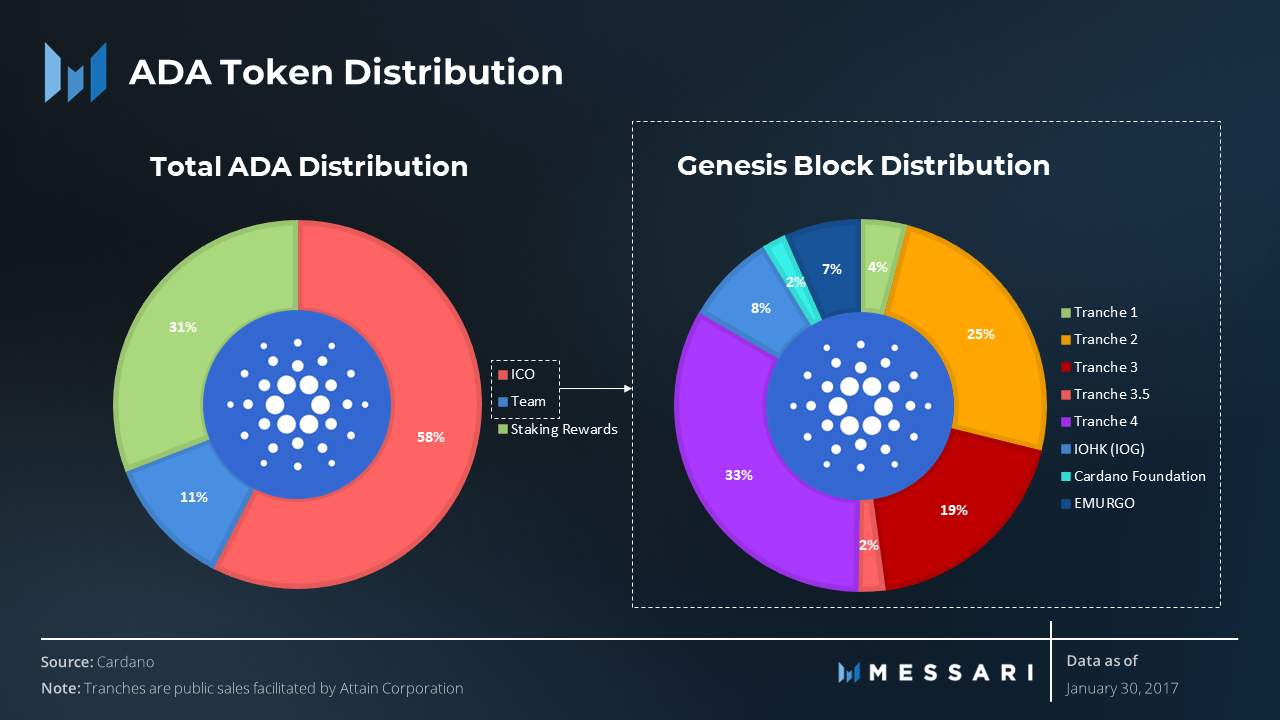
Image source: Messari
Supply and Incentive Sources
- Token supply
- ADA has a capped total supply. Block rewards come from monetary expansion plus transaction fees. A portion is distributed to stake pools and delegators, and another portion flows into the on chain treasury.
- Reward composition
- In each epoch, the reward pool is formed by predefined monetary expansion plus transaction fees. Rewards are then distributed to stake pools and delegators based on protocol parameters, with allocation determined by stake weight and performance.
- Treasury mechanism
- The protocol uses the parameter τ to define what percentage of epoch rewards are allocated to the treasury for future community governance and ecosystem funding.
Core Use Cases of ADA
- Network fees
- Users pay fees in ADA when sending transactions and executing smart contracts.
- Staking and delegation
- Token holders can either run a stake pool, which has higher requirements, or delegate staking rights through a wallet to a pool to receive a share of block rewards. Staking does not require lock up, and assets remain in the user’s own address.
- Governance and voting
- As governance functionality expands, ADA is expected to be used for submitting and voting on on chain proposals, including protocol parameter changes and funding decisions.
- Pricing and collateral within the ecosystem
- In DeFi, NFTs, and on chain games, ADA is often used as collateral, as a liquidity pair asset, or as a settlement asset.
Unlike some proof of stake networks, Cardano’s staking design typically features no mandatory lock up period, delegated assets remain in the user’s wallet, and users can switch stake pools at any time. This reduces barriers to participation and lowers liquidity related risk.
Core Features and Technical Standards of Cardano
Cardano’s technical characteristics are centered on its ledger model, formal methods, and layered design.
- The EUTXO ledger model
- Cardano extends Bitcoin’s UTXO model to support smart contracts. Each output can carry scripts and data, which makes outcomes more deterministic and supports better parallelization.
- Formal verification and peer reviewed development
- Core protocols and languages such as Plutus pursue formal modeling and verification, strengthening security and auditability.
- Layered architecture and modularity
- By decoupling settlement and computation through CSL and CCL, Cardano can replace or extend execution environments without undermining ledger security.
- Native assets and multi asset support
- Cardano supports multi asset issuance at the ledger layer without requiring additional smart contracts. Tokens are governed by the same UTxO rules as ADA.
- Stake pool ecosystem
- The network includes a large number of independent stake pools, aiming to balance decentralization and participation accessibility. Most users can participate by delegating rather than running infrastructure.
Cardano vs Ethereum: Key Differences
Although Cardano and Ethereum are both leading smart contract platforms, they differ significantly across dimensions such as ledger model, architecture, consensus, staking participation requirements, governance and treasury design, and smart contract models.
| Dimension |
Cardano |
Ethereum |
| Ledger model |
EUTXO with local state and more predictable outcomes |
Account-based global state with sequential execution |
| Architecture |
Two-layer design (CSL + CCL), settlement and computation decoupled |
Single main chain plus Layer 2 scaling (e.g., rollups) |
| Consensus |
Ouroboros PoS with formal security proofs |
PoS (Casper family) without a single unified formal proof framework |
| Staking participation |
No lock-up, no slashing, flexible delegation |
Native staking requires ETH threshold/validator operation; slashing exists |
| Governance and treasury |
Protocol built-in treasury and governance parameters |
Primarily social governance and the EIP process |
| Smart contract model |
Plutus/EUTXO, emphasizing formality and determinism |
EVM/Account model, mature ecosystem and tooling |
Account Model
Cardano uses the UTxO and EUTXO model, splitting state into a set of indivisible unspent outputs. Each transaction consumes previous outputs and produces new outputs. Smart contract state is stored in specific UTxOs.
Ethereum uses the account model, where each address has a global balance and storage, and transactions execute sequentially against the same global state.
In practice, this leads to several differences:
- Transaction parallelism
- In EUTXO, transactions can be processed in parallel as long as they do not compete for the same outputs. This can support scaling more naturally. In the account model, additional designs such as sharding or rollups are used to mitigate global state bottlenecks.
- Fee predictability and outcome determinism
- Under EUTXO, transaction inputs and script execution are closer to local state, making outcomes and fees easier to reason about in advance. Under the account model, fees and outcomes can be affected by earlier transactions, which can make them harder to predict.
Differences in Staking Mechanisms
Cardano staking is characterized by non custodial staking, an open stake pool structure, and its reward configuration.
- Fully non custodial staking
- Delegation registers a delegation certificate on chain. ADA never leaves the wallet address. There is no lock up period and no slashing mechanism.
- Open stake pools
- Participation barriers are relatively low, and token holders can freely choose or switch stake pools.
- Rewards come from monetary expansion and fees
- Rewards are distributed based on total stake in the pool and block production performance.
Ethereum staking in the proof of stake era includes requirements around stake amounts, slashing, and custody considerations.
- Native staking requires a fixed amount of ETH and operating a validator node. Otherwise, users typically participate through third party staking services or liquid staking protocols.
- Slashing exists and penalizes validators for malicious behavior or severe operational failures.
- Some participation methods involve custody by third parties, introducing additional trust risk.
Governance Model Comparison
Cardano’s governance model was designed from the start with on chain governance and treasury funding in mind. Some parameters such as reward allocation and pool saturation thresholds can be adjusted through governance processes. The treasury is automatically funded through protocol rules and is intended to support ecosystem development and public goods.
Ethereum governance is more centered on social coordination among client developers and community participants through the EIP process. On chain voting can play a supporting role, but protocol upgrades are primarily delivered through client implementations and community consensus rather than a unified on chain voting system.
How to Participate in the Cardano Ecosystem and Risk Notes
Users can participate in Cardano at different depths, from simply holding ADA to using dApps and engaging in staking and governance.
- Holding and transferring ADA
- Users can obtain ADA through compliant trading platforms, transfer it to a self custodial wallet that supports staking, and use it for transfers and asset management.
- Delegated staking
- Users can select a stake pool in a wallet and submit a delegation certificate. ADA remains in the user’s own address and does not need to be sent to a third party. Staking rewards are earned on an epoch schedule, and users can change delegation targets or transfer funds at any time.
- Using dApps
- Users can participate in Cardano DeFi such as lending and DEX activity, NFTs, identity applications, or supply chain solutions, and pay fees in ADA during interactions.
- Governance and community participation
- Users can take part in proposal discussions and voting, and contribute through development, auditing, and other community work.
When participating, users need to balance potential opportunities with risks. For example, ADA price volatility can be influenced by macro conditions, market sentiment, and project progress, which can create drawdown risk. Cardano also faces competition from other public blockchains, and if ecosystem development falls short of expectations, it may affect long term outcomes.
Conclusion
Cardano is a third generation blockchain platform that emphasizes research rigor and sustainable governance. It uses a two layer architecture and the Ouroboros consensus mechanism to build a proof of stake network designed for low energy use and high security.
Compared with Ethereum, its strengths are often described as more structured protocol design, a non lock up staking model, and a clearer on chain governance vision. At the same time, ecosystem maturity and developer activity remain areas of continued growth.
Overall, Cardano uses the CSL and CCL layered architecture and Ouroboros PoS to establish a distinct tradeoff across security, scalability, and energy usage. The EUTXO ledger model and native multi asset support can improve determinism and parallelization. Its open staking and governance design also enables ordinary token holders to participate in network security and ecosystem evolution with relatively low barriers. For investors and developers focused on long term infrastructure building and governance development, Cardano remains a public blockchain worth watching.
FAQs
What is the biggest technical difference between Cardano and Bitcoin?
Bitcoin uses proof of work and a simple UTxO ledger model, primarily for value storage and transfers. Cardano uses proof of stake and EUTXO, and supports smart contracts and a multi asset ecosystem through a layered architecture.
Will ADA be locked when staking on Cardano? Is there any penalty?
Cardano staking does not require lock up. Funds remain in the user’s address, users can transfer at any time or change delegation targets, and there is no slashing mechanism at the protocol level.
How is Ouroboros different from typical PoS designs?
Ouroboros divides time into epochs and slots, selects slot leaders using VRF based random selection, and provides formal security proofs for chain growth and safety. Compared with many PoS designs, it is more rigorous in modeling and proof structure.
What does the EUTXO model mean for developers?
Developers need to represent contract state through UTxOs and consider resource contention and parallel consumption. In exchange, they can benefit from more deterministic execution and more predictable fees, which can be useful for building high reliability financial applications.
What does Cardano rely on for future scalability?
Cardano’s scaling path includes expanding the computation layer and sidechains, using Layer 2 solutions, and further leveraging EUTXO parallelization and protocol parameter tuning to improve throughput and user interaction experience.