In the realm where GameFi meets AI applications, traditional development is hindered by high entry barriers and slow content delivery, while general-purpose large models struggle to produce fully functional gameplay directly. AKEDO lowers these barriers and builds platform-specific content data by modularizing multi-agent collaboration—separating map, rule, balance, and narrative into distinct, cooperative elements.
From a blockchain and digital asset perspective, AKEDO creates a closed loop by integrating creation, publishing, advertising revenue sharing, and token incentives: $AKE is used for creation and publishing fees, as well as for staking and liquidity pairing. Understanding the framework’s positioning, product suite, and token roles is essential for recognizing its place in the Web3 content ecosystem.
What Is AKEDO? How Does It Relate to AKEDO Games and $AKE?
AKEDO is a multi-agent AI framework that transforms natural language intent into executable content. AKEDO Games serves as the ecosystem’s game product layer for players and creators, supporting gameplay, distribution, and community engagement for generated content. These operate at different layers: AKEDO is the foundational infrastructure for creation and collaboration, while AKEDO Games is a portal for content consumption and distribution.
AKE is the ecosystem’s native utility token, powering AI creation, protocol fee staking incentives, and liquidity pairing between new game tokens and $AKE. The framework produces content, Games deliver gameplay, and the token unites payments, rewards, and liquidity. For on-chain contract verification, the commonly referenced address is 0x2c3a8ee94ddd97244a93bc48298f97d2c412f7db (BNB Smart Chain); always refer to the official site and whitepaper for definitive information.
| Concept |
Positioning |
Core Functionality |
| AKEDO |
Multi-Agent AI Framework + Creation Engine / Launchpad |
Autonomous content creation, multi-agent collaboration, publishing tools |
| AKEDO Games |
Ecosystem Games / Content Product Layer |
Playable content, player interaction, distribution |
| $AKE |
Native Utility Token |
AI creation payments, staking rewards, LP pairing |
Together, they form a seamless chain: “framework creation → product delivery → token settlement and incentives,” ensuring clear distinctions between platform, game entry, and token utility.
What Are the Core Products in the AKEDO Ecosystem? How Are Games, AI, and Interactive Content Structured?
The AKEDO ecosystem unfolds as “Creation Engine → Launchpad → Content Forms → Pets/NFT → AI Agent.” The Creation Engine converts prompts into playable content; the Creator Launchpad enables publishing and game tokenization; AKEDO Games supports gameplay and distribution; Adodo and the AKEDOG NFT ecosystem use pet avatars and cards/NFTs to enhance community identity and assetization; Interactive Film and ADODO AI Agent extend narrative and agent interaction beyond traditional level-based content.
| Product / Module |
Type |
Main Role |
| Creation Engine |
Creation Engine |
Natural language-driven game and content generation |
| Creator Launchpad |
Publishing Launchpad |
Publishing, aggregation, and game tokenization tools |
| AKEDO Games |
Game Product |
Gameplay, distribution, and player entry point |
| Adodo / AKEDOG Cards·NFT |
Pet and Asset Layer |
Community avatars, cards, tradable gameplay assets |
| Interactive Film / ADODO AI Agent |
Interactive Content & Agent |
Narrative interaction and intelligent agent experience |
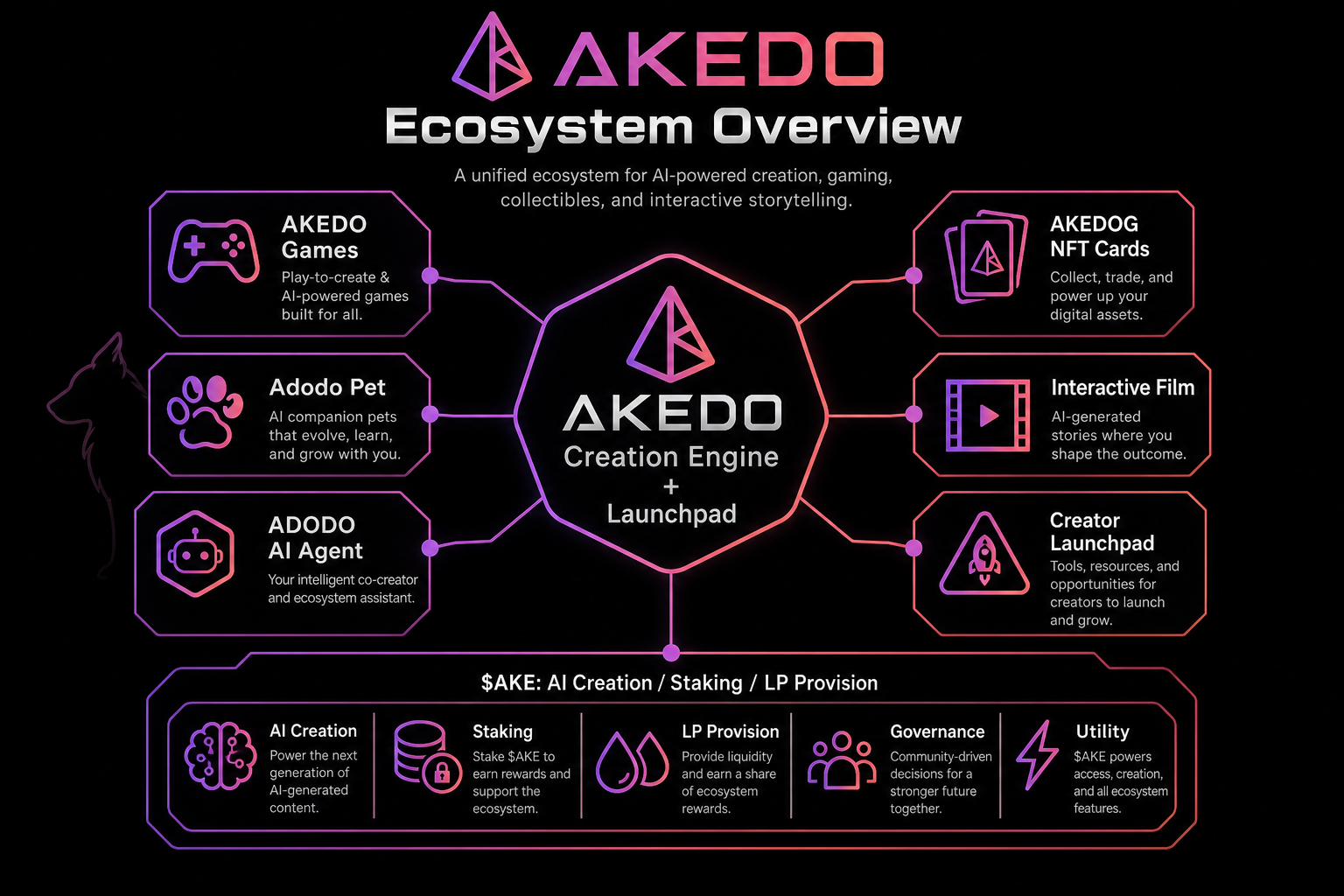 Figure 1. AKEDO ecosystem at a glance: Creation Engine and Launchpad at the core, connecting games, Adodo/NFT, interactive content, and $AKE utility.
Games emphasize playability and retention, AI focuses on multi-agent generation, and interactive content prioritizes narrative and agent dialogue. Creators don’t need to build engines from scratch, and players can seamlessly switch between creation and consumption within the same ecosystem.
How Does AKEDO’s Multi-Agent AI Framework Work? What Are the Roles of the Four Agent Types?
AKEDO breaks game development into four specialized Agents, each powered by large language models and collaborating by module. World Builders design maps and scenes; Rule Designers define gameplay mechanics; Balancers adjust difficulty and fairness; Storytellers craft narrative arcs. After a creator submits a natural language prompt, each Agent completes its module in parallel or sequence. According to the whitepaper, a playable game design can be generated in about two minutes.
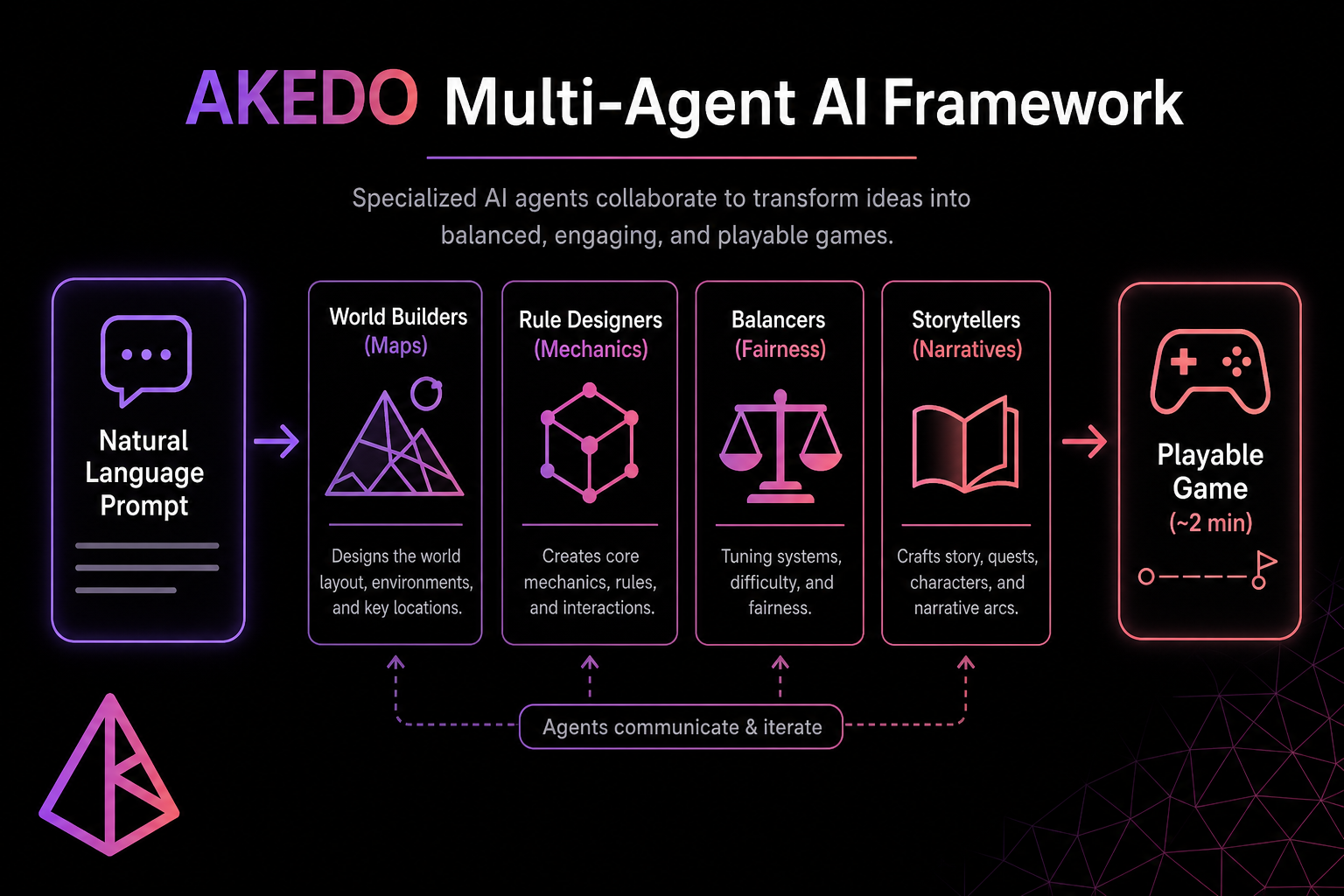 Figure 2. Four-Agent collaboration: a natural language prompt is processed by World Builders, Rule Designers, Balancers, and Storytellers to produce a playable game.
Unlike general tools that generate an entire codebase in a single conversation, AKEDO’s multi-agent approach separates maps, rules, balance, and narrative, mirroring traditional production pipelines and enabling single-module iteration. This process embodies “vibe coding”—driving the engine with intent descriptions instead of line-by-line code, lowering the barrier for anyone who can express gameplay ideas.
What Is the Role of the $AKE Token in the Ecosystem?
$AKE Tokenomics caps total supply at 100 billion. Community allocation is approximately 31.5% (nodes 16%, creators 8%, players 7.5%); the remainder is roughly Investors 25%, Ecosystem & Growth 17.5%, Early Contributors 15%, Advisors 5%, LP 5%, Community Airdrop 1%. Each allocation has cliff and linear vesting, with details governed by the whitepaper.
$AKE serves three main functions: AI Creation (about $0.1 per prompt, $10 per publish, paid in $AKE); Staking (protocol fees split approximately 33% platform / 33% stakers / 33% burn); LP Provision (liquidity pairing for new game tokens and $AKE). $AKE is the medium for creation payments, protocol fee redistribution, and liquidity.
How Do AKEDO Creators Monetize via Ads, Protocol Revenue Sharing, and Token Incentives?
AKEDO creator monetization mechanisms support multiple revenue streams: Advertiser-Related Games (branded content games earn ad revenue based on engagement), Protocol Revenue Sharing (a portion of protocol income is distributed to creators), Platform Advertising Revenue (sharing platform ad revenue), and $AKE Incentives (token rewards for ecosystem contributions). The Launchpad also enables issuance of game or collection tokens, with early discovery supported by bonding curves.
Monetization follows the logic: “content production → engagement/ad exposure → protocol and ad revenue sharing → token incentives,” not just play-to-earn. Creators can combine multiple paths; proportions and settlements depend on platform disclosures and require understanding of contract and traffic structures.
How Is AKEDO Positioned in the TON, Telegram, and BNB Chain Ecosystems?
AKEDO initially reached social users via Telegram and TON (e.g., Akedog and other lightweight games); mainnet and $AKE functionality are on BNB Smart Chain, supporting creation settlement, staking, and liquidity pairing. The social layer targets user acquisition, while BSC focuses on asset settlement.
The team’s background includes experience in the gaming industry (including Tencent-affiliated studios, per the whitepaper), with investors such as Karatage, Collab Currency, Sfermion, TON Ventures, and others. The strategy is “multi-channel user acquisition + unified mainnet settlement.”
What Are the Advantages and Risks of Participating in or Holding $AKE?
Compared to AKEDO vs traditional GameFi, which involves heavy redevelopment and slow iteration, AKEDO’s advantages include: multi-agent design lowers entry barriers; prompt-to-prototype in about two minutes; parallel monetization through ads, protocol revenue sharing, and token incentives; and a closed payment, staking/burning, and LP loop with $AKE.
Risks include: content quality depends on Agent and manual iteration; revenue sharing depends on traffic and disclosure policies; Launchpad tokenization introduces volatility and liquidity risks. Additional risks involve smart contract and key security, counterfeit assets and phishing sites, confusion between Telegram/TON access and BSC asset layers, and dependence on large models and blockchain infrastructure. Advantages and risks should be evaluated independently; no yield projections are offered.
Summary
AKEDO leverages a multi-agent AI framework for autonomous content creation, connecting games, interactive content, Adodo/NFT, and AKE settlement via its Creation Engine and Launchpad. Four Agent types cover maps, rules, balance, and narrative; $AKE is used for creation consumption, staking rewards, and new token LP. Participation requires careful review of the official website, whitepaper, and contract disclosures, and clear distinction between the framework, game products, and token utility.
FAQ
What Is AKEDO?
AKEDO is a multi-agent AI framework for autonomous content creation, offering a game and content creation engine and publishing launchpad. Creators use natural language prompts to drive specialized Agents, generating playable games and interactive content, and can participate in the ecosystem economy through advertising, protocol revenue sharing, and $AKE incentives.
What Is the Utility of the $AKE Token?
$AKE is primarily used for AI creation and publishing fee payments, staking protocol revenue sharing, and liquidity pairing with new game tokens. Protocol fees are split roughly one-third each among the platform, stakers, and burning; total supply is capped at 100 billion, with allocations detailed in the whitepaper.
How Does AKEDO Use AI to Create Games?
After a creator submits a natural language description, World Builders, Rule Designers, Balancers, and Storytellers are responsible for maps, mechanics, fairness, and narrative, respectively. Multi-agent collaboration delivers playable content, with designs completed in about two minutes, following a “vibe coding” workflow.
What Is Adodo? How Does It Relate to AKEDO?
Adodo is a pet avatar and community gameplay asset within the AKEDO ecosystem, often appearing with AKEDOG Cards/NFTs, nodes, or upgrade mechanisms. Adodo does not replace the Creation Engine but enhances identity, interaction, and assetization, supporting the ecosystem’s creation and gameplay loop.
How Is AKEDO Different from Traditional GameFi?
Traditional GameFi relies on long-term development by professional teams and single play-to-earn cycles. AKEDO emphasizes natural language-driven multi-agent creation, Launchpad tokenization tools, and parallel monetization through ad revenue sharing, protocol revenue sharing, and $AKE incentives. The differences are in entry barriers, content delivery speed, and diversified income streams—not simple substitution.
How Do AKEDO Creators Monetize?
Public paths include branded ad game revenue sharing, protocol income sharing, platform ad revenue sharing, and $AKE incentives; the Launchpad can also support game or collection token issuance. Monetization depends on content quality, traffic, and platform rules, requiring understanding of smart contracts and disclosure policies, with no yield guarantees.