APRO, as a decentralized AI oracle network, must continuously coordinate off-chain data, validator nodes, and cross-chain messaging. To sustain long-term node collaboration, APRO needs an economic incentive model. Traditional centralized data services rely on a single entity, while decentralized oracle networks depend on token models to keep running.
The AT token's logic centers on node staking, network governance, data validation, and ecosystem rewards. Several core modules in the APRO network interact directly with AT, making it more than just a medium of exchange—it also carries network security and governance functions.
The AT token facilitates value coordination within the APRO network. By linking nodes, data services, and governance via AT, APRO keeps its entire oracle network running.
Structurally, AT functions more like a network utility token than a simple payment tool. Validator nodes must hold and stake AT to take part in data validation, directly impacting APRO's security model.
Data requests on APRO typically require multiple nodes. A smart contract initiates an off-chain data request; nodes then pull data from various external sources, the network aggregates and validates the results, and the verified data is finally submitted on-chain.
This design ties the AT token directly to data reliability. If a node submits faulty data, its staked AT may be slashed, incentivizing nodes to maintain consistent data quality.
According to official sources, AT is also used for governance voting and ecosystem incentives. Holders can vote on protocol parameter changes, node rule updates, and network upgrades.
Core Functions of AT in the APRO Network
AT's core functions cover node staking, data services, governance, and incentive distribution—all working together to support APRO's long-term stability.
Nodes must stake AT to become validators. They submit a staking request, the system verifies their status and staked amount, they start processing validation tasks, and finally they earn rewards based on performance.
The table below summarizes AT's main roles:
| Function Module |
Primary Role |
| Node Staking |
Maintain network security |
| Data Rewards |
Incentivize node operation |
| Governance Voting |
Adjust protocol parameters |
| Service Payment |
Pay data query fees |
| Ecosystem Incentives |
Support network expansion |
AT's design focuses on aligning node behavior through economic incentives. A decentralized oracle network cannot rely on a central manager, so APRO uses the token mechanism to keep nodes engaged.
Unlike centralized data services, APRO's validation results come from multiple nodes. AT directly affects node earnings, encouraging them to provide stable, accurate data.
Why Nodes Need to Stake AT
AT staking is a vital part of APRO's security model. Its primary goal is to reduce malicious data submissions and network attacks.
Since nodes continuously supply off-chain data, the network requires economic safeguards. A node locks a certain amount of AT, then participates in data requests, submits validated results, and the network determines rewards or penalties based on data quality.
This means incorrect data directly hurts node earnings. If a node sends abnormal data, its staked AT may be slashed, so nodes prioritize accuracy and reliability.
AT staking also serves as both access control and security verification. By filtering out low-quality nodes through staking, APRO boosts overall data trustworthiness.
APRO's node model also reduces single points of failure. With multiple nodes validating data, an attack on one node won't directly compromise the final on-chain result.
How AT Participates in Network Governance
AT influences governance voting and protocol upgrades on APRO. A decentralized oracle network needs ongoing parameter adjustments, making governance a critical component.
AT holders can participate in the governance process: the community proposes a change, holders vote, the system confirms the outcome, and approved proposals move to execution.
APRO's governance typically covers node rules, reward ratios, and protocol parameters. Different outcomes can affect network security, node earnings, and ecosystem direction.
This means AT carries not just economic value but also governance power. The more AT you hold, the greater your influence in network decisions.
Unlike traditional internet platforms, APRO's governance model emphasizes community participation. The oracle network stays decentralized, so no single entity holds all governance authority.
APRO's Reward and Penalty Mechanism
APRO's reward and penalty system keeps the node network running stably. The oracle needs long-term data reliability, so APRO uses a continuous incentive model.
Rewards revolve around data services: an on-chain app requests data, nodes fetch and validate it, the network aggregates results, and AT rewards are distributed based on contributions.
Penalties target malicious nodes and faulty data. If a node submits abnormal results, the system may reduce its rewards or even slash part of its staked assets.
The table below outlines the core logic:
| Mechanism |
Main Impact |
| Data Rewards |
Increase node participation |
| Staking Constraints |
Deter malicious behavior |
| Anomaly Penalties |
Enhance data trustworthiness |
| Node Auditing |
Maintain network stability |
APRO relies on its economic model to ensure security. Node earnings are directly tied to data accuracy, reducing the chance of persistent faulty data.
How Is the Economic Model of the AT Token Designed?
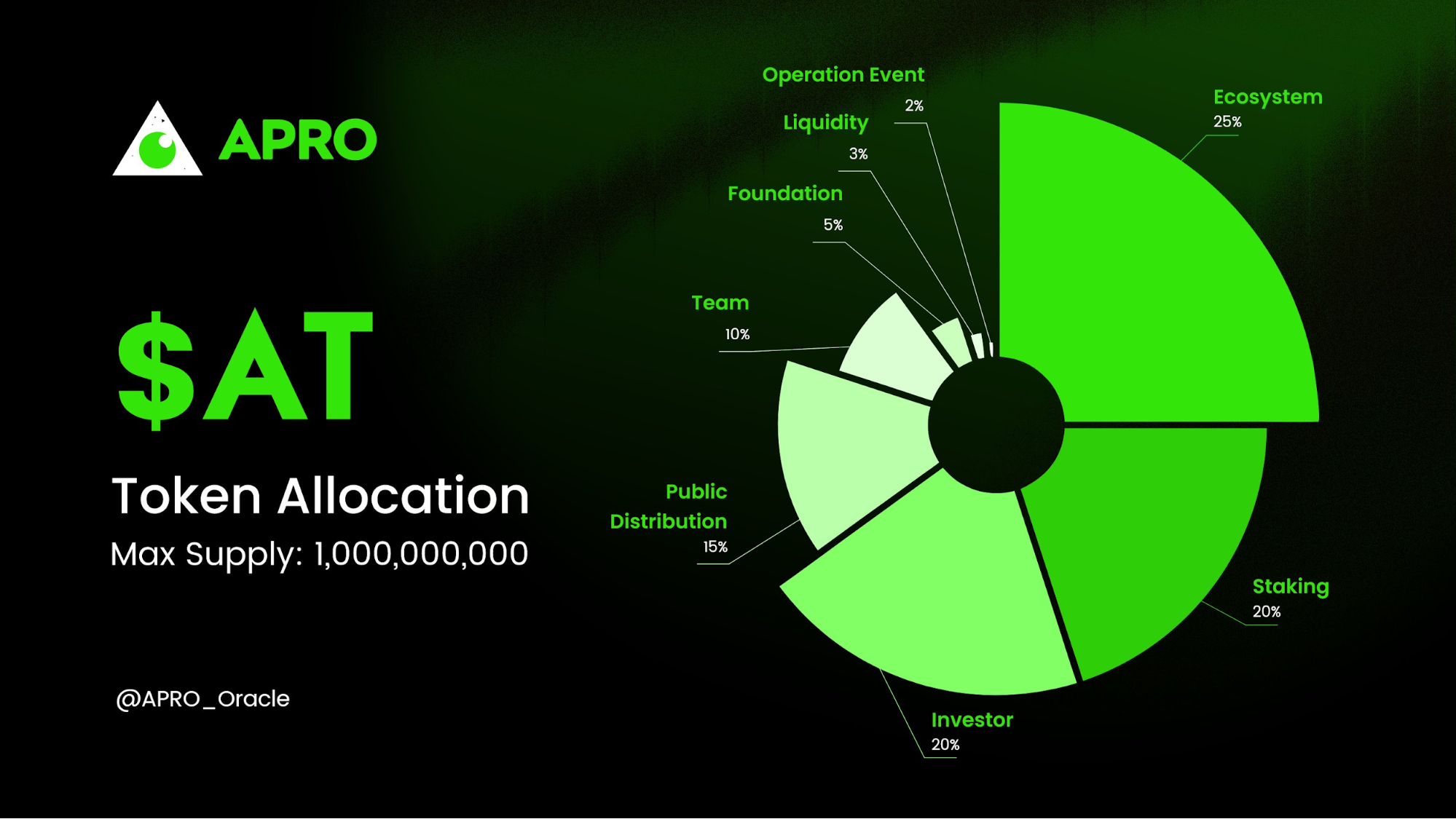
Official figures show AT's maximum supply is 1 billion tokens. The allocation is structured around ecosystem growth, node incentives, and long-term protocol development.
APRO's token distribution prioritizes network operation and ecosystem expansion. Attracting nodes, developers, and partnerships over the long run requires a significant allocation to ecosystem building.
The table below shows the official allocation:
| Allocation Category |
Percentage |
| Ecosystem Development |
25% |
| Staking Incentives |
20% |
| Institutional Investors |
20% |
| Public Sale |
15% |
| Team |
10% |
| Foundation |
5% |
| Liquidity |
3% |
| Operations |
2% |
Ecosystem development gets the largest share, reflecting APRO's focus on long-term network growth. The staking incentives portion mainly supports node rewards and security.
Institutional and team allocations fund early development, while the foundation and liquidity modules support ongoing operations and market stability.
The full unlock schedule, real-time circulating supply, and detailed release timeline have not been fully disclosed in official materials, so the future circulating structure is subject to official updates.
What Are the Use Cases for AT?
AT's main use cases include node services, data queries, governance voting, and ecosystem collaboration. Various on-chain applications interact with the APRO data network.
DeFi protocols are a major use case. Lending protocols, stablecoin systems, and on-chain derivatives often need real-time price data, so APRO continuously processes external data requests.
APRO's cross-chain verification system also uses AT. A cross-chain protocol submits a verification request, nodes read the source chain state, the network aggregates and validates the data, and the result is posted to the target chain.
AT is also used for network governance and ecosystem incentives. Some ecosystem partnerships may require AT to coordinate node services and data query costs, making AT a key part of APRO's business model.
Unlike traditional API services, APRO prioritizes on-chain data reliability. AT runs through data validation, node operation, and governance, so APRO's efficiency is directly linked to its token model.
Conclusion
The AT token is a core functional asset in the APRO oracle network, responsible for node staking, data validation, governance voting, and reward distribution. APRO uses AT to coordinate node behavior and build a decentralized data verification system.
APRO's operational logic centers on node collaboration and economic incentives. Nodes must stake AT to validate, and the reward/penalty system affects data reliability and network security.
Overall, AT is more than a payment medium. It also carries security constraints, governance coordination, and ecosystem expansion functions within the APRO network.
FAQ
What is the purpose of the AT token?
AT is primarily used for node staking, data validation, governance voting, and reward distribution in the APRO network. It directly impacts the security mechanism and node incentive system of the APRO oracle.
Why do nodes need to stake AT?
Nodes must stake AT to participate in data validation. Staking discourages malicious behavior and improves the reliability of off-chain data validation.
How does AT participate in APRO governance?
AT holders can vote on governance matters such as protocol parameter changes, node rule updates, and protocol upgrades. The amount of AT held typically influences voting power.
How does APRO's reward mechanism work?
APRO distributes AT rewards based on the quality of each node's data service. After nodes fetch, validate, and aggregate data, rewards are issued according to contribution.
What is the maximum supply of AT?
According to official economic model data, the maximum supply of AT is 1,000,000,000 tokens.
How are AT tokens distributed?
The official allocation includes ecosystem development (25%), staking incentives (20%), institutional investors (20%), public sale (15%), team (10%), foundation (5%), liquidity (3%), and operations (2%).







