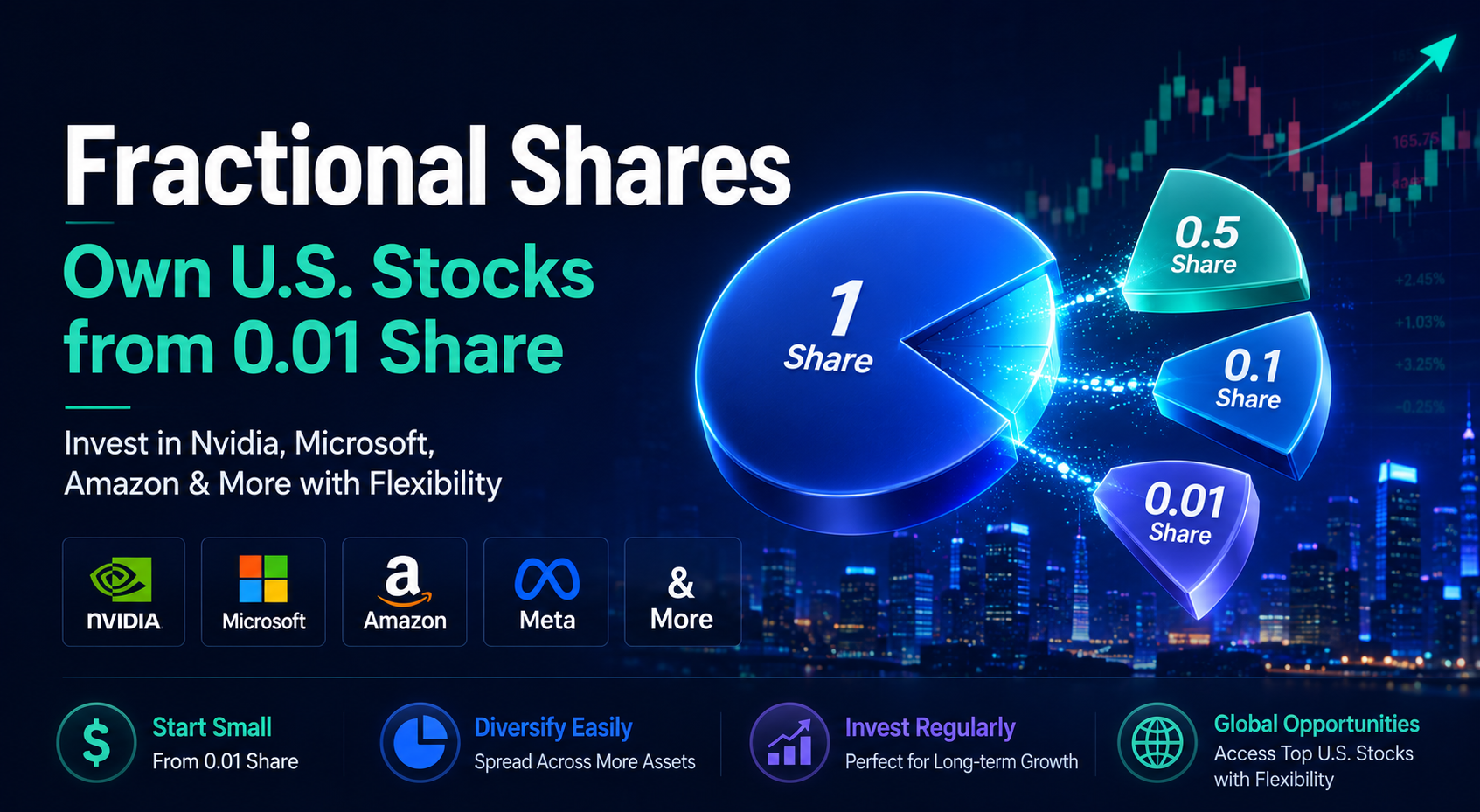
Investing in U.S. stocks has traditionally required significant capital. For many popular tech stocks, a single share can cost hundreds of dollars or more, making flexible allocation challenging for many investors. With the rise of fractional shares, investors can now purchase 0.1, 0.05, or even 0.01 shares, dramatically lowering the barrier to entry.
From Nvidia to Amazon, Microsoft to Meta, a growing number of investors are using fractional shares to build global portfolios. But what exactly are fractional shares, and why are they becoming a major trend in global investing? This article provides a comprehensive look at this paradigm-shifting approach.
What Are Fractional Shares?
In traditional stock markets, investors typically trade in whole shares. For instance, a stock priced at $500 requires a minimum $500 investment for a single share.
Fractional shares remove this limitation. They allow investors to buy a portion of a stock rather than a full share.
For example:
- 0.5 shares of Nvidia
- 0.1 shares of Microsoft
- 0.05 shares of Amazon
- 0.01 shares of Meta
Essentially, investors still enjoy the same proportional gains from stock price appreciation, but with far greater flexibility in position sizing. For those with limited capital or a desire to diversify, fractional shares significantly lower the hurdle to investing in quality assets.
Why Are Fractional Shares Gaining Popularity?
In recent years, a clear trend has emerged: more investors are favoring small, diversified investment strategies. Fractional shares cater perfectly to this demand. Key drivers include:
Lowering the Bar to Quality Assets
Many world-class companies maintain high share prices over extended periods.
Examples include:
- Nvidia
- Microsoft
- Amazon
- Netflix
- Broadcom
For newcomers, buying a full share can require hundreds or even thousands of dollars. This not only raises the entry barrier but also limits flexibility in capital allocation. Fractional shares enable participation with as little as a few dozen dollars.
In effect, fractional shares democratize access to premium assets in global capital markets.
Easier Portfolio Diversification
A classic investing principle: don't put all your eggs in one basket.
With only $1,000 to invest and a popular tech stock at $500 per share, purchasing two companies' shares would nearly exhaust the budget.
Fractional shares allow investors to spread their capital across more positions.
For example:
$1,000 can be allocated to:
- Nvidia
- Microsoft
- Amazon
- Meta
- Broadcom
And even across multiple ETFs simultaneously. This approach helps build a more balanced portfolio.
Ideal for Long-Term Auto-Invest
In long-term investing, regular contributions are often more sustainable than lump-sum purchases. However, high stock prices can restrict Auto-Invest plans. Fractional shares solve this.
For example, investing a fixed amount monthly:
Regardless of price fluctuations, investors can continuously buy corresponding fractions of shares. As a result, fractional shares have become a key tool for long-term DCA strategies.
Does 0.01 Share Really Matter?
A common question from those new to fractional shares: How much can 0.01 shares earn? The real value lies not in immediate large gains but in lowering the entry threshold. For instance, if a stock rises 20%, the percentage return is identical whether you hold 1 share or 0.1 shares. The only difference is the capital invested. For long-term investors, fractional shares serve as a method for gradually accumulating quality assets. Over time and with consistent contributions, even tiny positions can grow into substantial portfolios.
Thus, 0.01 shares isn't about chasing short-term windfalls—it's about enabling broader participation in the growth of leading global companies.
Why the AI Boom Is Fueling Fractional Share Growth
Artificial intelligence has become a powerful engine for global capital markets. From GPU chips to cloud computing, data centers to AI software services, numerous tech companies are benefiting. Nvidia's meteoric rise is a prime example.
Meanwhile:
- Microsoft
- Meta
- Amazon
- Broadcom
These companies also continue to benefit from the expansion of AI infrastructure and applications. However, their share prices remain high. For ordinary investors, fractional shares offer a more accessible entry point. They allow participation in AI industry opportunities without committing large sums upfront.
This is a key reason why fractional share adoption has surged in recent years.
Who Should Use Fractional Shares?
While fractional shares lower the barrier, they are not just for small investors. The following groups stand to benefit:
Beginner Investors
Easier first step into the market.
Long-Term Auto-Invest Users
Simplifies executing fixed-amount investment plans.
Diversification Seekers
Enables spreading capital across more stocks and ETFs.
Global Asset Allocators
Facilitates building cross-industry, cross-market portfolios.
Fractional shares have evolved from a "beginner tool" into a fundamental component of the global investment landscape.
How Gate Stock Trading Simplifies Fractional Investing
As demand for global asset allocation grows, many investors seek to participate in both digital assets and U.S. equities. Gate Stock Trading addresses this with flexible options. Currently, Gate Stock Trading supports trading over 10,000 U.S. mainstream stocks and ETFs using USDT, covering NYSE, Nasdaq, NYSE Arca, NYSE American, BATS, and other major U.S. securities markets and liquidity networks.
Moreover, Gate Stock Trading allows purchases as small as 0.01 shares. This means that even with high-priced stocks like Nvidia, Microsoft, and Amazon, investors can allocate based on their budget without a large upfront commitment.
For digital asset users, this model bridges digital and traditional financial markets, unlocking new possibilities for global portfolio diversification.
Will Fractional Shares Change the Future of Investing?
Historically, capital markets have evolved toward lowering participation barriers. Markets once reserved for institutions are now accessible to individual investors. Fractional shares epitomize this trend. They not only broaden access to premium companies but also enhance flexibility and efficiency in asset allocation. As digital investment tools proliferate and more platforms adopt fractional trading, the barriers to building a global portfolio will likely continue to shrink.
Conclusion
Fractional shares are reshaping how investors approach U.S. equities. Buying 0.01 shares doesn't mean compromising on quality—it means gaining flexibility. Whether investing in high-growth names like Nvidia or building long-term ETF portfolios, fractional shares make global markets more accessible. For users looking to expand from digital assets into broader global allocation, Gate Stock Trading—with its USDT compatibility and 0.01-share minimum—offers a seamless gateway to U.S. stocks and ETFs.
Risk Disclaimer: This article is for educational purposes only and does not constitute investment advice. Stocks, ETFs, and digital asset trading carry market risks. Investors should fully understand the characteristics of these products and make informed decisions based on their own risk tolerance.







