With AI Agent becoming a key development direction in the blockchain industry, more projects are exploring how to blend artificial intelligence with crypto networks. However, there is no universal consensus on what an AI Agent should be. Some projects focus on Agents participating in financial activities, while others see them as standalone digital entities.
In the current AI Agent landscape, Velvet and Virtuals Protocol are both representative infrastructure projects. Both leverage AI technology to enhance on-chain applications, but they differ significantly in market focus, product design, and ecosystem structure.
What Is Velvet?
Velvet is an infrastructure platform built for the DeFAI space. It simplifies how users engage with DeFi by combining AI Agents, Intent-Based Trading, and on-chain asset management tools.
The core idea behind Velvet is to let users complete on-chain activities by expressing their goals instead of manually executing every step. For example, a user can simply state they want a specific asset allocation or to execute a particular investment strategy, and the system takes care of finding the optimal execution path and completing the necessary operations.
Beyond trade execution, Velvet also offers a Vault asset management system that lets users create and manage on-chain investment portfolios. This positions Velvet as a financial operating system that integrates AI with asset management.
What Is Virtuals Protocol?
Virtuals Protocol is an open platform centered around AI Agents, designed to help developers create, deploy, manage, and monetize autonomous AI Agents.
Virtuals’ main objective is to establish AI Agents as independent participants in on-chain economic activity. Developers not only build Agents but can also give them economic properties through tokenization, allowing them to sustain operations and capture value.
Unlike traditional chatbots, Virtuals Protocol aims to create digital entities with identity, memory, behavioral logic, and economic incentive mechanisms. This makes it more of an AI Agent ecosystem infrastructure than a pure AI application platform.
How Do Their Product Positions Differ?
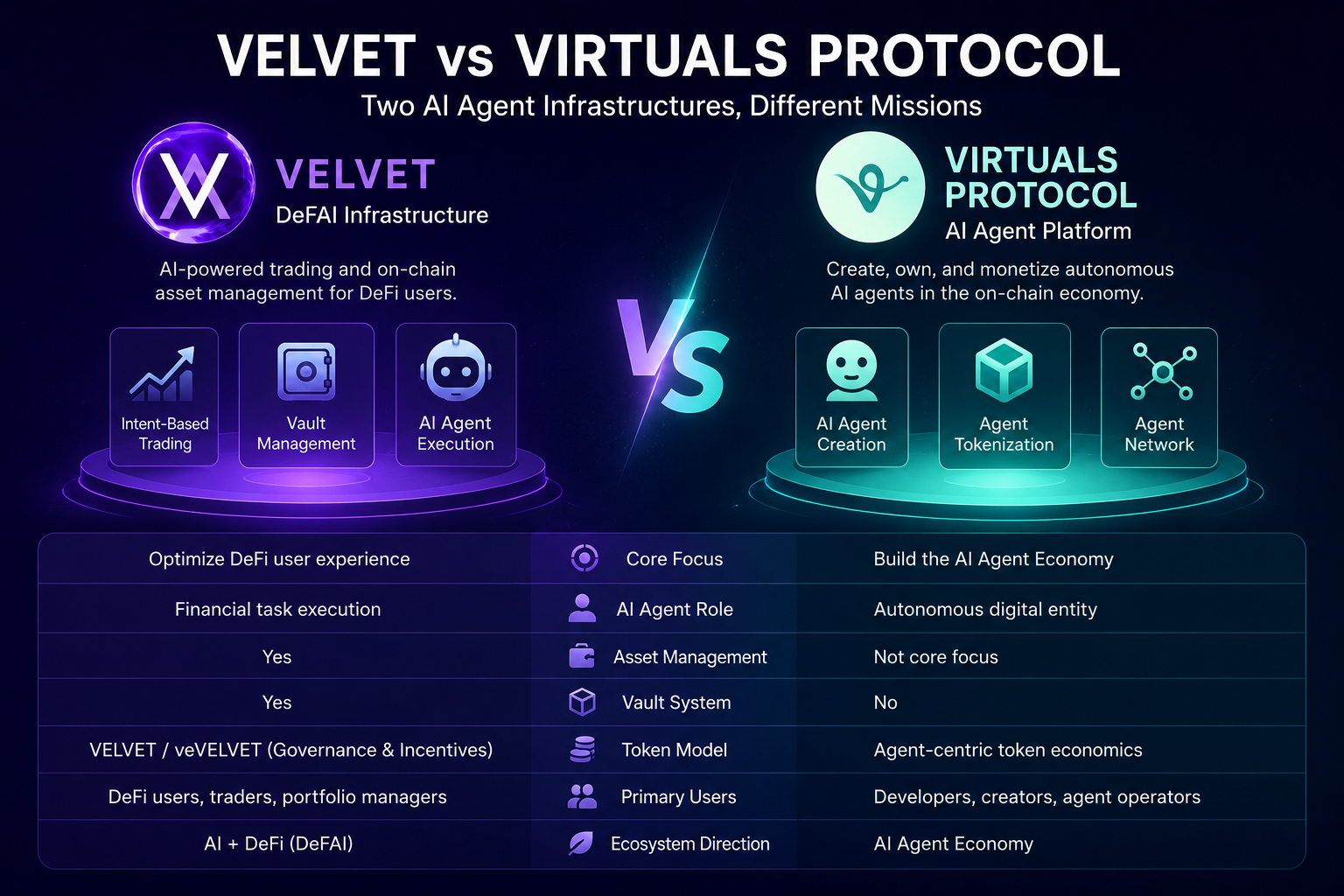
The most significant difference between Velvet and Virtuals lies in their product positioning.
Velvet is built for DeFi users, with the primary mission of helping them trade, allocate assets, and manage portfolios. AI Agents in Velvet act as execution tools and intelligent assistants, with the goal of improving financial efficiency.
Virtuals Protocol, on the other hand, treats the AI Agent itself as the core product. The platform focuses on creating and operating Agents rather than helping users complete a specific financial task. For Virtuals, Agents are the main participants in the ecosystem, not auxiliary tools.
In short, Velvet asks, “How can we make DeFi easier for users?” while Virtuals asks, “How can we make AI Agents independent economic entities?”
How Do Their AI Agent Architectures Differ?
Velvet’s AI architecture is built around task execution logic.
When a user states a goal, the AI Agent parses the request, analyzes market conditions, and orchestrates the follow-up execution flow. The Agent’s role is focused on trade optimization, asset management, and strategy execution.
Virtuals Protocol’s Agent architecture emphasizes autonomy and continuity. A Virtual Agent can have its own identity, long-term memory, and the ability to interact with the external environment.
This means that Velvet’s Agent functions more like a financial assistant, while Virtuals’ Agent behaves more like a digital character that can exist over the long term and actively participate in economic activities.
How Do They Handle On-Chain Asset Management?
Asset management is one of the clearest differentiators between the two.
Velvet has built a full Vault system that lets users create portfolios, manage asset allocations, and participate in shared investment strategies. Asset management is a core component of the platform.
In Velvet’s ecosystem, Intent-Based Trading and the Vault system together form a comprehensive asset management framework. Users can both execute trades and manage their portfolios over time.
Virtuals Protocol does not prioritize asset management. While Agents can engage in on-chain activities, the platform’s focus remains on creating and operating Agents, not on portfolio management. As a result, Virtuals lacks a dedicated asset management system like Velvet Vault.
How Do Their Token Models Differ?
Velvet’s token economy is centered on protocol governance and ecosystem incentives.
The VELVET token is used for governance participation, incentive distribution, and accessing veVELVET rights. Its design mirrors that of many DeFi protocols, emphasizing long-term ecosystem growth and community governance.
Virtuals Protocol’s token system is more aligned with the Agent economy model. The platform allows AI Agents to be tied to tokens, giving them independent economic capabilities.
This approach means Virtuals is more concerned with value creation and capture by AI Agents, while Velvet focuses more on governance and operation of the protocol itself.
Which User Groups Are Best Suited for Each?
Velvet is ideal for users interested in DeFi and asset management.
For those looking to streamline trading, optimize asset allocation, or use AI to improve portfolio efficiency, Velvet offers a more direct solution.
Virtuals Protocol is better suited for AI Agent developers, Agent operators, and teams exploring Agent economy models.
For developers who want to build autonomous digital characters, design Agent business models, or study the network effects of AI Agents, Virtuals provides a more complete infrastructure.
How Do the Ecosystem Development Directions Differ?
Velvet’s ecosystem development is concentrated on DeFAI.
The platform continues to expand AI Agent capabilities in trade execution, portfolio management, and on-chain financial automation, aiming to lower the barrier to DeFi and boost asset management efficiency.
Virtuals Protocol, in contrast, focuses on the Agent Economy. The platform seeks to build an ecosystem of numerous autonomous Agents, each with its own identity, revenue sources, and independent operational ability.
Thus, while both belong to the AI Agent track, the markets they serve are fundamentally different.
Velvet vs Virtuals Protocol Comparison Table
| Comparison Dimension |
Velvet |
Virtuals Protocol |
| Core Positioning |
DeFAI Infrastructure |
AI Agent Infrastructure |
| Primary Goal |
Optimize DeFi User Experience |
Create and Operate AI Agents |
| AI Agent Role |
Financial Execution Tool |
Independent Digital Entity |
| Intent-Based Trading |
Supported |
Non-Core Function |
| Asset Management Capability |
Strong |
Weak |
| Vault System |
Supported |
Not Provided |
| Agent Tokenization |
Non-Core Direction |
Core Function |
| Primary Users |
DeFi Users & Asset Managers |
Agent Developers & Operators |
| Ecosystem Focus |
AI-Powered Financial Services |
Agent Economy |
Summary
Although Velvet and Virtuals Protocol both operate in the AI Agent track, they solve entirely different problems. Velvet focuses on DeFAI, helping users manage assets and execute on-chain financial activities through Intent-Based Trading, AI Agents, and the Vault system. Virtuals Protocol focuses on the Agent Economy, building an autonomous digital entity ecosystem through the creation, deployment, and tokenization of AI Agents. At their core, Velvet is more of an AI-driven financial infrastructure, while Virtuals Protocol is more of an operating system and economic network for AI Agents.
FAQs
What are Velvet’s core features?
Velvet’s core features include Intent-Based Trading, AI Agent-assisted execution, and the Vault portfolio management system, all designed to improve the DeFi user experience.
What are Virtuals Protocol’s core features?
Virtuals Protocol provides infrastructure for creating, deploying, tokenizing, and operating AI Agents, enabling them to participate in on-chain activities as independent digital entities.
Does Velvet support AI Agents?
Velvet uses AI Agents as tools for executing financial tasks, understanding user intent, optimizing trade paths, and supporting asset management.
Does Virtuals Protocol offer asset management?
Virtuals Protocol’s focus is on building an AI Agent ecosystem, not on asset management, so it does not have a complete portfolio management system like Velvet Vault.
Which platform is better for DeFi users?
For users who want to engage in on-chain trading, asset allocation, and portfolio management, Velvet offers features that better match their needs. Virtuals Protocol is more suited for those focused on developing and operating AI Agents.







