Tokenized Stocks are a form of digital securities that map real-world stock assets onto blockchain networks, while traditional stocks are financial assets issued and traded through stock exchanges and central securities depositories. Though both are tied to publicly traded company shares, the underlying logic and infrastructure differ significantly.
As the tokenization of Real-World Assets (RWA) continues to evolve, tokenized stocks have emerged as a key bridge between traditional finance and digital assets. As one of the most representative asset classes in the RWA space, tokenized stocks are shifting stock assets from legacy securities systems toward on-chain financial infrastructure.
What Are Tokenized Stocks
Tokenized stocks are on-chain digital assets that represent real-world stocks via blockchain technology. Their value is typically pegged to the underlying stock, and they are held and traded as digital tokens.
In most models, the issuer purchases and custodies the actual stock, then issues a proportional number of on-chain tokens. Investors hold digital certificates, while the underlying shares are managed by a custodian.
Tokenized stocks are a critical component of real-world asset tokenization and a major step toward merging blockchain with traditional securities markets.
What Are Traditional Stocks
Traditional stocks are ownership certificates issued by public companies, representing partial ownership and associated rights.
In conventional securities markets, stock trading relies on stock exchanges, brokerages, central securities depositories, and clearinghouses working in tandem. Investors trade stocks through securities accounts, with ownership records maintained by a centralized registry.
After decades of development, traditional stock markets boast mature regulatory frameworks, trading mechanisms, and investor protections, forming the backbone of global capital markets.
How Do Their Asset Structures Differ
The core difference between tokenized and traditional stocks lies in how the asset is represented.
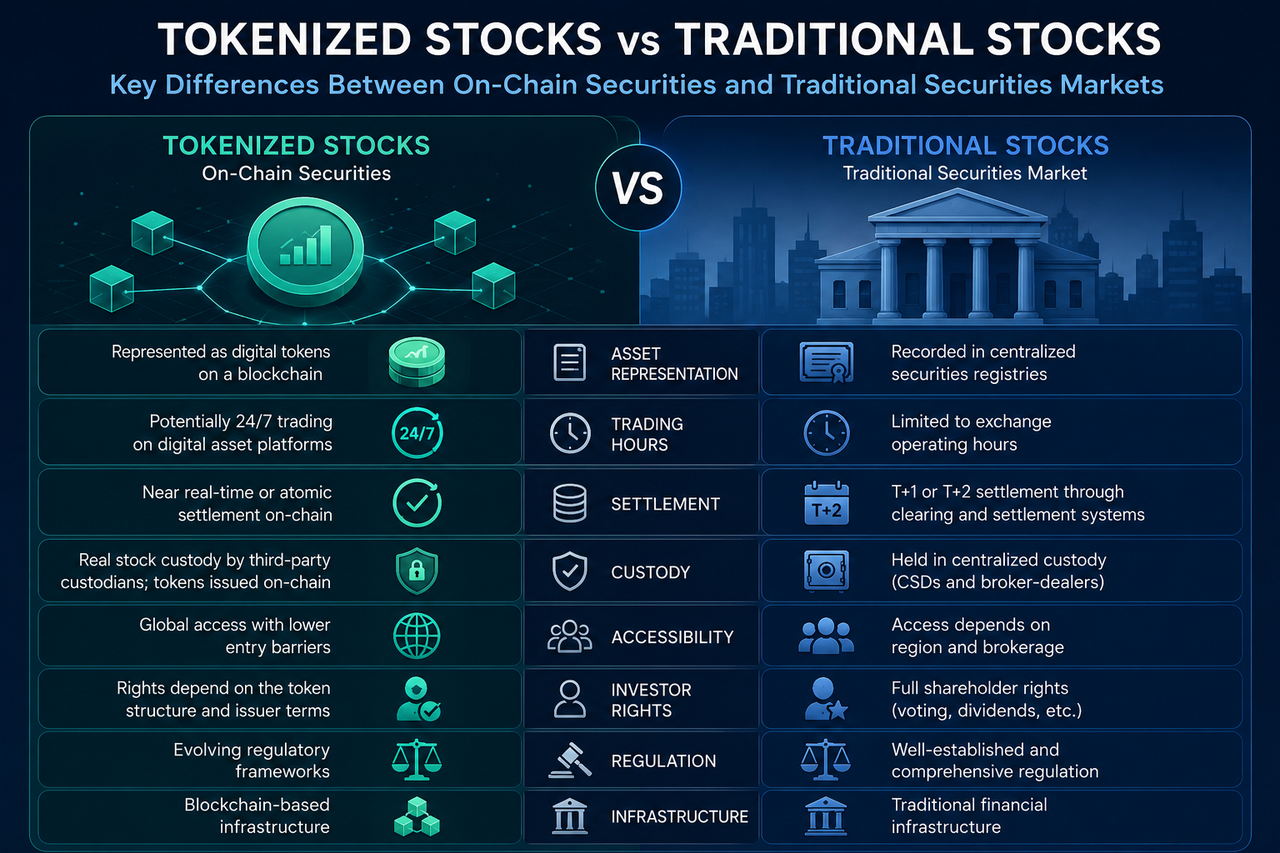
Traditional stocks are recorded in a securities registry, with investors holding shares in a brokerage account. Tokenized stocks, on the other hand, exist as digital tokens on a blockchain, held via digital wallets or platform accounts.
Both derive value from publicly traded companies, but tokenized stocks introduce additional layers: issuer, custodian, and on-chain issuance mechanism.
In essence, tokenized stocks are a digital representation built on top of traditional stocks.
How Do Their Trading Methods Differ
Traditional stock trading is limited to exchange operating hours.
Investors submit orders through brokerages, and exchanges match them. Trading is subject to market hours and regional regulations.
Tokenized stocks trade on digital asset platforms and blockchain networks.
Since blockchains operate around the clock, some tokenized stock products support extended or near-24/7 trading. Users can buy and sell through digital asset accounts without needing a traditional securities account.
This creates a stark contrast in market accessibility.
Why Do Settlement Mechanisms Differ
Settlement is one of the most distinct differences between the two.
Traditional markets typically use T+1 or T+2 settlement. After a trade, clearinghouses calculate net obligations, and the central depository completes registration.
Tokenized stocks can leverage blockchain ledgers to record transfers directly.
In some models, trade confirmation and settlement happen nearly simultaneously—a process known as atomic settlement, which eliminates intermediary delays and counterparty risk.
Thus, blockchain is seen as a way to improve settlement efficiency in securities markets.
How Do Custody Systems Differ
Traditional stock markets rely on a centralized custody system.
Investors hold stocks through brokerages, but the central securities depository handles final registration and management. Regulators oversee the entire market uniformly.
Tokenized stocks typically follow a "real stock custody + on-chain token issuance" model.
The underlying shares are held by professional custodians, while the issuer manages on-chain tokens. Investors must therefore assess the issuer and custodian, not just the stock itself.
This structure offers greater flexibility but introduces additional custody risks.
Are Investor Rights Identical
Tokenized and traditional stocks do not necessarily confer the same rights.
Traditional stocks clearly grant shareholder rights: voting, attending shareholder meetings, and receiving dividends.
Whether tokenized stocks carry these rights depends on product design.
Some tokenized stocks only offer price-linked economic exposure, without full shareholder rights. Others distribute dividends via the token structure.
Understanding product terms is essential for assessing investor rights.
How Do Regulatory Frameworks Compare
Traditional stock markets operate under mature, well-defined regulatory systems.
Securities issuance, trading, custody, and disclosure are strictly regulated. Market participants benefit from a solid legal foundation.
Tokenized stocks remain in a regulatory gray area.
Legal definitions for digital securities and tokenized stocks vary widely across jurisdictions. Some regions have established frameworks; others are still developing rules.
Regulatory uncertainty is one of the biggest challenges facing the tokenized stock market today.
Tokenized Stocks vs Traditional Stocks
| Dimension |
Tokenized Stocks |
Traditional Stocks |
| Asset Form |
On-chain digital tokens |
Securities registry entry |
| Holding Method |
Digital asset account or wallet |
Securities account |
| Trading Hours |
May support 24/7 trading |
Exchange operating hours |
| Settlement |
On-chain real-time or near-real-time |
T+1 or T+2 |
| Custody Model |
Stock custody + token issuance |
Central securities depository |
| Circulation Scope |
Global digital asset market |
Regional securities markets |
| Technical Architecture |
Blockchain network |
Traditional financial infrastructure |
| Regulatory Maturity |
Developing |
Highly mature |
| Investor Rights |
Varies by product structure |
Clearly defined |
Conclusion
Both tokenized and traditional stocks are tied to publicly traded company value, but they operate on different infrastructure. Traditional stocks rely on exchanges, brokerages, and central depositories, while tokenized stocks use blockchain for recording and transfer.
They differ significantly in asset structure, trading methods, settlement efficiency, custody models, investor rights, and regulatory frameworks.
FAQs
Are tokenized stocks equivalent to holding real stocks?
Not necessarily. Some use a 1:1 backing model; others only provide price exposure. Always review the issuance structure and product documentation.
Why are tokenized stocks settled faster?
Blockchain records asset transfers and ownership changes directly, bypassing clearing and registration steps in traditional markets.
Why is traditional stock regulation more mature?
Traditional markets have developed comprehensive legal systems, regulatory frameworks, and investor protections over decades.
Do tokenized stocks come with voting rights?
Not all do. Some only offer economic benefits. Voting rights depend on the issuance structure and product design.
Will tokenized stocks replace traditional stocks?
They are more likely to coexist. Traditional markets have mature infrastructure, while tokenized stocks offer new technological pathways and distribution methods, potentially creating a complementary relationship.