Open source software forms a core part of modern internet infrastructure. From cloud services and AI frameworks to blockchain projects, it relies on contributions from developer communities around the world. However, traditional donation and sponsorship models often struggle to measure contribution value accurately, leaving many critical projects without sustainable incentives.
Tea Protocol and Gitcoin are two representative open source incentive platforms. Both aim to turn developer contributions into economic incentives through different mechanisms, but they differ significantly in how they measure value, distribute rewards, and involve the community.
What Is Tea Protocol?
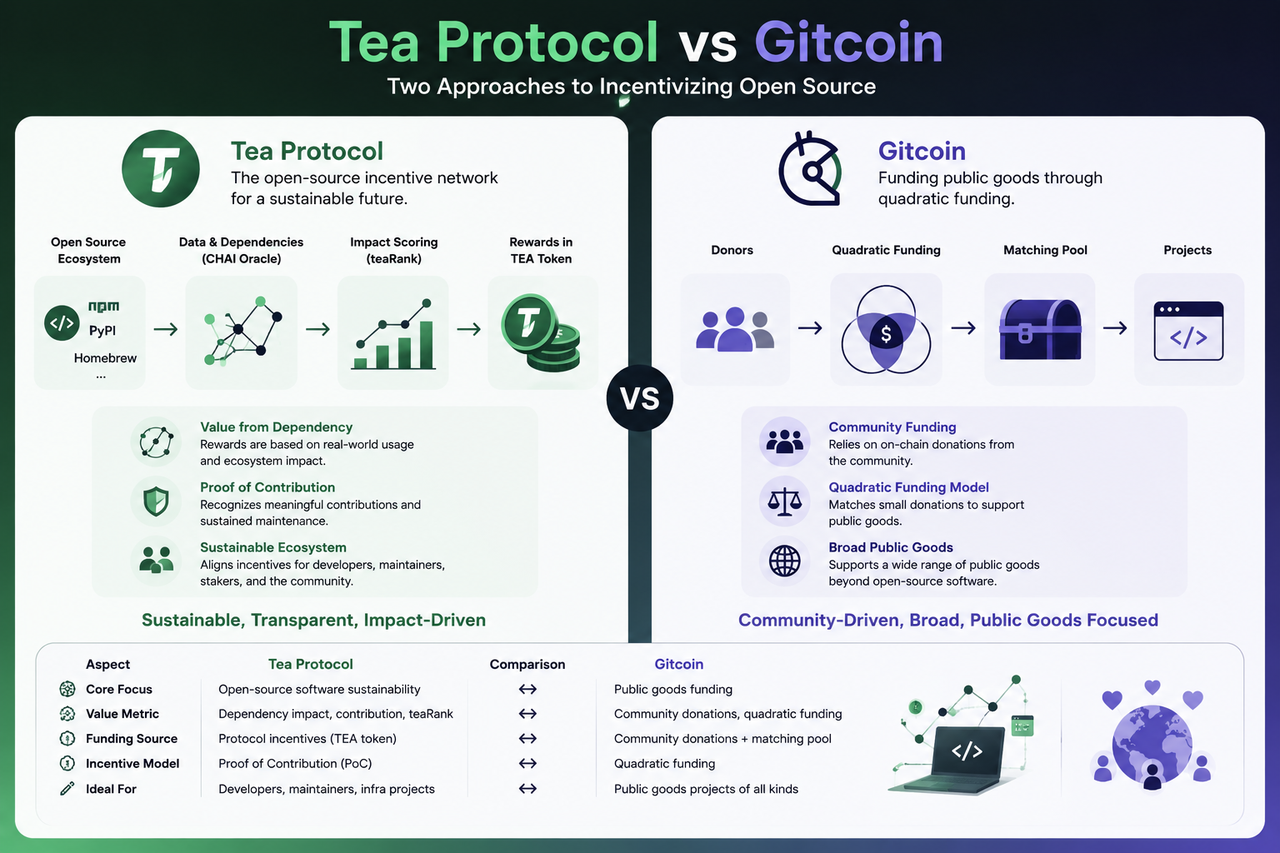
Tea Protocol is a decentralized incentive protocol designed for open source software. Through Proof of Contribution, teaRank, and on-chain reward mechanisms, it creates a sustainable value distribution system for developers and maintainers. It emphasizes the actual ecosystem value of contributions and automatically distributes rewards according to a project’s importance within the software supply chain.
Core features:
-
Contribution quantification: Measures the real impact of developers and projects through PoC and teaRank
-
Automated incentives: Distributes rewards based on contribution and ecosystem importance
-
Software supply chain security: Evaluates dependency relationships to improve the security of critical infrastructure
-
On-chain governance: TEA Token holders participate in protocol decisions
What Is Gitcoin?
Gitcoin is an open source incentive platform centered on public goods funding. It distributes funds through community donations and the Quadratic Funding model. Its goal is to encourage developers and project teams to contribute to public goods, especially projects with long term value for society or technical communities.
Core features:
-
Community funding: Amplifies the impact of small donations through Quadratic Funding
-
Public goods focus: Supports open source projects in software, education, infrastructure, and other areas
-
Contribution incentives: Project activity and funding volume together influence rewards
-
Community participation: Developers and donors jointly shape project funding allocation
Comparing Incentive Sources Between Tea Protocol and Gitcoin
| Dimension |
Tea Protocol |
Gitcoin |
| Incentive mechanism |
Proof of Contribution + teaRank |
Quadratic Funding + community donations |
| Reward trigger |
Open source contribution and ecosystem influence |
Community donations and voting |
| Level of automation |
High, with rewards calculated automatically on-chain |
Medium, relying on donations and voting |
| Ecosystem focus |
Software supply chain value |
Public goods contribution |
| Reward recipients |
Developers, maintainers, security researchers |
Developers, project teams |
Comparing Contribution Assessment Between Tea Protocol and Gitcoin
Tea Protocol focuses more on quantifying the value of each contribution within the broader software ecosystem by analyzing project dependencies and maintenance activity. Gitcoin, on the other hand, mainly relies on community voting and funding allocation to measure project value, making it more dependent on external awareness and community consensus.
Comparing Fund Distribution Between Tea Protocol and Gitcoin
Tea Protocol distributes rewards automatically based on contribution records and ecosystem influence, with an emphasis on the value of long term contribution. Gitcoin distributes rewards through community funding and the amplification effect of Quadratic Funding, relying more heavily on where funds flow and what the community chooses.
Comparing Governance Models Between Tea Protocol and Gitcoin
Tea Protocol uses TEA Token based on-chain governance, allowing holders to participate in protocol upgrades and incentive parameter adjustments. Gitcoin governance relies more on platform management and community collaboration and has not yet become fully on-chain.
Conclusion
Tea Protocol and Gitcoin both aim to address the incentive and sustainability challenges facing open source software, but they start from different assumptions and use different approaches. Tea Protocol places greater emphasis on contribution quantification and automated on-chain distribution, while Gitcoin focuses on community funding and public goods.
FAQs
What Is the Main Difference Between Tea Protocol and Gitcoin?
Tea Protocol focuses on quantifying open source contribution and ecosystem impact, with rewards distributed automatically. Gitcoin focuses on community funding and public goods contribution, with rewards depending on funding and voting.
Which Model Is Better Suited to Long Term Project Maintenance?
Tea Protocol is better suited to long term project maintenance because its rewards are tied to contribution and a project’s ecosystem influence, making it more sustainable.
How Does Tea Protocol Measure Contribution Value?
It uses Proof of Contribution and the teaRank system, combining software dependency relationships and contribution history to assess the value of projects and developers.
Where Do Gitcoin Rewards Mainly Come From?
Gitcoin rewards mainly come from community donations, with Quadratic Funding amplifying the impact of small donations.
Tea Protocol uses on-chain governance and TEA Token based decision making. Gitcoin relies on community collaboration and platform management, making its governance model more centralized.