In the medical device industry, a company's business model is typically closely tied to hospital procurement systems, long equipment lifecycles, and technology upgrade cycles. Compared to consumer goods, medical devices have stronger technological barriers and customer stickiness, resulting in stable revenue growth and long-term repeat purchases.
From an industry structure standpoint, SYK operates in a market driven by both technology and integration with healthcare systems. Its business model relies not only on product sales but also on long-term partnerships with hospital systems and continuous product innovation.
SYK (Stryker) Stock Overview
SYK is the ticker for Stryker Corporation, headquartered in the U.S. and one of the world's largest medical device companies by market cap. It is listed on the New York Stock Exchange, with operations spanning multiple countries. Its customers primarily include hospitals, healthcare institutions, and surgeons.
SYK is not a single-product company but a multi-business medical technology group. Its core businesses revolve around high-end medical technologies such as orthopedics, surgical equipment, and medical robotics. It strengthens its competitive position by continuously expanding its product portfolio.
In the capital markets, SYK is widely regarded as a bellwether in the medical device industry. Its business model is closely tied to healthcare demand, aging population trends, and medical technology upgrades, giving it strong research value.
Stryker (SYK) Revenue Sources and Structure
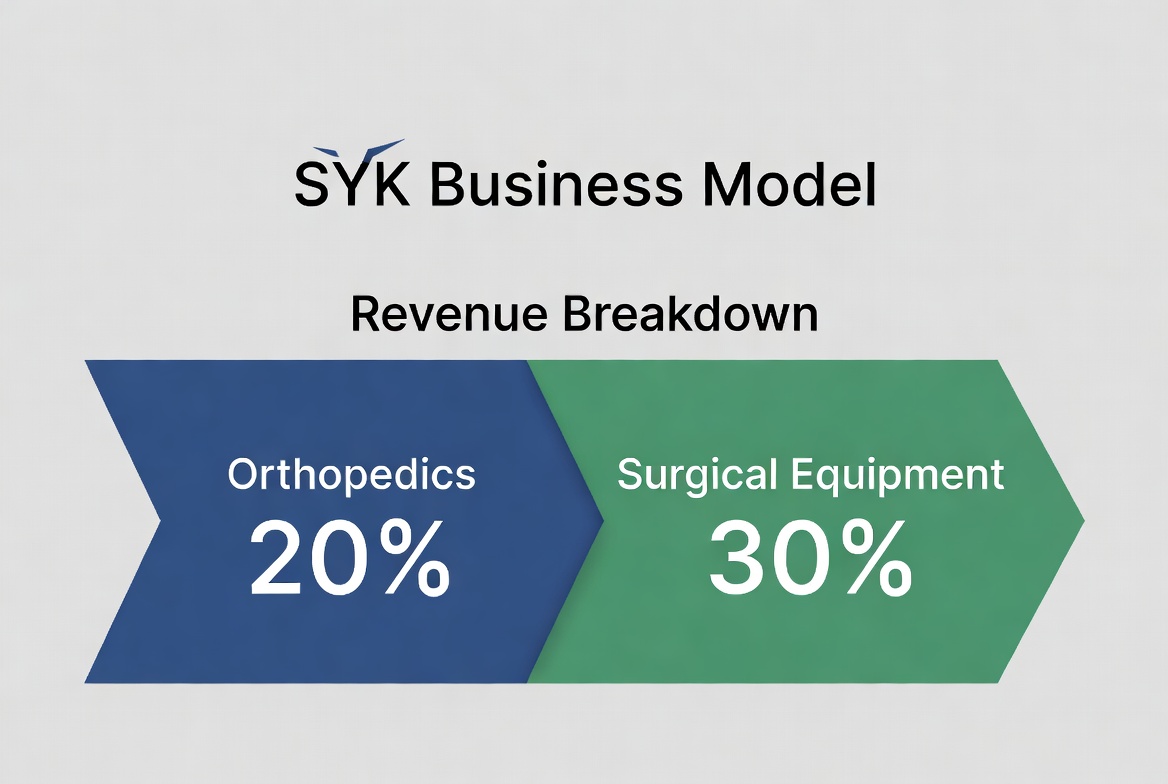
SYK's revenue comes from several medical segments, with orthopedic implants and surgical equipment solutions being the core. While different business lines contribute varying amounts of revenue, the overall portfolio is well-balanced.
The orthopedic business typically generates stable, long-term revenue, while surgical equipment and medical technology solutions provide growth drivers. This structure lets SYK balance stability with growth while reducing reliance on any single product.
From an industry perspective, medical device revenue is closely linked to hospital procurement cycles, equipment upgrade cycles, and surgical volumes. As a result, SYK's revenue is both cyclically stable and highly predictable.
How SYK's Orthopedic Implant Business Generates Revenue
Orthopedic implants are one of SYK's core businesses, including joint replacement, trauma repair, and spinal products. These products are used in long-term medical treatment scenarios and carry high technical barriers and certification requirements.
Revenue primarily comes from hospital procurement and surgical use. Because orthopedic implants require surgical implantation, sales are not just product transactions but are tightly integrated with the medical service process, creating a high barrier to entry.
The orthopedic business is characterized by "high barriers, long cycles, and stable demand." As the population ages, demand for joint replacement and orthopedic surgeries continues to grow, providing a long-term growth foundation for this segment.
How Stryker's Surgical Equipment and Surgery Solutions Drive Growth
Beyond orthopedics, SYK has a strong presence in surgical equipment and surgery solutions, including operating room equipment, endoscopy systems, and digital surgery platforms. This segment is more driven by technology upgrades.
Surgical equipment typically has shorter upgrade cycles. Hospitals upgrade based on technological advances and efficiency needs, giving this business strong growth potential. These devices are often integrated with software systems to improve overall medical workflow efficiency.
Surgery solutions are evolving toward digitalization and intelligence, such as surgical navigation systems and robot-assisted technologies. These trends provide SYK with new growth opportunities and strengthen its position in the high-end medical device market.
How SYK's R&D and Innovation Boost Product Competitiveness
R&D capability is a core driver of SYK's business model. The medical device industry demands extremely high technical standards. New products must pass strict regulatory approvals and clinical validation, making R&D investment a direct determinant of competitiveness.
SYK continuously invests in orthopedic materials, biotechnology, and medical robotics, improving product performance and safety through technology upgrades. This sustained innovation enables the company to launch next-generation medical solutions and maintain market leadership.
Medical device companies typically rely on long-term technological accumulation rather than short-term product iterations. Therefore, SYK's R&D system not only impacts product competitiveness but also directly determines its long-term position in the global medical market.
How Customer Stickiness and Hospital Procurement Strengthen Earnings Stability
SYK's primary customers are hospitals and healthcare institutions, whose procurement systems are typically long-term and standardized. Once a supplier's products are embedded in a hospital system, replacement costs are high, creating strong customer stickiness.
Procurement of medical devices also involves surgeon preferences, equipment compatibility, and training systems. These factors further increase switching costs, enabling the company to maintain long-term relationships.
This structure gives SYK strong revenue stability. As equipment and technology are upgraded, hospitals tend to make upgrade purchases from existing suppliers, creating a continuous revenue stream.
Summary
SYK's business model is fundamentally a long-term system driven by medical technology. It generates stable revenue through orthopedic implants, growth through surgical equipment and digital solutions, and long-term customer relationships through R&D innovation and hospital system integration.
SYK represents the classic "high barriers, long cycles, strong stickiness" structure of the medical device industry. Its growth logic is built on technological innovation, demographic shifts, and upgrades in the global healthcare system.
FAQ
What are SYK's main businesses?
SYK's main businesses include orthopedic implants, surgical equipment, and medical technology solutions, covering hospital surgical treatments and medical device systems.
Why is SYK's orthopedic business important?
The orthopedic business has high technical barriers and long-term demand. As the population ages, demand for related surgeries continues to rise, making it a core revenue source.
How does the surgical equipment business affect SYK's growth?
Surgical equipment has regular upgrade cycles. Hospitals make upgrade purchases as technology advances, giving this business strong growth potential.
What are the characteristics of SYK's business model?
Its core characteristics are high customer stickiness, long-term procurement relationships, and technology-driven growth, with stable and predictable revenue.
Why is customer stickiness high in the medical device industry?
Because hospital procurement systems are complex, equipment lifecycles are long, and it involves surgeon training and system compatibility, resulting in high replacement costs.