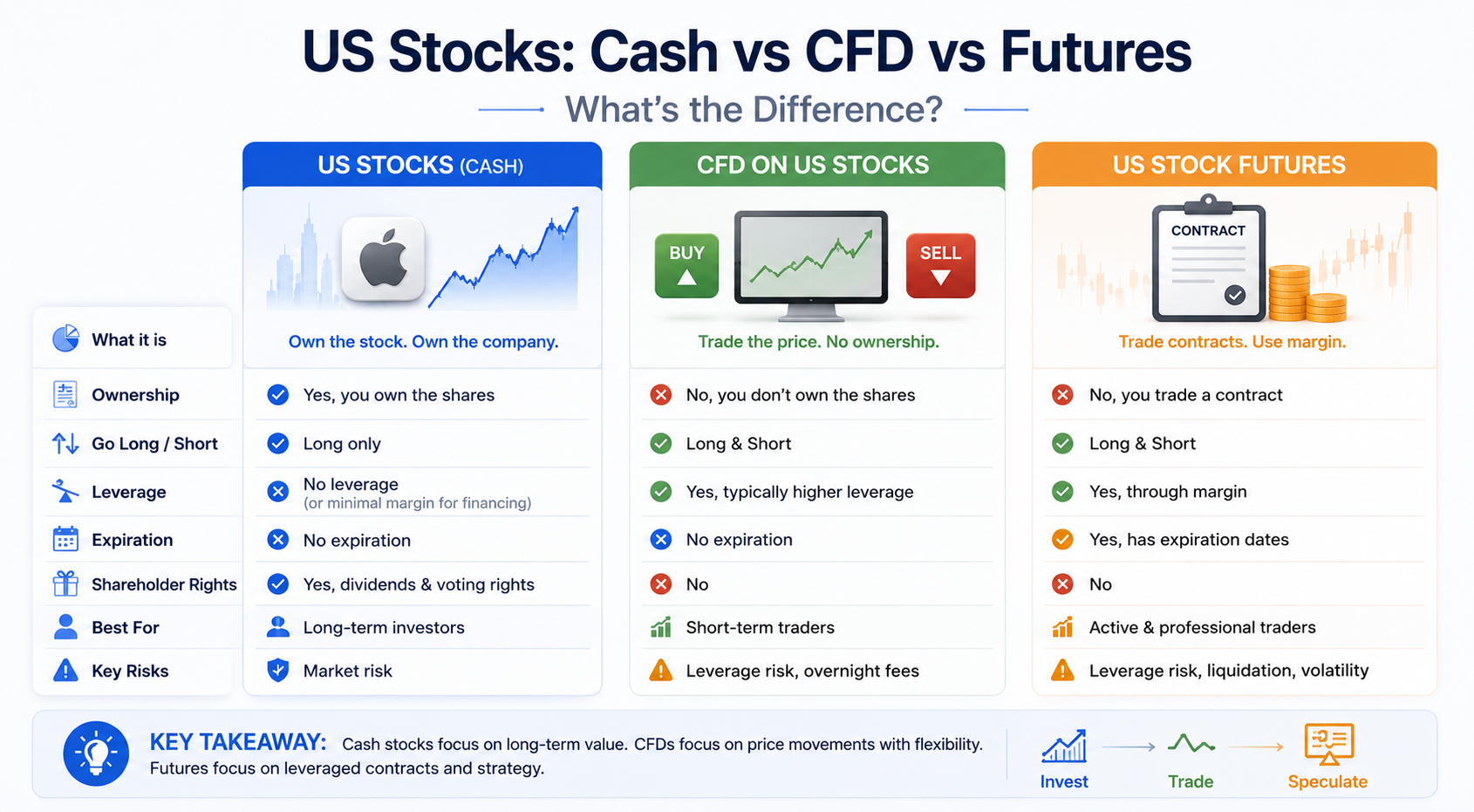
As the U.S. stock market continues to draw global investors, more people are exploring how to access American capital markets. But "buying U.S. stocks" isn't limited to one approach. Beyond traditional spot trading, products like CFD and futures on U.S. stocks frequently appear on investors' radars. While all are tied to U.S. stock prices, their underlying mechanics, risk profiles, and use cases differ markedly. For newcomers to the U.S. equity market, grasping these differences not only helps in picking the right investment vehicle but also prevents unnecessary risk borne from product misunderstanding.
This article breaks down the distinct features of U.S. stock spot, CFD, and futures, and examines why, in the current market climate, more investors are refocusing on the spot market.
Why Do So Many Investors Mix Up These Three Trading Methods?
When discussing U.S. stock investing, many habitually lump spot, CFD, and futures together as "U.S. stock trading." On the surface, they all relate to price action in names like Apple, Microsoft, Nvidia, and Meta. When Nvidia rises, spot investors can profit, CFD traders can profit, and futures traders can profit too.
But beneath the surface, the operational logic of these three products is fundamentally different. The core question is this: Does the user actually own the stock, or are they simply trading on price moves? Understanding this distinction is the key to telling these U.S. stock trading methods apart.
What Are U.S. Stock Spot?
U.S. stock spot is the most traditional and straightforward investment method. When an investor buys shares of a company, they are essentially holding a piece of that company's equity. Buying Nvidia stock, for example, makes the investor a shareholder. Even if the stake is tiny, the investor legally owns those shares.
Thus, the hallmarks of U.S. stock spot are:
- Actual ownership of the stock
- Entitlement to shareholder rights
- Ability to hold for the long term
- Participation in corporate growth value
How to Participate in the U.S. Capital Market
Over the past several years, the U.S. stock market has churned out numerous long-term winners. From Apple and Microsoft to Nvidia and Meta, these companies' long-term growth has delivered substantial returns for spot investors. For those who believe in a company's future and seek compound returns over time, U.S. stock spot is typically the more logical choice.
What Are CFD U.S. Stocks?
A CFD (Contract for Difference) is a derivative trading instrument. Unlike spot, CFD traders never actually own the stock. The entire trade revolves around predicting price movement. If an investor thinks Nvidia will go up, they buy a Nvidia CFD; if they think it will go down, they open a short position. The final profit or loss comes from the difference between the entry and exit prices.
CFD products generally offer:
- No actual stock ownership
- Ability to go long or short
- Leverage is often available
- A focus on short-term price swings
Leverage can supercharge gains, but it also amplifies losses. For instance, with 5x leverage, a 10% stock rally could yield a 50% theoretical gain—but a 10% decline would also magnify the hit.
As such, CFDs are better suited for traders with market experience and solid risk management.
What Are U.S. Stock Futures?
U.S. stock futures, like CFDs, fall under the derivative umbrella. But their trading mechanics differ. Futures use a margin system: investors only need to put up a fraction of the position's value as margin to control a much larger stake. This is a major reason why the futures market sees such high capital efficiency.
Futures products typically feature:
- No actual stock ownership
- Margin-based trading
- Built-in leverage
- Expiration dates for some products
For professional traders, futures open up more strategic possibilities:
- Hedging risk
- Arbitrage
- Short-term directional plays
However, futures demand rigorous capital management and risk control. During wild market swings, leverage can dramatically magnify downside risk.
U.S. Stock Spot vs. CFD vs. Futures: A Side-by-Side Comparison
To make the differences crystal clear, here's a comparison table.
| Item |
U.S. Stock Spot |
CFD U.S. Stocks |
Futures U.S. Stocks |
| Actual stock ownership |
Yes |
No |
No |
| Shareholder rights |
Yes |
No |
No |
| Leverage available |
Typically no |
Yes |
Yes |
| Short selling allowed |
In some cases |
Yes |
Yes |
| Expiration date |
No |
No |
Some products have |
| Risk level |
Relatively low |
Higher |
Higher |
| Suitable for long-term holding |
Yes |
Generally |
Generally |
| Suitable for short-term trading |
Generally |
Yes |
Yes |
| Best for |
Investors |
Traders |
Professional traders |
From a long-term investing standpoint, the biggest gap is that spot investing focuses on corporate value growth, while derivatives trading zeroes in on price action itself.
Why Are More Investors Turning Back to U.S. Stock Spot?
The past few years have seen multiple market shakeups. Both crypto and traditional finance investors are now putting a premium on risk control and long-term returns.
Meanwhile, the rise of AI has once again spotlighted the growth value of top-tier companies. Nvidia is a prime example: it evolved from a GPU maker into a global AI infrastructure powerhouse. Its stock performance reflects fundamental business shifts and industry trends.
Other similar cases include:
- Broadcom
- Meta
- Microsoft
- Amazon
For many investors, rather than chasing high-leverage trades, holding quality companies to capture long-term growth dividends is a more compelling strategy. That's a key reason why U.S. stock spot investing has regained its luster in recent years.
Fractional Shares Are Changing the Game for U.S. Stock Investors
For the average investor, buying U.S. stocks spot comes with a practical hurdle: some top companies have high share prices. Buying a full share can require a big chunk of capital. For instance, popular tech stocks can cost hundreds of dollars or more per share.
Fractional share trading has effectively knocked down that barrier.
Investors no longer need to buy a whole share; they can purchase:
- 0.1 shares
- 0.05 shares
- 0.01 shares
This model lets users flexibly allocate assets based on their own capital, and it makes long-term dollar-cost averaging much easier to execute.
How to Access the U.S. Stock Spot Market More Easily
With global asset allocation demand on the rise, more investors want to hold both digital assets and traditional assets like U.S. stocks and ETFs from a single platform. Gate Stock Trading offers a streamlined way to do just that. Currently, Gate Stock Trading lets users trade over 10,000 U.S. stocks and ETFs using USDT, covering major U.S. exchanges and liquidity networks including NYSE, Nasdaq, NYSE Arca, NYSE American, and BATS.
For long-term focused investors, U.S. stock spot provides direct participation in corporate growth without the extra risk of high-leverage products. Plus, Gate Stock Trading supports fractional shares with a minimum of 0.01 shares. Even for high-flyers like Nvidia, Microsoft, and Amazon, investors can build positions that fit their budget.
Managing both digital assets and global securities from one account is far more convenient than juggling multiple accounts across different platforms—a major plus for global asset allocation.
Conclusion
U.S. stock spot, CFD, and futures are all tied to the U.S. stock market, but they are fundamentally different products. For users who prioritize long-term value investing, spot emphasizes corporate growth and asset allocation, while CFDs and futures cater to participants with higher risk tolerance and trading experience.
As AI, cloud computing, and the digital economy continue to evolve, the U.S. stock market remains home to a wealth of global leaders. For investors looking to share in those companies' growth, understanding the differences between products and choosing an approach that matches their risk profile is far more important than chasing short-term hype.
Risk Disclaimer: This article is for educational purposes only and does not constitute investment advice. Trading stocks, ETFs, and derivatives all carry market risk. Investors should fully understand each product's characteristics and potential risks, and make cautious decisions based on their own circumstances.







