Moving averages are among the most widely used Technical Indicators in crypto trading because they help turn noisy price action into a clearer trend line. Instead of reacting to every sudden candle, traders use moving averages to see whether price is generally rising, falling, or moving sideways.
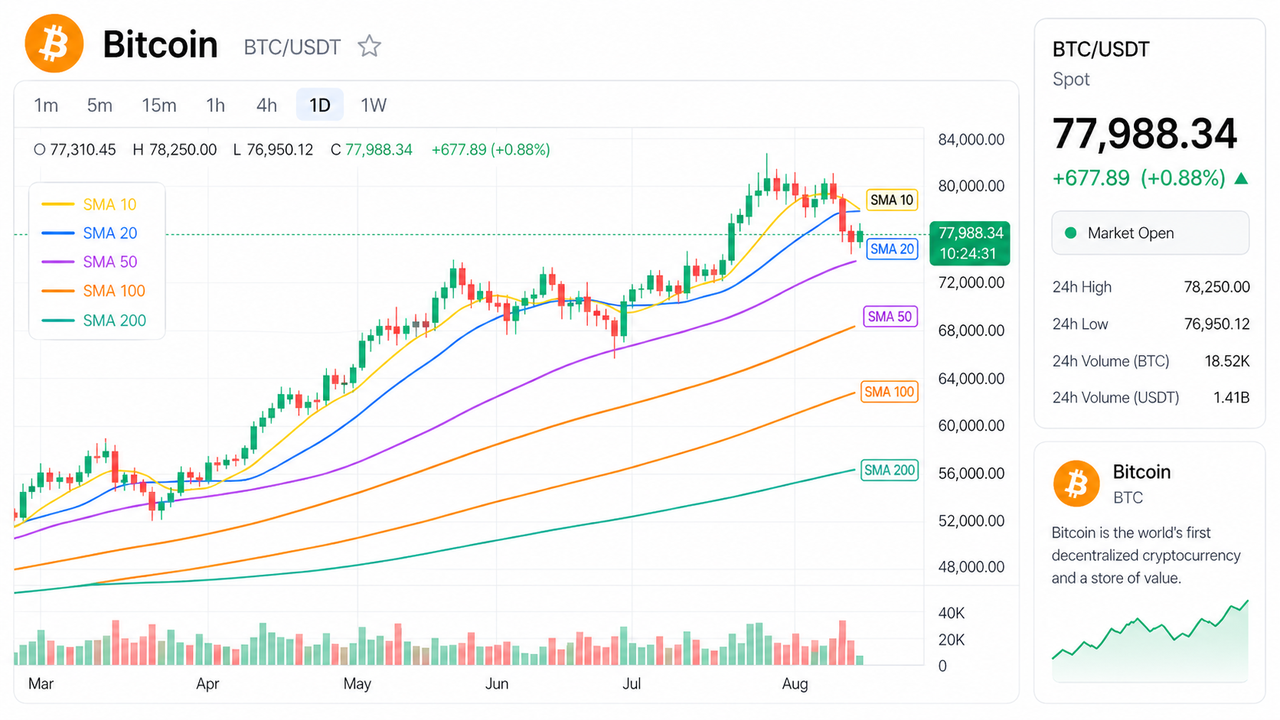
A Simple Moving Average, or SMA, is one of the most basic moving average tools. It calculates the average closing price over a selected number of candles. A 10-period SMA looks at the last 10 candles, while a 200-period SMA looks at the last 200 candles. This period setting matters because it changes how fast or slow the line responds to price.
In fast-moving crypto markets, this difference can be important. A short SMA may help traders spot near-term shifts quickly, but it can also produce more false signals. A long SMA may respond more slowly, but it often gives a cleaner view of the larger trend. This is why traders often combine several SMA periods instead of relying on only one.
The SMA period controls how much price history is included in the average. A shorter period uses fewer candles, so the line stays closer to current price. A longer period uses more candles, so the line becomes smoother and slower.
For example, the SMA 10 responds quickly when Bitcoin or another crypto asset moves sharply. It can help traders follow short-term momentum, but it may also flip direction often during choppy markets. The SMA 200, on the other hand, changes much more slowly. It is less useful for catching every short-term move, but it can help define the broader market environment.
This is where SMA differs from EMA in practical use. EMA gives more weight to recent prices, so it reacts faster. SMA treats each price in the period equally, which makes it smoother and easier to read for broader trend context. Both are moving averages, but SMA is often preferred when traders want a cleaner, less reactive reference line.
The SMA 10 is a short-term moving average that tracks recent price behavior closely. It is often used by active traders who want to understand the immediate direction of the market.
When price stays above the SMA 10, it may suggest short-term strength. When price falls below it, near-term momentum may be weakening. However, because crypto markets can move sharply in both directions, the SMA 10 can also produce noisy signals.
This period is useful for reading fast market conditions, especially on lower timeframes. A trader watching a 15-minute or 1-hour chart may use the SMA 10 to judge whether buyers are still controlling the short-term move. On a daily chart, it can act as a quick trend guide during strong rallies or pullbacks.
The SMA 10 should not be treated as a complete trading system. It works better as a short-term baseline that helps traders understand whether price is moving with or against immediate momentum.
The SMA 20 is one of the most common short-to-medium-term SMA periods. It is also widely known as the standard midline used in Bollinger Bands. Because of this, many traders already watch the SMA 20 even when they are not using it as a standalone moving average.
In crypto trading, the SMA 20 often helps define the rhythm of a short-term trend. During a strong uptrend, price may repeatedly pull back toward the SMA 20 before continuing higher. During a downtrend, price may reject near the SMA 20 before moving lower again.
The SMA 20 is slightly smoother than the SMA 10, but still responsive enough to reflect recent price changes. This makes it useful for traders who want a balance between speed and stability.
It can also help identify whether a market is stretched. If price moves far above the SMA 20, traders may watch for cooling momentum. If price stays below it for a long period, it may suggest persistent weakness.
The SMA 30 is less famous than the SMA 20 or SMA 50, but it can be useful as a stable mid-term reference. It sits between short-term and medium-term analysis, making it helpful for traders who want a smoother line without waiting for the slower SMA 50.
In volatile crypto markets, the SMA 30 can reduce some of the noise seen in shorter moving averages. It does not react as quickly as the SMA 10 or 20, but it may provide a cleaner view of whether the market is maintaining direction.
For swing traders, the SMA 30 can help identify whether a pullback is still part of a broader move or whether the trend is beginning to lose structure. If price keeps reclaiming the SMA 30 after dips, the market may still have underlying strength. If price repeatedly fails near it, sellers may be gaining control.
The SMA 30 is not a universal standard, but it can be a practical middle ground for traders who find the SMA 20 too fast and the SMA 50 too slow.
The SMA 50 is one of the most widely watched medium-term moving averages. Traders often use it to judge whether an asset is in a healthy trend or beginning to weaken.
In crypto markets, the SMA 50 can act as a trend filter. If price is above the SMA 50 and the line is rising, traders may view the medium-term trend as constructive. If price is below the SMA 50 and the line is falling, the market may be in a weaker phase.
The SMA 50 can also act as dynamic support or resistance. During an uptrend, price may pull back to the SMA 50 and bounce if buyers remain active. During a downtrend, rallies into the SMA 50 may face selling pressure.
This period is especially useful on daily charts. Many traders use it to separate normal pullbacks from deeper trend damage. A brief dip below the SMA 50 may not always be meaningful, but repeated closes below it can suggest that market structure is changing.
The SMA 100 provides a broader view than the SMA 50 while still reacting faster than the SMA 200. It is often used by traders who want to understand the medium-to-long-term trend without relying only on the slowest moving average.
In crypto trading, the SMA 100 can help confirm whether a market is still holding its larger structure. If price remains above the SMA 100, the asset may still be trading in a stronger broader trend. If price loses the SMA 100 and fails to recover it, traders may become more cautious.
The SMA 100 can be useful during transitional phases. Sometimes price breaks below the SMA 50 but still holds above the SMA 100. This may suggest that short-term weakness exists, but the larger trend has not fully broken down. If both the SMA 50 and SMA 100 begin to turn lower, the bearish case may become stronger.
This makes the SMA 100 a helpful middle layer between active trend tracking and long-term market judgment.
The SMA 200 is one of the most important long-term trend lines in technical analysis. In crypto markets, traders often use it as a broad bull and bear market reference.
When price trades above the SMA 200, the market may be viewed as structurally stronger. When price trades below the SMA 200, traders may see the environment as more defensive or uncertain. This does not mean price will automatically rise or fall, but it gives traders a useful long-term context.
The SMA 200 is slow because it includes a large amount of price history. That delay can be a weakness for short-term entries, but it is also what makes the line useful for filtering noise. It is less affected by one sudden pump or one sharp sell-off.
Many traders also watch how price behaves around the SMA 200. A strong reclaim above it may attract attention, while repeated rejection below it can show that buyers are struggling to regain control.
Because so many market participants watch the SMA 200, it can become psychologically important. It is not powerful because it predicts the future perfectly. It matters because many traders, funds, and analysts use it as a shared reference point.
| SMA Period | Main Role | Typical Use in Crypto Trading | Signal Style |
|---|---|---|---|
| SMA 10 | Short-term baseline | Tracks immediate price direction and fast momentum | Fast but noisy |
| SMA 20 | Short-to-medium reference | Common Bollinger Band midline and pullback guide | Responsive with some smoothing |
| SMA 30 | Stable mid-term reference | Helps reduce short-term noise while staying fairly responsive | Balanced |
| SMA 50 | Medium-term trend line | Used for trend judgment, pullbacks, and dynamic support/resistance | Moderate |
| SMA 100 | Medium-to-long-term reference | Helps confirm broader trend structure | Slower and steadier |
| SMA 200 | Long-term market structure | Used as a major bull/bear trend filter | Slow but widely watched |
SMA periods help traders read crypto markets from different angles. The SMA 10 and SMA 20 focus on short-term movement, while the SMA 30 and SMA 50 provide a more stable view of market direction. The SMA 100 and SMA 200 are slower, but they help traders understand broader structure and long-term trend conditions.
No single SMA period is best for every situation. A short-term trader may care more about the SMA 10 or 20, while a swing trader may focus on the SMA 50 or 100. Long-term analysts often watch the SMA 200 because it gives a broad view of whether the market is trading above or below a major trend reference.
The strongest use of SMA periods is not to predict every move, but to create context. When combined with price structure, volume, EMA, support and resistance, and other Technical Indicators, SMAs can help traders make more disciplined decisions in volatile crypto markets.
There is no single best SMA period for all crypto traders. Shorter periods such as SMA 10 and SMA 20 are useful for near-term movement, while longer periods such as SMA 100 and SMA 200 are better for broader trend analysis.
Traders use the SMA 200 because it is one of the most widely watched long-term moving averages. It helps show whether price is trading above or below a major trend reference.
SMA is not always better than EMA. SMA is smoother and gives equal weight to all prices in the period, while EMA reacts faster because it gives more weight to recent prices. Traders choose between SMA and EMA based on their strategy.
Yes. In trending markets, SMA lines can act as dynamic support or resistance. Price may bounce near an SMA during an uptrend or reject near it during a downtrend, although this does not always happen.
Yes, many traders use multiple SMA periods together to compare short-term, medium-term, and long-term trends. This can make market structure easier to read than relying on one moving average alone.