SEC Ends Investigation into Ondo Finance — No Charges Filed, Ushering in a New Era of Tokenized Assets

Beginner
Quick Reads
Last Updated 2026-03-27 01:36:51
Reading Time: 1m
The U.S. Securities and Exchange Commission has formally ended its two-year investigation into Ondo Finance, opting not to pursue any charges. This development clears the path for the legitimization of tokenized assets, prompting a swift rebound in the ONDO token.

Over the past two years, real world asset (RWA) tokenization has evolved from a conceptual idea to real-world application. Traditional financial assets—such as U.S. Treasuries, fund shares, and bonds—are now being fractionalized, traded, and settled on the blockchain, transforming global asset allocation strategies. Ondo Finance stands out as one of the most prominent projects in this field.

Because Ondo’s business directly involves U.S. Treasuries and securities, its compliance status has faced intense scrutiny from the U.S. Securities and Exchange Commission (SEC). Beginning in 2023, the SEC launched a long-term investigation into Ondo Finance, focusing on two central issues:

  • Whether Ondo’s tokenized Treasury products constitute unregistered securities offerings
  • Whether the ONDO token itself qualifies as a security

For the past two years, the investigation has not produced a public conclusion, leaving the market in a prolonged state of uncertainty. This unresolved regulatory risk has been a key factor weighing on ONDO’s valuation.

SEC Investigation Concludes: No Charges Filed

In December 2025, the SEC officially notified Ondo Finance that its investigation had concluded with no charges brought. This outcome confirms that, at least under the current regulatory framework, the SEC does not find major compliance issues with Ondo’s product structure or token model.

From a regulatory perspective, this decision is highly symbolic. It signals that U.S. regulators are now defining clearer “safe boundaries” for RWA tokenization:

As long as asset structures are transparent, underlying assets are genuine, investors are fully informed, and risk disclosures are comprehensive, tokenization is not inherently equivalent to issuing illegal securities.

ONDO Price Surges; Market Risk Premium Drops Sharply
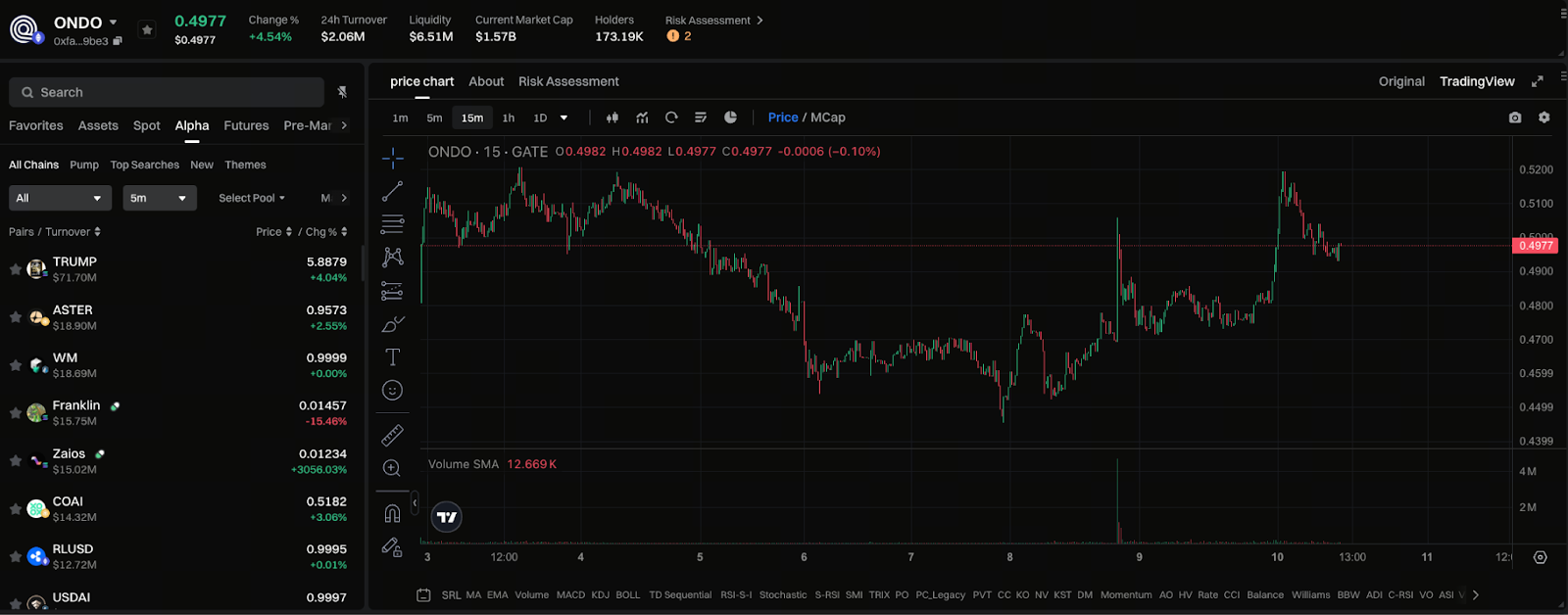

Source: https://www.gate.com/alpha/eth-0xfaba6f8e4a5e8ab82f62fe7c39859fa577269be3

Following the announcement, ONDO’s token price rallied sharply in a short period, with trading volumes surging as well. The risk premium, which had been elevated due to regulatory uncertainty, quickly contracted.

Analyzing the market structure, this rally was not just sentiment-driven. Three types of capital participated simultaneously:

  • Mid-term allocation funds that had previously stayed on the sidelines returned
  • Trend-driven capital betting on the RWA narrative increased their positions
  • Some short sellers were forced to cover at critical resistance levels

This demonstrates a fundamental shift in the market’s perception of Ondo: from a “potential regulatory risk project” to a “compliance-validated RWA leader.”

Broader Implications for the RWA Tokenization Sector

The SEC’s resolution has implications for the entire RWA sector, exceeding its direct impact on Ondo.

1. It effectively provides regulatory validation for the “tokenized U.S. Treasuries” model. Previously, many projects emulated Ondo’s structure but were concerned about systemic compliance risks. Those concerns have now been significantly eased.

2. It greatly lowers the psychological barrier for traditional financial institutions to enter the RWA space. For banks, funds, and brokerages, the primary concern was never technology, but legal liability. This event directly addresses that core issue.

3. It reinforces the legitimacy of “on-chain yield-generating assets” as a distinct asset class. RWA has moved beyond being a “fringe innovation” in crypto and is becoming a vital bridge between DeFi and traditional finance.

Ondo Finance’s Next Chapter: From Compliance to Scale

With a clear compliance pathway, Ondo Finance will shift its strategy from “proving legitimacy” to entering a phase of large-scale expansion.

Key areas to watch going forward include:

  • Expanding tokenized asset classes from Treasuries to corporate bonds and fund shares
  • Broadening the client base from crypto-native users to institutions and high-net-worth individuals
  • Deepening integration with traditional financial infrastructure

With regulatory uncertainty removed, competition in the RWA sector will center on product structure, liquidity depth, risk management systems, and global compliance capabilities.

Author: Max
Disclaimer
* The information is not intended to be and does not constitute financial advice or any other recommendation of any sort offered or endorsed by Gate.
* This article may not be reproduced, transmitted or copied without referencing Gate. Contravention is an infringement of Copyright Act and may be subject to legal action.

Related Articles

The ve(3,3) Flywheel Explained: How AERO Tokenomics Powers Aerodrome’s DeFi Economy
Beginner

The ve(3,3) Flywheel Explained: How AERO Tokenomics Powers Aerodrome’s DeFi Economy

In the competition for DeFi liquidity, high-inflation mining alone is no longer enough to build lasting advantages. Aerodrome applies the ve(3,3) economic model to redesign token emissions, voting mechanisms, and revenue distribution, creating a liquidity flywheel centered on governance and cash flow. This article examines AERO tokenomics, the veAERO locking mechanism, and protocol revenue models to explain how Aerodrome builds a sustainable DeFi economic system.
2026-03-25 06:41:58
AI-Native Settlement Layers: How United Stables Is Building the Next Financial Rail
Beginner

AI-Native Settlement Layers: How United Stables Is Building the Next Financial Rail

Stablecoins were originally designed as dollar substitutes within exchanges, primarily used for asset pricing and trade settlement. As on-chain financial ecosystems have matured, their role has expanded beyond simple payments to include collateral assets, cross-chain liquidity mediums, and unified settlement units. In particular, as AI systems and automated agents begin to participate directly in economic activity, demand has risen sharply for programmable value units capable of instant settlement. This shift is pushing stablecoins toward the role of foundational financial infrastructure.
2026-03-25 03:16:17
Aerodrome Tokenomics: How ve(3,3) Powers Base's Most Profitable DEX
Beginner

Aerodrome Tokenomics: How ve(3,3) Powers Base's Most Profitable DEX

AERO is the native token of Aerodrome Finance, a core decentralized exchange and liquidity protocol in the Base ecosystem. It is primarily used for liquidity incentives and ecosystem operations. veAERO is a governance NFT that users receive by locking AERO, representing both voting power and the right to share protocol revenue. Through a dual track structure of AERO as a utility token and veAERO as a governance credential, Aerodrome separates liquidity usage value from long term governance power, allowing participants to act as liquidity providers, governance decision makers, and revenue sharers within the same system.
2026-03-25 06:40:31
How Does PAXG Work? In-Depth Overview of the Physical Gold Tokenization Mechanism
Beginner

How Does PAXG Work? In-Depth Overview of the Physical Gold Tokenization Mechanism

PAXG (Pax Gold) is a tokenized asset backed by physical gold, issued by the fintech company Paxos and traded on the Ethereum blockchain as an ERC-20 token. The core concept is to tokenize physical gold on-chain, with each PAXG token representing ownership of a certain amount of gold. This structure enables investors to hold and trade gold in the form of a digital asset.
2026-03-24 19:12:51
How is the price of PAXG determined? Pegging mechanism, trading depth, and influencing factors
Beginner

How is the price of PAXG determined? Pegging mechanism, trading depth, and influencing factors

PAXG (Pax Gold) is a tokenized asset backed by physical gold reserves, launched by fintech firm Paxos and issued as an ERC-20 token on the Ethereum blockchain. The core concept is to digitally represent real-world gold assets, allowing investors to hold and trade gold via the blockchain network. Because each PAXG token corresponds to a specific quantity of physical gold, its price is theoretically expected to closely track the global gold market.
2026-03-24 19:11:40
DePIN Identity Network and Real World Applications: How Humanity Protocol Brings on-chain Identity Into the Physical World
Beginner

DePIN Identity Network and Real World Applications: How Humanity Protocol Brings on-chain Identity Into the Physical World

Most Web3 identity systems remain confined to on-chain environments and struggle to achieve meaningful adoption in real world settings. Through a DePIN architecture and physical verification hardware, Humanity Protocol aims to bring decentralized identity into access control systems, hospitality, public services, and offline events, allowing on-chain identity to function not just as a digital credential, but as foundational infrastructure for real world access.
2026-03-25 07:40:53





