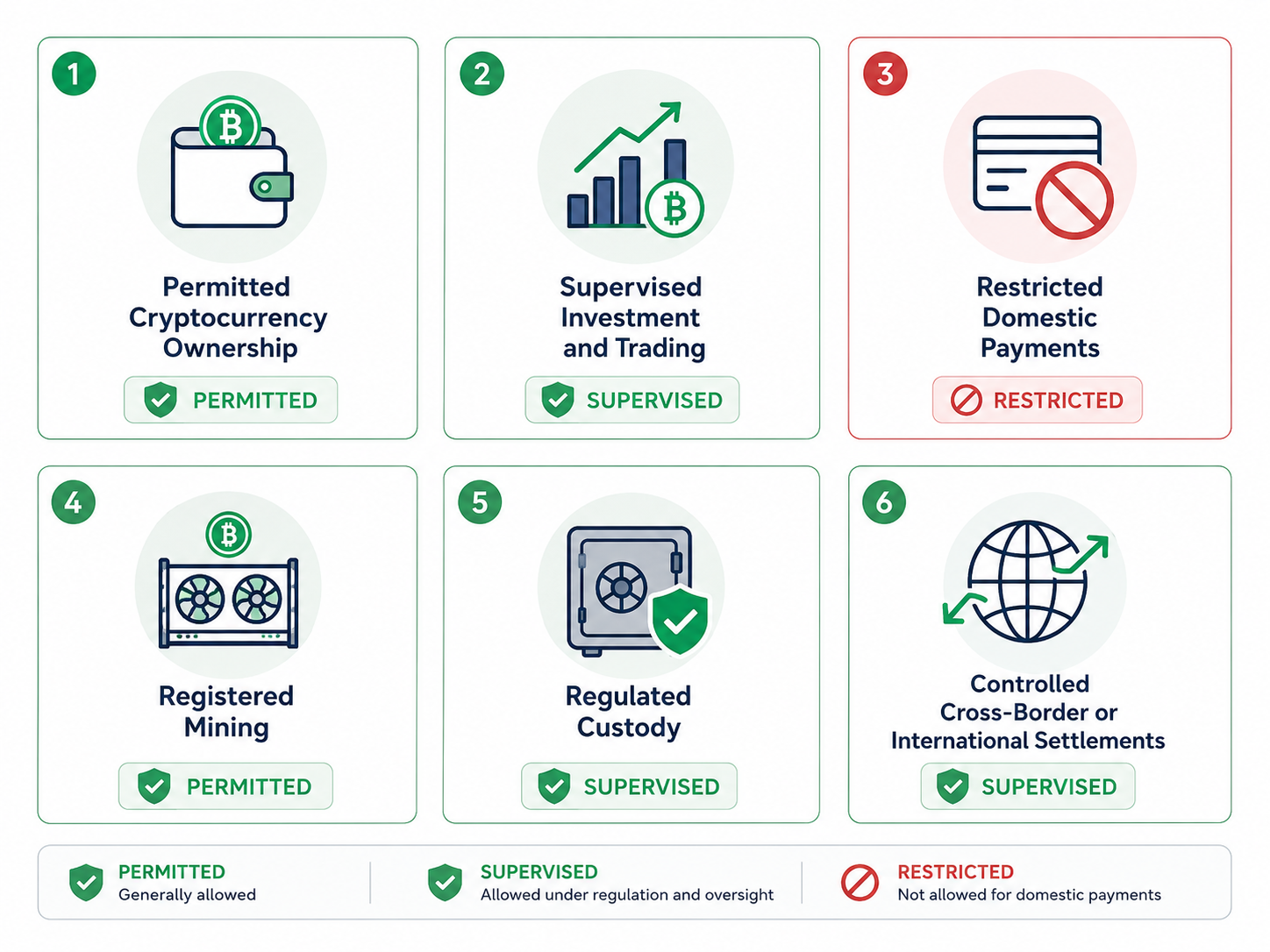
The Russia cryptocurrency legal framework permits cryptocurrency ownership, regulated mining and selected international settlements, but decentralized cryptocurrency is not legal tender and generally cannot be used for domestic payments. Russia is also developing a comprehensive law that would bring crypto trading, brokerage and custody under licensed financial-market supervision.
TL;DR
-
Russia generally treats cryptocurrency as property or a digital investment asset, not as an alternative to the ruble.
-
Cryptocurrency cannot ordinarily be used to pay for domestic goods, services or work.
-
Mining is legal when registration, electricity, reporting and tax requirements are satisfied.
-
Selected cross-border crypto settlements are permitted through an experimental legal regime.
-
Bill No. 1194918-8 proposes a comprehensive framework for exchanges, brokers, custodians and investor access, but final enactment was not confirmed in official records reviewed on July 22, 2026.
Has Russia Passed a Comprehensive Crypto Regulation Bill?
Reports that Russia passed a comprehensive crypto regulation bill refer to Bill No. 1194918-8, titled On Digital Currency and Digital Rights. However, the latest official records reviewed for this article do not yet confirm that the bill has completed every stage required to become an effective federal law.
The Russian government introduced the bill on April 1, 2026. The official State Duma record and the text available through Russia’s legal-information system confirm adoption in the first reading on April 21, 2026. The bill’s explanatory documents state that it is intended to make the crypto market more transparent, establish service standards and protect investors.
Some recent media and industry reports claim that the State Duma subsequently approved the bill in later readings. Until the official legislative record shows final State Duma adoption, Federation Council consideration and presidential signature, the proposal should be described as an advancing comprehensive crypto bill rather than an operative federal law.
This distinction affects reported provisions such as retail investment limits, commencement dates and eligible-asset requirements. Those details should not be presented as enforceable until they appear in the final officially published text.
What Is the Russia Cryptocurrency Legal Framework?
The Russia cryptocurrency legal framework is a collection of existing laws, tax rules, mining regulations, central-bank measures and proposed market legislation.
Russia distinguishes decentralized cryptocurrency from regulated digital financial assets and the digital ruble. Bitcoin is therefore not legally equivalent to either a tokenized financial right issued through an approved Russian system or the central bank’s digital currency.
| Activity or asset |
Current general position |
Main restriction or requirement |
| Holding cryptocurrency |
Generally permitted |
Ownership, transaction and tax records may be required |
| Buying or selling crypto |
Permitted in principle |
Financial-monitoring and intermediary rules may apply |
| Domestic crypto payments |
Generally prohibited |
The ruble remains the principal domestic payment instrument |
| Cryptocurrency mining |
Legal under conditions |
Registration, electricity, reporting and tax rules apply |
| Cross-border settlements |
Permitted through controlled arrangements |
Eligibility and compliance requirements apply |
| Crypto exchanges and custody |
Comprehensive licensing framework proposed |
Final law and Bank of Russia rules remain necessary |
| Digital ruble |
State-issued central bank money |
Separate from decentralized cryptocurrency |
The practical answer to whether cryptocurrency is legal in Russia depends on the activity. Owning Bitcoin, operating a mining facility and accepting Bitcoin for a domestic retail sale are governed differently.
What Would Bill No. 1194918-8 Change?
Bill No. 1194918-8 would move Russia from fragmented crypto regulation toward a unified market supervised through licensed financial institutions.
The draft defines digital currency, digital rights, digital accounts, mining and mining pools. It also identifies the entities that may organize the circulation of digital currencies and digital rights. Existing participants in an experimental legal regime could receive a simplified route into the new system.
The proposal focuses on three areas.
Crypto exchanges, brokers, asset managers and custodians operating within Russia’s regulated market would need authorization and would be subject to supervisory requirements.
These rules could cover:
-
minimum capital and governance;
-
client identification and anti-money-laundering controls;
-
transaction monitoring and recordkeeping;
-
cybersecurity and operational resilience;
-
segregation of client assets;
-
regulatory reporting and audits.
The proposal would make regulated crypto businesses resemble conventional financial-market institutions rather than informal trading services.
Investor Access
The framework would allow cryptocurrency to be offered as a supervised investment asset while preserving stronger restrictions for non-qualified investors.
Earlier policy proposals discussed knowledge testing, financial thresholds and purchase limits. However, the final value of any retail cap cannot be verified from an enacted and officially published version of Bill No. 1194918-8. A reported limit such as 300,000 rubles should therefore remain outside the publish-ready legal summary until confirmed by the final text or a Bank of Russia regulation.
Eligible Cryptocurrencies and Custody
The Bank of Russia would be expected to determine which digital currencies could be offered through licensed domestic services and what standards custodians must follow.
Possible criteria may include liquidity, reliable pricing and market history, but no definitive list of eligible cryptocurrencies should be stated before the regulator publishes it. The draft creates the legal structure for supervised circulation rather than permanently naming Bitcoin, Ether, USDT or another asset as approved.
Can Cryptocurrency Be Used for Payments in Russia?
Cryptocurrency generally cannot be used to pay for ordinary goods, services or work inside Russia.
Russia permits cryptocurrency to function as property, an investment asset or, under special arrangements, an international settlement instrument. It does not generally permit decentralized cryptocurrency to compete with the ruble as domestic money.
The economic purpose of a transaction determines which rule is relevant:
-
Buying cryptocurrency as an investment may be permitted.
-
Paying a Russian retailer in cryptocurrency is generally prohibited.
-
Exchanging one crypto asset for another may fall under trading rules.
-
Settling an eligible foreign-trade transaction may be permitted through a controlled regime.
-
Moving assets between wallets owned by the same person may be lawful, but records should establish common ownership.
Describing a retail purchase as a “digital transfer” would not necessarily avoid the payment restriction when cryptocurrency is the consideration for goods or services.
How Do Cross-Border Crypto Settlements Work?
Russia allows selected international cryptocurrency settlements under an experimental legal regime supervised by the Bank of Russia.
The arrangement is designed for eligible foreign-trade transactions rather than unrestricted consumer payments. A Russian exporter or importer may use an approved structure involving identity checks, transaction monitoring, designated settlement infrastructure and accounting records.
A simplified process includes:
-
The parties enter an eligible foreign-trade contract.
-
The Russian participant uses an approved settlement route.
-
The intermediary performs identity, sanctions and source-of-funds checks.
-
Cryptocurrency is transferred to the foreign counterparty.
-
The transaction is recorded for accounting and tax purposes.
Permission under Russian law does not override foreign law. A recipient, wallet provider or exchange may still reject a transaction because of sanctions, anti-money-laundering controls or restrictions in another jurisdiction.
Is Cryptocurrency Mining Legal in Russia?
Cryptocurrency mining is legal when miners comply with registration, energy, reporting and tax requirements.
Legal entities and individual entrepreneurs conducting mining activity may need to join the relevant Federal Tax Service register. Private individuals can be subject to electricity-consumption thresholds, while regional or seasonal restrictions may apply where mining threatens grid stability.
Miners must verify four points: whether registration is required, whether mining is permitted in the location, how mined assets must be reported and how income and expenses are taxed. Electricity theft, false metering, operation in a restricted territory or concealment of income can create separate liability.
How Is Cryptocurrency Taxed in Russia?
Russia generally treats cryptocurrency as property for tax purposes, so taxable income may arise from mining, selling or disposing of digital currency.
Individuals and businesses should retain acquisition prices, disposal proceeds, wallet addresses, transaction hashes, fees and mining expenses. A transfer between wallets owned by the same person may not have the same tax effect as a sale, but the owner must be able to prove common control.
The exact tax result depends on the taxpayer and transaction structure. Russian tax rules and official guidance should be checked before filing or completing a material transaction.
How Could the Framework Affect Russia’s Crypto Market?
A comprehensive Russia crypto law could expand institutional participation while making the domestic market more centralized, visible and expensive to operate.
Licensed banks, brokers and custodians would gain clearer routes to offer cryptocurrency services. This could improve recordkeeping and legal accountability, but capital, cybersecurity, audit and compliance obligations would raise costs. Larger financial institutions may be better positioned to satisfy those requirements than smaller crypto businesses.
Retail investors could receive clearer legal access but less freedom. Knowledge tests, purchase restrictions and approved-asset lists may reduce exposure to thin or fraudulent tokens while narrowing the range of available services.
The framework would also give authorities more information linking customers, transactions and wallets. Greater visibility could support tax and anti-money-laundering enforcement, although users seeking privacy or broader asset access may continue using foreign platforms, peer-to-peer markets or self-custody.
For cross-border trade, formal crypto channels may provide another settlement route. The benefit remains limited by sanctions risk, foreign compliance requirements, liquidity and the willingness of counterparties to accept Russian-linked transactions.
What Risks and Uncertainties Remain?
The largest immediate risk is confusing a proposed or parliament-approved bill with a law that has entered into force.
Other uncertainties include:
-
the final wording of Bill No. 1194918-8;
-
Federation Council and presidential approval;
-
official publication and commencement dates;
-
Bank of Russia licensing requirements;
-
retail investor limits;
-
the approved-asset methodology;
-
treatment of self-custody and foreign platforms;
-
regional mining restrictions;
-
international sanctions and counterparty risk.
The Russia cryptocurrency regulation timeline shows why these distinctions matter: Russia’s framework has developed through multiple laws, amendments and experimental measures rather than one single legalization event.
Conclusion
The Russia cryptocurrency legal framework already permits cryptocurrency ownership, regulated mining and selected international settlements while generally prohibiting domestic crypto payments.
Bill No. 1194918-8 would add a comprehensive system for licensed trading, brokerage, custody and investor access. However, official records reviewed on July 22, 2026 did not confirm final enactment, an operative retail investment limit, a definitive eligible-asset list or a legally effective commencement date.
The final market impact will depend on the enacted text and Bank of Russia implementation rules. This content is educational and does not constitute legal, tax, sanctions or investment advice.
FAQs
Has Russia fully legalized cryptocurrency?
Russia permits several cryptocurrency activities, but it has not made decentralized cryptocurrency legal tender. Domestic payments remain generally restricted, while ownership, mining, investment and selected foreign-trade uses follow separate rules.
Has Bill No. 1194918-8 become law?
Official records reviewed on July 22, 2026 confirm introduction and first-reading approval but do not yet confirm completed enactment. Final State Duma action, Federation Council approval, presidential signature and official publication should be verified before calling it an effective federal law.
Can Russians use Bitcoin to buy goods?
Bitcoin generally cannot be used to pay for ordinary domestic goods or services in Russia. Bitcoin may instead be held or traded as property or an investment asset under applicable rules.
Is cryptocurrency mining legal in Russia?
Cryptocurrency mining is legal when registration, reporting, tax, electricity and regional requirements are satisfied. Mining may be restricted in particular territories or during periods of electricity stress.







