The tokenization of real-world assets has become a major development trend in the blockchain industry. As more traditional financial institutions begin adopting blockchain technology, assets such as Treasury bonds, credit, fund shares, and real estate are progressively entering the on-chain market. Compared to crypto-native assets, real-world assets boast a significantly larger market size, positioning them as a critical bridge between traditional finance and digital finance.
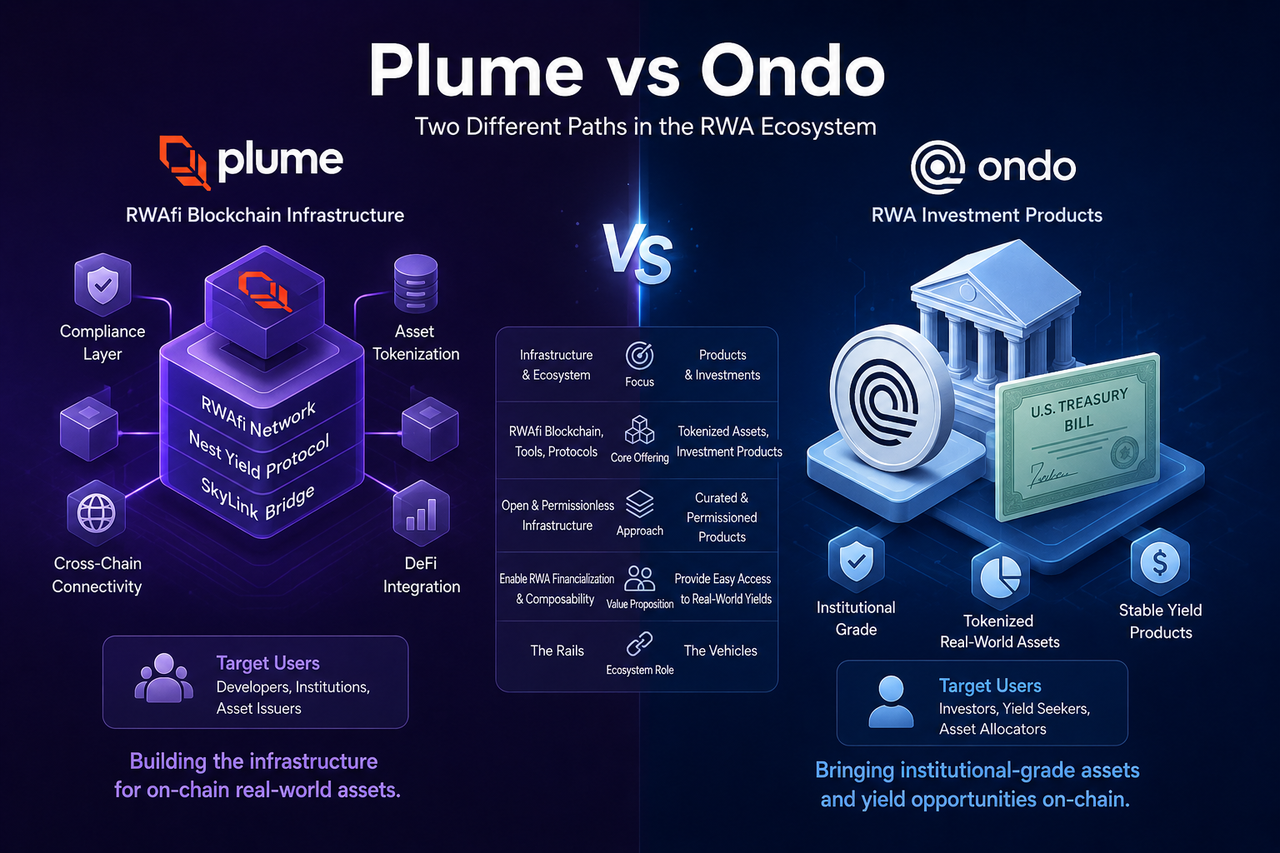
As the sector matures, the RWA ecosystem has splintered into multiple specialized subfields. Plume operates closer to the underlying infrastructure and public chain layer of the RWA space, while Ondo functions more as a financial product issuer built on top of RWA. The two represent distinct development pathways for bringing real-world assets on-chain: one constructs the foundational network, the other builds specific financial products.
Plume and Ondo: A Brief Analysis
As an infrastructure network purpose-built for the financialization of real-world assets, Plume introduces the concept of RWAfi (Real World Asset Finance). Its goal is to enable real-world assets not only to be issued on-chain but also to participate in lending, yield management, liquidity provisioning, and cross-chain applications. To this end, Plume has developed a full-fledged ecosystem encompassing asset issuance, compliance management, data services, and yield protocols.
Ondo, on the other hand, is a blockchain project dedicated to issuing investment products based on real-world assets. Its primary business is mapping traditional financial products onto the on-chain environment.
One of Ondo's best-known achievements is bringing U.S. Treasury yield products to the blockchain, allowing users to gain exposure to returns from traditional financial assets via digital tokens. Through standardized product design and institutional partnerships, Ondo aims to lower the entry barrier for users accessing traditional financial assets.
How Do Plume and Ondo Differ in Project Positioning?
Project positioning is the most fundamental distinction between Plume and Ondo.
Plume's objective is to build the infrastructure required for the financialization of real-world assets, offering a unified technical framework for developers, asset issuers, and financial institutions. Plume focuses on how to get more real-world assets smoothly into the on-chain ecosystem and enable them to engage in various financial activities.
Ondo, by contrast, is primarily oriented toward the investment market. Ondo concentrates on designing and issuing standardized financial products that allow investors to access real-world asset yields through on-chain means. Compared to infrastructure development, Ondo emphasizes product operations and asset management capabilities.
In simple terms, Plume is more like a platform that builds the market, while Ondo is a participant offering products within that market.
How Do Plume and Ondo Differ in Technical Architecture?
Plume and Ondo follow distinctly different technical approaches.
Plume uses a dedicated infrastructure architecture designed specifically for real-world asset scenarios. Its network supports not only asset tokenization but also on-chain compliance, data verification, cross-chain interoperability, and DeFi integration. Plume aims to be the underlying operating system for real-world asset financialization, enabling different institutions to issue, manage, and circulate assets within a unified network.
In contrast, Ondo does not prioritize building its own proprietary public chain. Ondo instead leverages existing blockchain ecosystems to issue real-world asset products and deliver standardized financial instruments to investors via mature on-chain infrastructure. Consequently, Ondo's focus is on the product layer rather than the underlying network.
How Do Plume and Ondo Differ in Asset Issuance Models?
Plume and Ondo also diverge in their approaches to real-world asset issuance.
Plume offers an open issuance framework that allows qualified asset managers, financial institutions, and projects to tokenize real-world assets through its network. Plume prioritizes standardizing issuance capabilities, aiming to reduce both the technical and compliance barriers for different assets entering the on-chain market.
Ondo more closely resembles a traditional financial product issuer. It primarily operates around its own designed product structures, packaging assets such as Treasury bonds into standardized on-chain products that serve as investment gateways for users. Therefore, Ondo's issuance model is product-driven rather than an open platform model.
How Do Plume and Ondo Differ in DeFi Integration Capabilities?
Once real-world assets are on-chain, their ability to participate in broader financial activities is a key metric for evaluating an RWA project's value.
Plume's RWAfi concept emphasizes deep integration between real-world assets and DeFi. Within the Plume ecosystem, assets can not only be issued but also engage in lending markets, yield protocols, liquidity management, and cross-chain applications. This design gives real-world assets financial composability similar to that of crypto-native assets.
Ondo's core goal, however, is to provide real-world asset investment products to the market. Although some of its products can connect to DeFi protocols, the overall business logic centers on asset holding and yield generation. Thus, compared to Plume's ecosystem-driven route, Ondo emphasizes the investment attributes of its products.
How Do Plume and Ondo Differ in Target User Groups?
Due to their different positions, the core users of each project also vary.
Plume's primary audience includes asset issuers, development teams, fintech companies, and ecosystem participants looking to build RWA applications. For these entities, Plume provides the underlying infrastructure necessary for real-world assets to enter the on-chain world.
Ondo's main users are investors and fund managers seeking exposure to real-world asset yields. These users typically gain returns linked to assets like U.S. Treasuries through Ondo's products, making Ondo more akin to a financial services platform serving the end market.
How Do Plume and Ondo Differ in Their Position in the RWA Value Chain?
From an industry chain perspective, Plume and Ondo occupy different segments of the real-world asset financialization process.
Plume sits closer to the infrastructure layer, addressing asset issuance, on-chain management, compliance control, and ecosystem development. Ondo resides closer to the product layer, packaging real-world assets into standardized investment vehicles and offering related services to the market.
Therefore, although both belong to the RWA track, they perform distinct functions. As the real-world asset market continues to grow, infrastructure builders and product issuers are likely to coexist long-term within the ecosystem, potentially forming synergistic relationships.
Core Differences Between Plume and Ondo
| Dimension |
Plume |
Ondo |
| Project Positioning |
RWAfi Infrastructure Network |
RWA Investment Product Platform |
| Core Goal |
Build the RWA Ecosystem |
Provide RWA Products |
| Technical Approach |
Dedicated RWA Blockchain |
Based on Existing Public Chains |
| Target Users |
Developers & Institutions |
Investors |
| Core Products |
Plume Network, Nest, SkyLink |
U.S. Treasury Yield Products, etc. |
| Asset Issuance |
Open Platform |
Platform-Led Issuance |
| DeFi Integration |
Deep Integration |
Product-Layer Integration |
| Position in Value Chain |
Infrastructure Layer |
Application Layer |
Summary
Plume and Ondo are both significant players in the real-world asset space, but their development paths are fundamentally different. Plume is dedicated to building the underlying infrastructure for real-world asset financialization, advancing asset issuance, on-chain management, and DeFi integration through the RWAfi network. Ondo, meanwhile, focuses on real-world asset product design and investment services, helping users access yields from traditional financial assets via standardized products.
From an RWA industry chain standpoint, Plume is closer to a blockchain infrastructure builder, while Ondo resembles an asset management and product issuance platform.
FAQs
What is the biggest difference between Plume and Ondo?
Plume's core positioning is as an RWAfi infrastructure network, primarily providing issuance, management, and financialization capabilities for real-world assets. Ondo's core positioning is as a real-world asset investment product platform, offering users on-chain investment tools based on real-world assets.
Are both Plume and Ondo RWA projects?
Yes, both Plume and Ondo belong to the real-world asset (RWA) track, but they are at different points in the value chain. Plume leans toward the infrastructure layer, while Ondo leans toward the application and product layer.
What is RWAfi?
RWAfi stands for Real World Asset Finance, a financial system formed by combining real-world assets with decentralized finance. RWAfi emphasizes that real-world assets can not only be tokenized but also actively participate in on-chain activities such as lending, yield aggregation, and liquidity management.
What is the difference between Nest and Ondo products?
Nest is an RWA yield infrastructure protocol within the Plume ecosystem, responsible for yield management and liquidity support. Ondo provides specific real-world asset investment products. The two operate at different layers within the ecosystem.