OUSD minting and redemption form the core capital flow mechanism within the Open USD (OUSD) ecosystem, governing how USD assets are converted 1:1 between on-chain and off-chain environments. Open Standard, built on the Build for scale principle, eliminates mint/redeem fees and removes manual flow limits, ensuring enterprise-level capital movement with a predictable cost structure.
Traditional stablecoins often impose substantial fees on large-scale minting and redemption, which restricts broader adoption. OUSD leverages independent corporate governance and a partner board system to return reserve Rendite to ecosystem partners while removing direct fees from the minting and redemption process, fundamentally reshaping the stablecoin economic model.
Operationally, minting and redemption are standardized, repeatable workflows: USD deposits undergo compliance checks and are placed in regulated reserves, followed by on-chain minting of an equivalent amount of OUSD; redemption reverses this process, involving token burning and USD release. Understanding the triggers and validation methods for each step is essential for assessing OUSD's Verfügbar in enterprise payments, remittances, and DeFi applications.
What preparation is required before minting?
Before minting OUSD, enterprises or institutions must complete identity verification and compliance onboarding. Open Standard grants minting privileges to network partners, while regular users typically participate indirectly through partner platforms or integrated interfaces.
| Preparation Item |
Requirement Description |
| Identity and Compliance |
Complete KYC/AML review |
| USD Funds |
Have transferable USD deposits or equivalent assets |
| On-chain Address |
Valid wallet or custody address on the target chain |
| Partner Qualification |
Authorized minting requires network partner status |
Compliance onboarding is a prerequisite for minting. Entities that have not completed the review cannot initiate on-chain minting. Enterprise users may complete onboarding through payment platforms or financial institutions within the partner network.
How are USD deposits and compliance reviews handled?
USD deposit initiates the minting process. Users or partners transfer USD through regulated channels to the Open Standard designated reserve custody structure. Reserves are held at leading US financial institutions, in compliance with US regulations, primarily in cash and cash equivalents, with segregated accounts protecting user assets.
Compliance review covers AML, KYC, and US stablecoin regulatory frameworks. Approved deposits are matched 1:1 with the OUSD to be minted. If the review fails, the deposit is returned and minting does not occur. Financial institutions or payment service providers manage deposits and reviews, while Open Standard coordinates reserve management and synchronizes on-chain supply.
How is on-chain minting executed?
Once compliance review and USD deposit are confirmed, the on-chain minting process begins. Authorized partners submit a minting request to the OUSD smart contract, which mints an equivalent amount of OUSD at a 1:1 ratio and allocates it to the specified address, with zero mint/redeem fees.
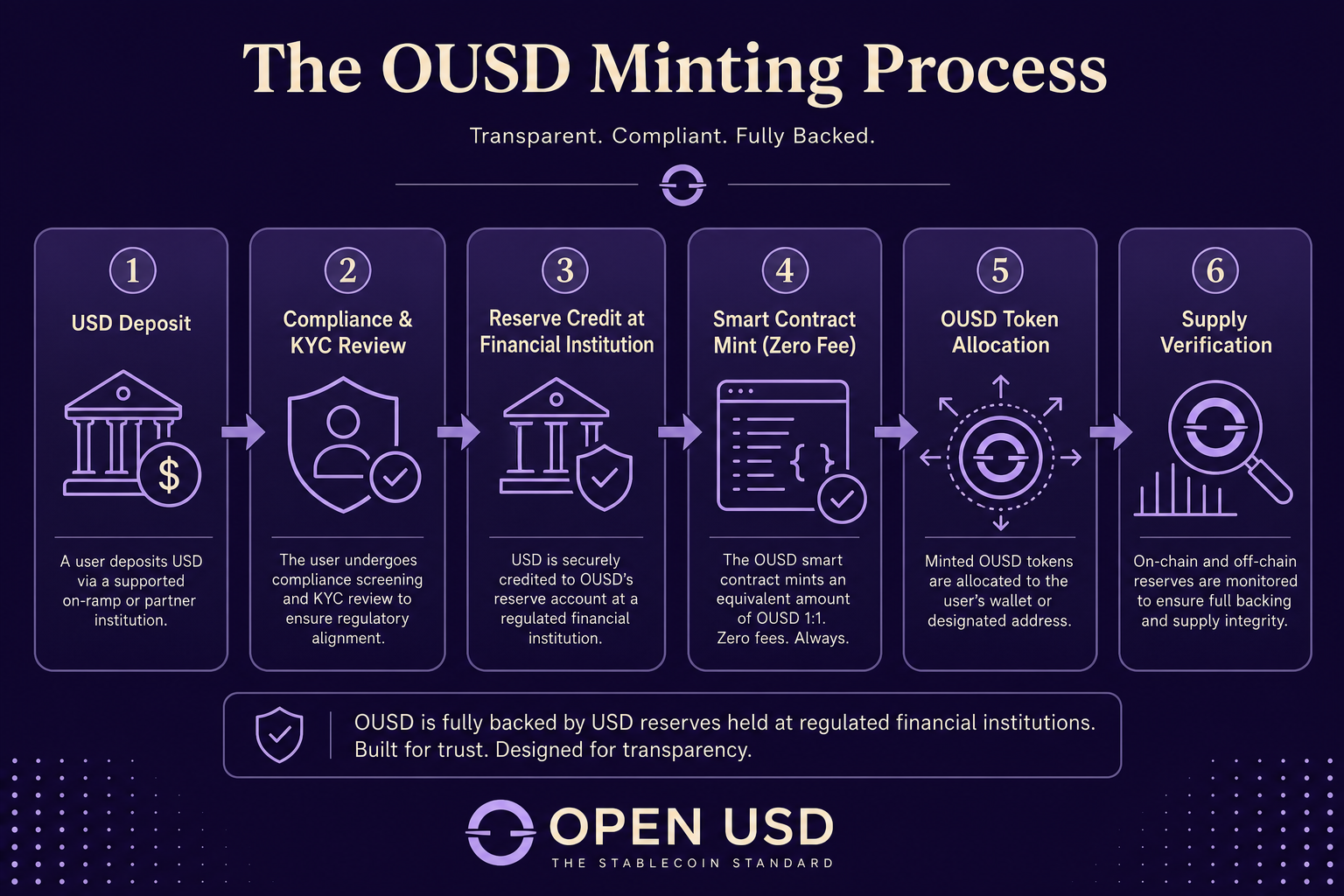 Figure 1. OUSD minting process: the complete path from USD deposit, compliance review, reserve confirmation to on-chain minting and supply verification.
The steps for on-chain minting are: deposit confirmation → reserve accounting → contract minting → token allocation → supply update. Upon launch, contract addresses and minting interfaces will be publicly disclosed. Compared to OUSD vs USDC, USDT core differences, OUSD does not charge protocol-level fees for minting.
How does redemption and USD release work?
Redemption is the reverse of minting. Holders or authorized partners submit a redemption request to the contract, specifying the burn amount and USD receiving account. Upon validation, the contract executes on-chain burning and triggers USD release from the reserve, also with zero mint/redeem fees.
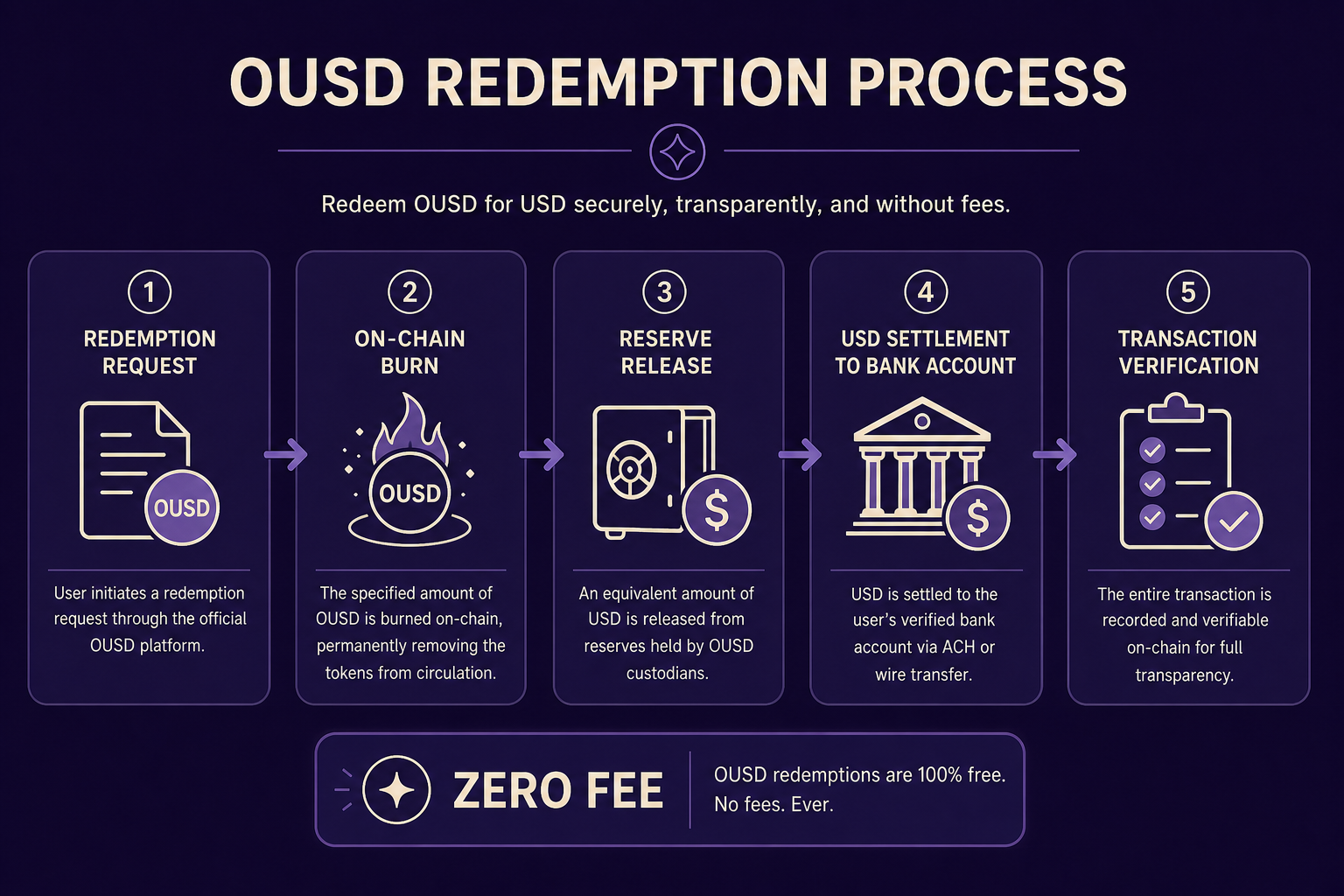 Figure 2. OUSD redemption process: the complete path from on-chain burning, redemption request, reserve release to USD settlement and verification.
Redemption must follow strict sequence: confirm token burning, then execute reserve release. USD is released via regulated withdrawal channels at major US financial institutions. Large redemptions may require additional compliance review.
How is the zero-fee mechanism sustained?
OUSD's zero mint/redeem fee is a structural feature of Build for scale, with no protocol fees for minting and redemption. Operating costs are covered by a small management fee from reserve Rendite.
| Fee Type |
OUSD Mechanism |
Common Traditional Stablecoin Model |
| Minting/Redemption Fee |
Zero fee |
Proportional or fixed fee charged |
| Flow Limit |
No manual limit |
Daily or per-transaction limits |
| Operating Cost Source |
Reserve Rendite management fee |
Mint/redeem fee + management fee |
After management fees are deducted, reserve interest is distributed to ecosystem partners by the Earn by default principle. The Open Standard partner Rendite mechanism ties Rendite to Hold, Mint, Accept, and other criteria, ensuring partners driving network expansion receive proportional incentives. Ordinary on-chain token holders do not directly receive reserve interest.
What are the differences in multi-chain minting?
OUSD will be deployed on Solana, Base, Sui, Tempo, and other chains. Each chain has different minting interfaces and gas costs, but the core mechanism remains: 1:1 peg, zero mint/redeem fee, unified reserve support. Solana is optimized for high-frequency payments, Base is compatible with the Ethereum toolchain, Sui and Tempo target parallel execution and payment optimization. The same USD reserve supports multi-chain circulation; users must verify the target chain address, and contract addresses will be disclosed at launch.
How is minting and redemption completion verified?
After minting or redemption, users can verify via three channels: on-chain verification by checking address balances and total supply changes in blockchain explorers; reserve verification by reviewing Open Standard's periodic reserve disclosures and independent third-party attestations, confirming 1:1 correspondence between on-chain supply and off-chain reserves; account verification by confirming receipt of OUSD in the wallet or USD in the bank account. Triple verification ensures users can confirm results without relying on a single source.
Summary
OUSD minting and redemption are centered on zero mint/redeem fees, following the Build for scale principle, with processes covering compliance onboarding, USD deposit, on-chain minting, token burning, and USD release. Reserves are held at major US financial institutions, in compliance with US regulations, with planned launch and multi-chain support for Solana, Base, Sui, Tempo, and more. There are no manual flow limits for minting and redemption; operating costs are covered by reserve management fees, and ecosystem partners driving adoption share reserve returns through the Earn by default mechanism.
FAQ
Are there fees for OUSD minting?
OUSD minting incurs zero mint/redeem fees, with no protocol-level charges. Users may still be subject to on-chain gas costs or Trading-Gebühr from partner platforms, depending on the channel's fee structure.
How long does it take to receive USD after OUSD redemption?
Redemption timing depends on on-chain confirmation speed, reserve release process, and bank withdrawal channel efficiency. Large redemptions may require additional compliance review; specific timing is governed by Open Standard's published operational policies.
Can regular users mint OUSD directly?
OUSD minting privileges are granted to network partners. Regular users usually participate indirectly via partner platforms, payment apps, or integrated interfaces, and must complete KYC/AML compliance review.
How is OUSD reserve managed across multiple chains?
OUSD across multiple chains is backed by a unified USD reserve, maintaining a 1:1 correspondence between total on-chain supply and off-chain reserves. Each chain has independent contracts, with reserve management and supply synchronization coordinated by Open Standard's operating system.
How can OUSD minting be confirmed?
Minting can be confirmed by triple verification: on-chain wallet balance increases by the corresponding OUSD, total supply increases in blockchain explorers, and Open Standard's reserve disclosure reflects the corresponding increment.
Can OUSD's zero-fee mechanism be sustained long-term?
Zero mint/redeem fees are a structural feature of Build for scale, with operating costs covered by a small management fee from reserve Rendite rather than minting and redemption charges. This model sustains the ecosystem via Earn by default Rendite distribution.







