DePIN (Decentralized Physical Infrastructure Networks) and AIoT (Artificial Intelligence of Things) are accelerating the deep convergence of real-world infrastructure and digital networks. As blockchain technology expands beyond finance into practical applications, a growing number of projects are leveraging community participation to build communication, hashrate, sensor, and data networks.
Simultaneously, the rise of artificial intelligence is fueling an immense appetite for real-world data. Environmental sensing, intelligent decision-making, and autonomous systems all require continuous streams of real-world input, positioning AIoT as a critical bridge between AI and the physical world.
What Is OKZOO?
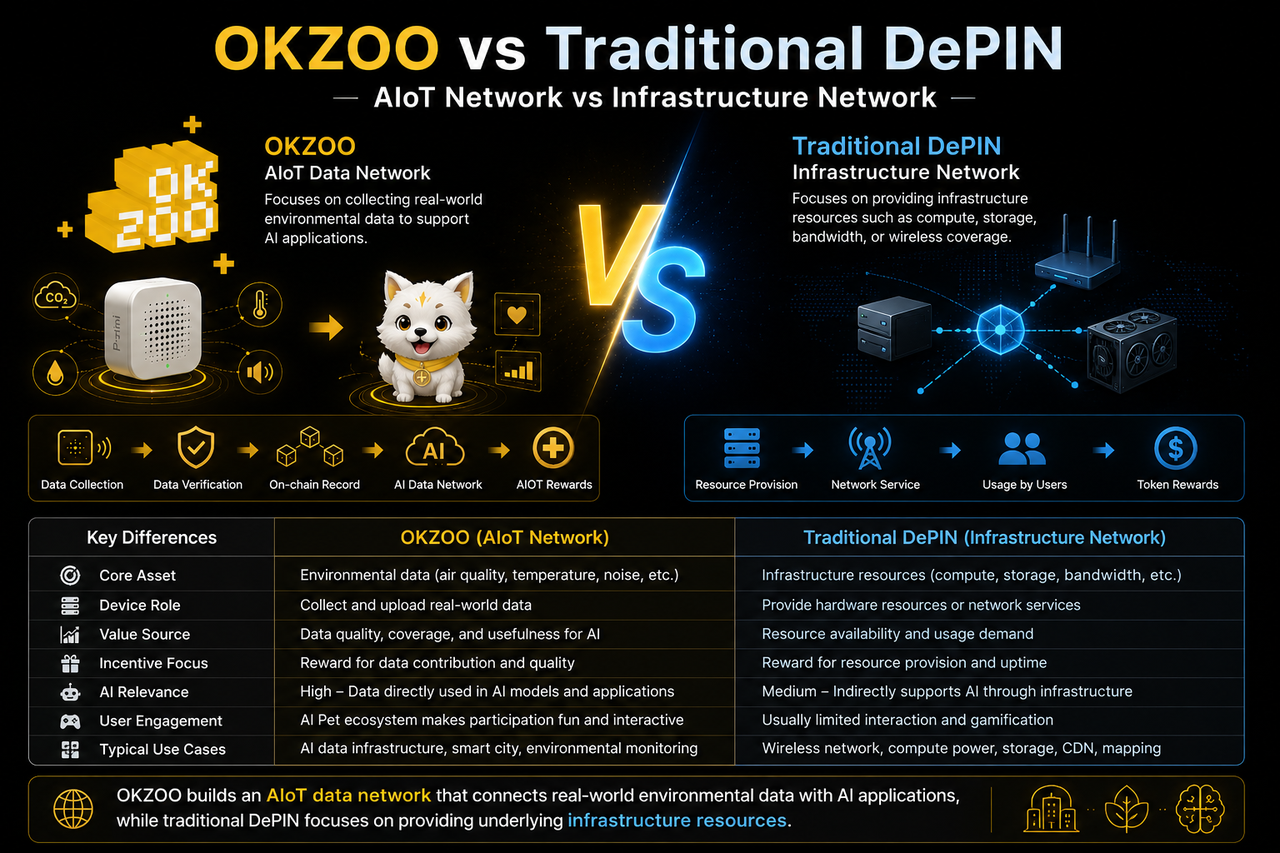
OKZOO is an environmental data network built on an AIoT architecture. It continuously collects real-world data—such as air quality, temperature, humidity, and noise—through community-deployed sensor devices. Once verified, this data can be used for AI model training, environmental analysis, and smart system applications.
Unlike many DePIN projects that derive value from hardware resource output, OKZOO's core asset is not the device itself but the environmental data it generates. The project also boosts user engagement through its AI Pet mechanism, making data contribution more interactive.
What Is a Traditional DePIN Network?
Traditional DePIN networks use blockchain incentive mechanisms to build real-world infrastructure. Participants deploy devices or share resources to provide communication coverage, computing power, storage space, or location services, earning rewards in return.
Examples include Helium, which builds wireless communication networks; Grass, which focuses on bandwidth sharing; and GEODNET, which offers high-precision positioning data. These projects share a common trait: they use distributed devices to deliver infrastructure services, with value derived primarily from resource supply capabilities.
How Are the Core Goals Different?
The fundamental distinction between OKZOO and traditional DePIN lies in the network's objective. Traditional DePIN projects aim to build infrastructure resources that users can directly utilize—such as network connectivity, data storage, or hashrate services.
OKZOO's goal, by contrast, is to establish a network that continuously generates real-world environmental data. Device deployment is not about providing resource services to users but about creating a reliable data source for AI systems. As a result, although both network types rely on hardware, the eventual value forms differ entirely.
How Do Data Sources and Value Logic Differ?
Value in traditional DePIN networks comes primarily from resource output. Wireless hotspots generate network coverage, GPU nodes deliver computing power, and storage nodes provide data-saving capacity. These resources are the final product of the network service.
OKZOO's value, however, stems from the data content collected by devices. Environmental data, after validation and integration, becomes critical input for AI model training, environmental monitoring, and intelligent decision-making. In other words, traditional DePIN produces resources; OKZOO produces data.
How Does User Participation Differ?
In most DePIN projects, users mainly deploy devices and continuously provide resource services. Rewards are typically tied to device uptime, coverage, or resource utilization, making participation more about infrastructure management.
OKZOO adds an AI Pet ecosystem on top of device operations. Users are not just data contributors—they can also interact with environmental data through digital pets. This design makes data contribution more visual and gamified, boosting long-term user engagement in network development.
What Are the Differences in Incentive Models?
Traditional DePIN projects typically base incentives on resource supply and demand. When a network's communication capacity, hashrate resources, or storage space is used, corresponding nodes earn rewards. Resource utilization rate is thus a key metric for reward distribution.
OKZOO's incentive logic centers on data contribution. When devices continuously generate high-quality environmental data and the data enters the network through a verification mechanism, contributors earn AIOT token rewards. The focus shifts from resource supply to data quality and scale.
Why Is the AI Application Value Different?
Although many DePIN networks can provide infrastructure support for AI, they usually serve as underlying services—offering hashrate, bandwidth, or storage. AI systems can use these resources for training and deployment, but the resources themselves do not directly constitute the data AI needs.
OKZOO, on the other hand, directly addresses AI data demands. Environmental data is itself a crucial input for AI applications, enabling use cases like environmental perception, smart city management, automation systems, and AI Agents. Hence, OKZOO is closer to an AI data infrastructure, while traditional DePIN leans more toward resource infrastructure.
OKZOO vs. Traditional DePIN: Comparison Table
| Dimension |
OKZOO |
Traditional DePIN |
| Core Positioning |
AIoT Data Network |
Infrastructure Resource Network |
| Core Assets |
Environmental Data |
Hashrate, Storage, Bandwidth, etc. |
| Device Role |
Data Collection |
Resource Provision |
| Value Source |
Data Quality and Scale |
Resource Supply Capability |
| Incentive Target |
Data Contributors |
Resource Providers |
| AI Relevance |
High |
Medium |
| User Interaction |
AI Pet Ecosystem |
Usually Weak |
| Typical Application |
AI Data Infrastructure |
Network, Hashrate, Storage Services |
Summary
Both OKZOO and traditional DePIN projects are built on real-world devices and community incentive mechanisms, but they focus on fundamentally different core resources. Traditional DePIN networks are built primarily around infrastructure resources, while OKZOO concentrates on collecting, verifying, and applying environmental data.
As AI's demand for real-world data continues to grow, data-driven networks are becoming a major direction for the DePIN ecosystem. The AIoT model embodied by OKZOO demonstrates a new path for DePIN—extending from resource sharing to data infrastructure—and reflects the further evolution of how AI connects with the physical world.
FAQs
Is OKZOO a DePIN project?
OKZOO exhibits typical DePIN characteristics—real-world device deployment, community participation, and on-chain incentives—so it is generally considered a DePIN project. However, because it focuses more on environmental data collection and AI application support, it is also seen as a key representative of AIoT networks.
What is the main difference between OKZOO and Helium?
Helium's core goal is to build a wireless communication network providing connectivity for devices; OKZOO's core goal is to build an environmental data network providing real-world data for AI systems. Both rely on device deployment, but they offer completely different types of resources.
Why is OKZOO called an AIoT project?
OKZOO combines artificial intelligence, IoT devices, and blockchain incentive mechanisms to collect environmental data via a sensor network and serve AI applications. This aligns with the typical characteristics of AIoT (Artificial Intelligence of Things).
What is the source of OKZOO's value?
OKZOO's value primarily comes from the continuous generation of environmental data. As device numbers grow and data coverage expands, the network can provide richer, more real-time real-world information for AI models and smart systems.
What is the difference between data-driven DePIN and resource-driven DePIN?
Data-driven DePIN primarily produces informational resources such as environmental data, geographic data, or sensor data. Resource-driven DePIN delivers infrastructure services like hashrate, storage, and bandwidth. Both depend on real-world devices, but the value forms of their final outputs differ.