Los tokens del exchange son esenciales en el ecosistema de plataformas de trading cripto, desempeñando roles como descuentos en tarifas de trading, incentivos para usuarios, gobernanza y utilidad on-chain. Con la evolución de la industria cripto hacia cadenas públicas, soluciones Layer2 e infraestructura Web3, la función de estos tokens está en constante transformación.
OKB, BNB y GT son actualmente los tokens del exchange más relevantes del mercado. Aunque los tres son activos dentro de ecosistemas de plataformas de trading, difieren notablemente en posicionamiento on-chain, estrategias de expansión, tokenómica y aplicaciones reales.
Panorama de OKB, BNB y GT
OKB, el token del exchange del ecosistema OKX, se utiliza principalmente para descuentos en tarifas de trading, incentivos del ecosistema, servicios on-chain y aplicaciones Web3. Con la expansión de OKX hacia Layer2 e infraestructura Web3, los casos de uso de OKB abarcan billeteras, interacciones on-chain y colaboración en el ecosistema.
BNB fue lanzado por el ecosistema Binance como token de descuento en tarifas de trading. Con el desarrollo de BNB Chain, BNB se ha convertido en un activo central de gas y en el token fundamental de su ecosistema de cadena pública.
GT (GateToken) es el token del exchange del ecosistema Gate, utilizado para reducción de tarifas de trading, privilegios VIP, participación en el ecosistema on-chain y funciones específicas en la red GateChain. GT actúa como activo de la plataforma de trading y del ecosistema on-chain.
Aunque los tres tokens del exchange han evolucionado desde simples “sistemas de crédito de plataforma” hasta activos de infraestructura on-chain y aplicaciones Web3.
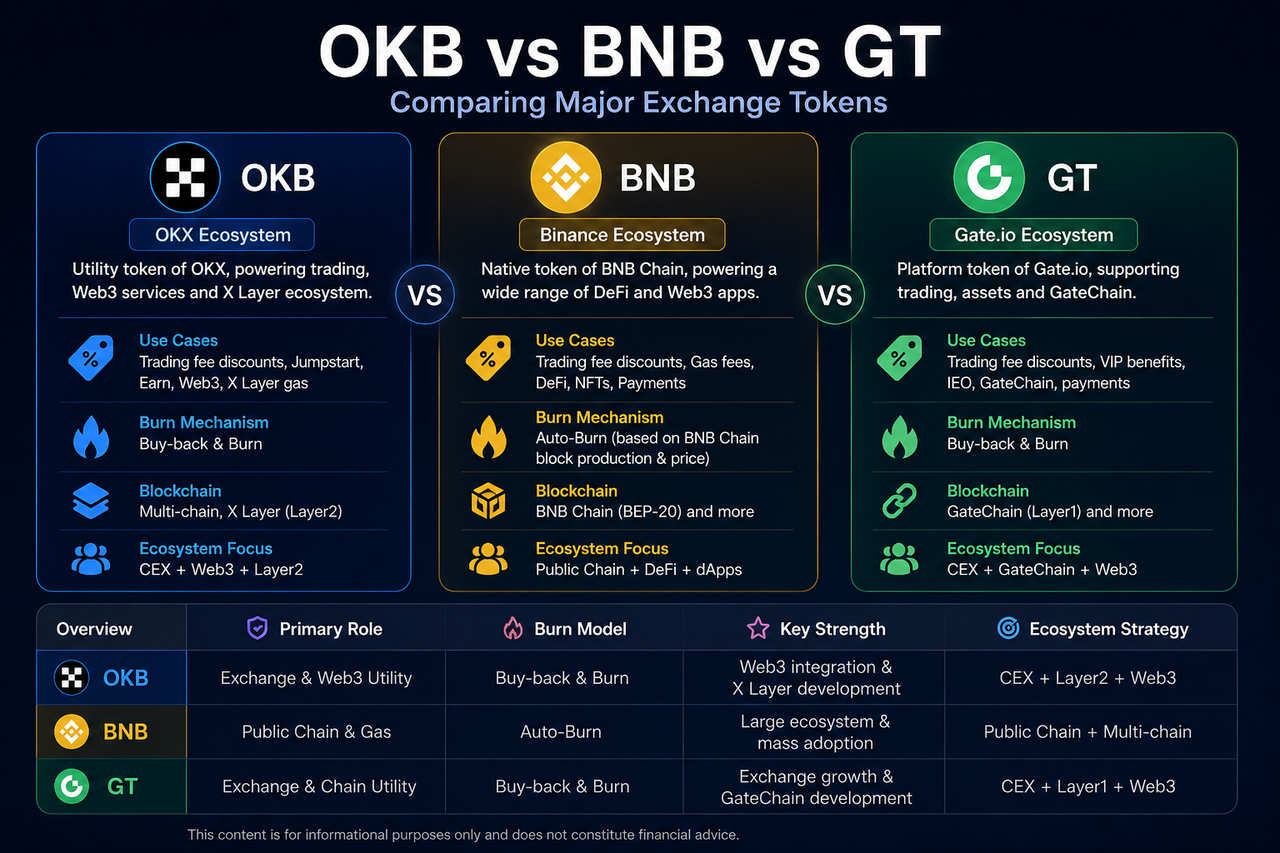
¿Cómo difieren los casos de uso principales de OKB, BNB y GT?
Los tres tokens ofrecen descuentos en tarifas de trading, pero sus utilidades dentro del ecosistema son muy distintas.
OKB destaca por la sinergia entre la plataforma de trading y los servicios Web3. Por ejemplo, OKB se utiliza para niveles de tarifas de trading, Jumpstart, productos Earn y escenarios del ecosistema X Layer.
Los casos de uso de BNB se centran en el ecosistema de cadena pública. Además de los descuentos en trading, BNB es el activo central de gas de la red BNB Chain y se emplea ampliamente en trading on-chain, DeFi y aplicaciones NFT.
El ecosistema de GT gira en torno a Gate y GateChain, con casos de uso como patrimonio de la plataforma, gestión de activos on-chain y servicios selectos del ecosistema.
| Token del exchange |
Ecosistema principal |
Casos de uso principales |
Posicionamiento on-chain |
| OKB |
OKX |
Tarifas de trading, Web3, X Layer |
Activo de coordinación del ecosistema |
| BNB |
Binance |
Gas, DeFi, trading |
Activo central de cadena pública |
| GT |
Gate |
Patrimonio de la plataforma, GateChain |
Activo de plataforma y on-chain |
¿En qué se diferencian los mecanismos de quema de OKB, BNB y GT?
El mecanismo de quema es clave en la tokenómica de los tokens del exchange, diseñado para reducir el suministro circulante.
OKB utiliza un modelo de recompra y quema a largo plazo, donde la plataforma periódicamente recompra y destruye parte de los tokens.
\$\$S_{t+1}=S_t-B_t \$\$
BNB implementa un mecanismo de quema automática, con la cantidad de quema generalmente vinculada a la actividad on-chain y las condiciones del mercado.
GT también sigue un modelo de recompra y quema, reduciendo el suministro circulante y respaldando la sostenibilidad del ecosistema a largo plazo.
Aunque los tres emplean modelos deflacionarios, sus mecanismos específicos y la lógica del ecosistema varían. Algunos tokens dependen más de la actividad on-chain, mientras que otros priorizan el crecimiento de la plataforma y la expansión del ecosistema.
Diferencias en el ecosistema on-chain de OKB, BNB y GT
BNB tiene el rol más destacado en el ecosistema on-chain. Con el crecimiento de BNB Chain, BNB se ha convertido en un activo fundamental para DeFi, GameFi, NFT y aplicaciones multicadena.
La expansión on-chain de OKB está impulsada por la estrategia Web3 de OKX y X Layer, enfocándose en integrar la plataforma de trading centralizada, la billetera y redes Layer2.
El ecosistema on-chain de GT se basa en GateChain, que prioriza la seguridad de los activos digitales, la gestión de activos y las transferencias on-chain.
¿Qué distingue la lógica de valor de OKB, BNB y GT?
La propuesta de valor de los tokens del exchange está ligada a la base de usuarios, actividad de trading, capacidad de expansión del ecosistema y escenarios de aplicación on-chain.
El valor de BNB se deriva principalmente de la demanda del ecosistema de cadena pública, incluyendo utilidad de gas, aplicaciones DeFi e interacciones on-chain.
La estructura de valor de OKB está relacionada con los servicios de la plataforma de trading, productos Web3 y la integración del ecosistema Layer2.
La lógica de valor de GT se alinea con el crecimiento del ecosistema Gate y las aplicaciones de la red GateChain.
¿Qué riesgos comparten los tokens del exchange?
A pesar de las diferencias en la estructura del ecosistema, los tokens del exchange comparten varios riesgos comunes.
Están estrechamente ligados a la operación de la plataforma de trading, por lo que cambios en la gestión, ciclos de mercado o entornos regulatorios pueden impactar sus ecosistemas.
Son activos altamente volátiles, y su desempeño depende del sentimiento de la industria y la actividad on-chain.
Además, a medida que los ecosistemas Web3 y DeFi avanzan, los tokens del exchange enfrentan competencia creciente de activos nativos de cadenas públicas y nuevos tokens de protocolo.
Resumen
OKB, BNB y GT son tokens del exchange, pero sus trayectorias y estructuras de ecosistema han tomado caminos distintos.
BNB prioriza cadenas públicas e infraestructura on-chain; OKB se enfoca en plataformas de trading, Layer2 e integración Web3; GT se centra en el ecosistema de la plataforma de trading y la red GateChain.
Con el cambio de la industria cripto hacia ecosistemas multicadena e infraestructura Web3, los tokens del exchange evolucionan de “herramientas de descuento en trading” a “activos del ecosistema”. Las diferencias entre ellos reflejan la dirección estratégica y el diseño del ecosistema de cada plataforma de trading en la era Web3.
Preguntas frecuentes
¿Por qué se considera a BNB un token de cadena pública?
Porque BNB es el activo central de gas de BNB Chain y se utiliza ampliamente en trading on-chain y aplicaciones DeFi.
¿Cuáles son los principales casos de uso de OKB?
OKB se emplea para descuentos en tarifas de trading, Jumpstart, servicios Web3 y el ecosistema X Layer.
¿Cuál es la relación entre GT y GateChain?
GT es el token del exchange del ecosistema Gate y está vinculado directamente a la red GateChain.
¿Por qué los tokens del exchange tienen mecanismos de quema?
Las plataformas implementan mecanismos de recompra y quema para reducir el suministro circulante, establecer un modelo deflacionario y sostener el ciclo del ecosistema de los tokens del exchange.
¿Se consideran los tokens del exchange activos DeFi?
Los tokens del exchange son activos de los ecosistemas de plataformas de trading, aunque algunos se han expandido hacia escenarios DeFi y ecosistemas on-chain.