As the blockchain ecosystem transitions from a single-chain to a multi-chain era, users and assets are increasingly distributed across diverse networks. While this multi-chain expansion unlocks richer applications and a larger market, it also fragments liquidity, giving rise to the "liquidity island" problem. For derivative protocols that depend on market depth and capital efficiency, such fragmentation directly impacts trading quality and protocol scalability.
Against this backdrop, cross-chain liquidity and unified settlement mechanisms have become key pillars of DeFi infrastructure development. As a decentralized perpetual futures protocol designed for multi-asset markets, Levare positions cross-chain architecture as critical infrastructure for bridging blockchain networks.
What Is Levare's Unified Liquidity Model?
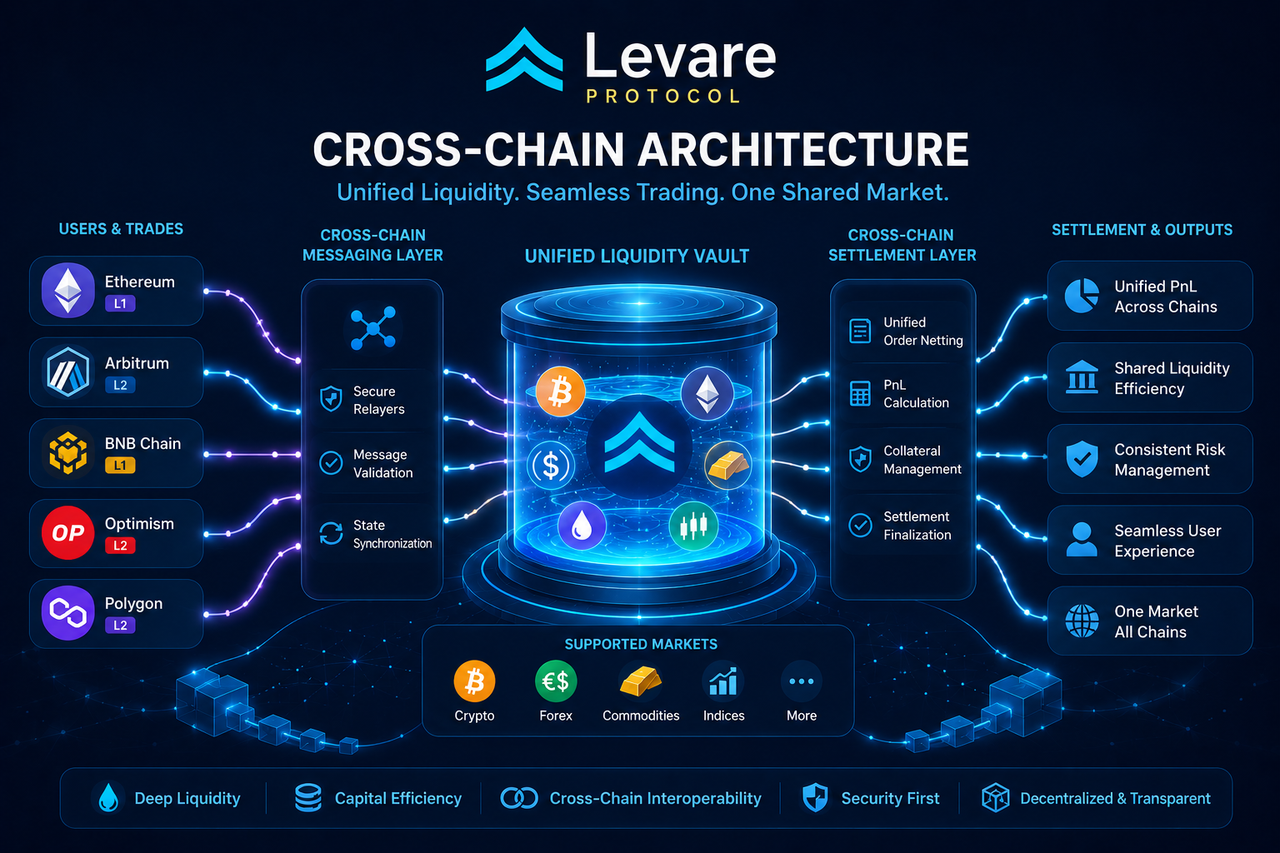
The unified liquidity model is the cornerstone of Levare's cross-chain architecture. Unlike multi-chain protocols that isolate liquidity in separate pools, Levare channels all on-chain trading activity into a single Liquidity Vault, creating a shared liquidity ecosystem.
In this model, no matter which blockchain a user connects from, the liquidity behind their trades comes from one unified pool. For liquidity providers, capital can be concentrated in one place to support the entire protocol, rather than being scattered across networks. For traders, the result is more consistent market depth and a seamless trading experience.
What Core Layers Make Up Levare's Cross-Chain Architecture?
Levare's cross-chain system comprises three distinct layers: the user access layer, the cross-chain communication layer, and the unified settlement layer. The user access layer handles interactions with users on different blockchains—covering deposits, position openings, position closures, and margin management.
The cross-chain communication layer synchronizes critical data—such as account status, position details, and fund movements—across networks. The unified settlement layer governs the protocol's risk control logic and final fund settlement. Together, these layers allow Levare to fuse multiple blockchains into a single, cohesive trading market.
How Does Cross-Chain Messaging Enable State Synchronization?
Cross-chain trading goes beyond asset transfers; real-time synchronization of trading states is equally vital. When a user opens a position on Blockchain A, the protocol must ensure that the entire system acknowledges that position and correctly tracks resulting risk exposure and margin status.
The cross-chain messaging network handles this data synchronization. It transmits position sizes, account balance updates, margin ratios, and trade execution results to the unified settlement layer, which then relays the information to relevant networks. By continuously updating data, Levare maintains consistent trading states and risk management across all blockchains.
How Does Levare Execute Cross-Chain Settlement?
Cross-chain settlement is foundational to Levare's unified liquidity model. Conventional multi-chain protocols compute profits and settle funds independently on each chain. Levare, by contrast, consolidates all trading activity into a unified settlement system.
When a user closes a position, the protocol calculates the final profit or loss using the market price from an oracle and pushes the settlement result to the shared Liquidity Vault. Regardless of which blockchain hosted the original trade, the result is aggregated into the unified pool. This approach ensures a single risk management framework and eliminates settlement logic discrepancies between chains.
How Does Levare's Cross-Chain Architecture Boost Capital Efficiency?
Capital efficiency is a primary driver behind Levare's unified liquidity design. In the traditional approach, a protocol deployed on multiple blockchains must set up separate liquidity pools for each chain. Even with substantial total capital, the liquidity available to any single market remains limited.
By sharing liquidity across chains, Levare allows multiple networks to draw from a common pool of capital. The protocol can support larger trading volumes without duplicating liquidity reserves. Moreover, liquidity providers avoid the overhead of frequently migrating funds across chains, cutting operational costs and improving overall capital utilization.
What Challenges Does Levare's Cross-Chain Architecture Face?
While improving capital efficiency, cross-chain architecture introduces greater system complexity. First, the cross-chain communication network must guarantee message accuracy and timeliness—any synchronization error can disrupt trade settlements. Second, cross-chain bridges and verification mechanisms remain significant security risks in the blockchain space, requiring continuous security audits and monitoring.
Furthermore, the shared liquidity model means a single fund pool supports multiple markets. Extreme volatility in one market could impact the entire system. Therefore, Levare must establish robust risk isolation and capital management mechanisms to ensure long-term protocol stability.
How Does Levare Differ from Traditional Multi-Chain Deployment?
Many DeFi protocols support multi-chain deployment, but that does not automatically mean unified liquidity. The traditional approach replicates the same protocol on each blockchain, with each chain maintaining its own users, liquidity pools, and settlement logic. Liquidity remains fragmented.
Levare, in contrast, builds a unified market architecture where all chains share one liquidity source and one settlement system. Relative to the traditional model, this design improves capital utilization, strengthens market depth, and reduces liquidity fragmentation. For users, it delivers an experience closer to a single global marketplace.
| Comparison Aspect |
Traditional Multi-Chain Deployment |
Levare Unified Liquidity Architecture |
| Liquidity Structure |
Independent pools |
Shared Liquidity Vault |
| Capital Utilization |
Relatively low |
Relatively high |
| Market Depth |
Depends on single-chain volume |
Depends on overall liquidity volume |
| Settlement Method |
Independent per chain |
Unified |
| User Experience |
Varies across chains |
Consistent, near-unified market |
| Scalability |
Liquidity continuously fragmented |
Liquidity centrally pooled |
Summary
Levare's cross-chain architecture is designed to create a multi-asset perpetual futures market through a unified liquidity model, cross-chain messaging network, and shared settlement mechanism. In contrast to traditional multi-chain deployments, Levare prioritizes liquidity consolidation and capital efficiency, using a shared Liquidity Vault to support trading from various blockchains and integrating all markets under a single risk management framework.
FAQs
Why Does Levare Need Unified Liquidity?
Unified liquidity eliminates the efficiency loss from capital fragmentation, enabling multiple blockchain networks to share one Liquidity Vault. This deepens market depth, reduces slippage, and improves capital utilization.
How Does Levare's Cross-Chain Settlement Work?
Levare processes all trade PnL through its unified settlement layer and mirrors the results to the shared Liquidity Vault. No matter where a trade originates, it is ultimately settled within the unified pool.
What Role Does Cross-Chain Messaging Play in Levare?
Cross-chain messaging synchronizes key data—position info, account status, margin changes, and trade outcomes—across networks, ensuring a consistent trading environment and risk management regime.
What Are the Advantages of Levare's Cross-Chain Architecture?
Levare's cross-chain architecture enhances capital efficiency, boosts market depth, reduces liquidity fragmentation, and delivers unified liquidity and settlement infrastructure for multi-asset perpetual futures trading.
What Risks Does Levare's Cross-Chain Architecture Face?
Levare's cross-chain architecture may face risks related to cross-chain communication, smart contracts, message verification, and systemic risk due to pooled liquidity. Robust security mechanisms and risk management frameworks are essential to maintain stable protocol operation.