Cryptocurrency is not completely banned in Russia. It is legal to own, acquire, sell and mine under defined conditions, but it is not generally recognised as legal tender and cannot ordinarily be used to pay for domestic goods or services. The Russia cryptocurrency legal framework regulates specific crypto activities rather than prohibiting cryptocurrency itself.
TL;DR
-
Russian residents may generally own and transfer cryptocurrencies such as Bitcoin.
-
Domestic cryptocurrency payments remain prohibited outside specifically authorised legal arrangements.
-
Cryptocurrency mining is legal, but registration, electricity limits, reporting and tax rules apply.
-
Certain cross-border crypto settlements may operate through an experimental legal regime.
-
A major 2026 cryptocurrency bill has passed the State Duma, but it should not be treated as effective law until the remaining legislative and publication stages are completed.
Is Cryptocurrency Legal in Russia?
Yes. Cryptocurrency itself is not prohibited in Russia, but different activities receive different legal treatment.
Federal Law No. 259-FZ recognises “digital currency” as a form of property-like digital value. This recognition allows cryptocurrency to be owned, transferred and considered in legal or tax matters. However, recognising crypto as an asset does not make Bitcoin or another cryptocurrency official money.
The distinction is central to the wider Russia cryptocurrency legal framework: possession and investment activity may be permitted, while using cryptocurrency as a substitute for the Russian ruble remains restricted.
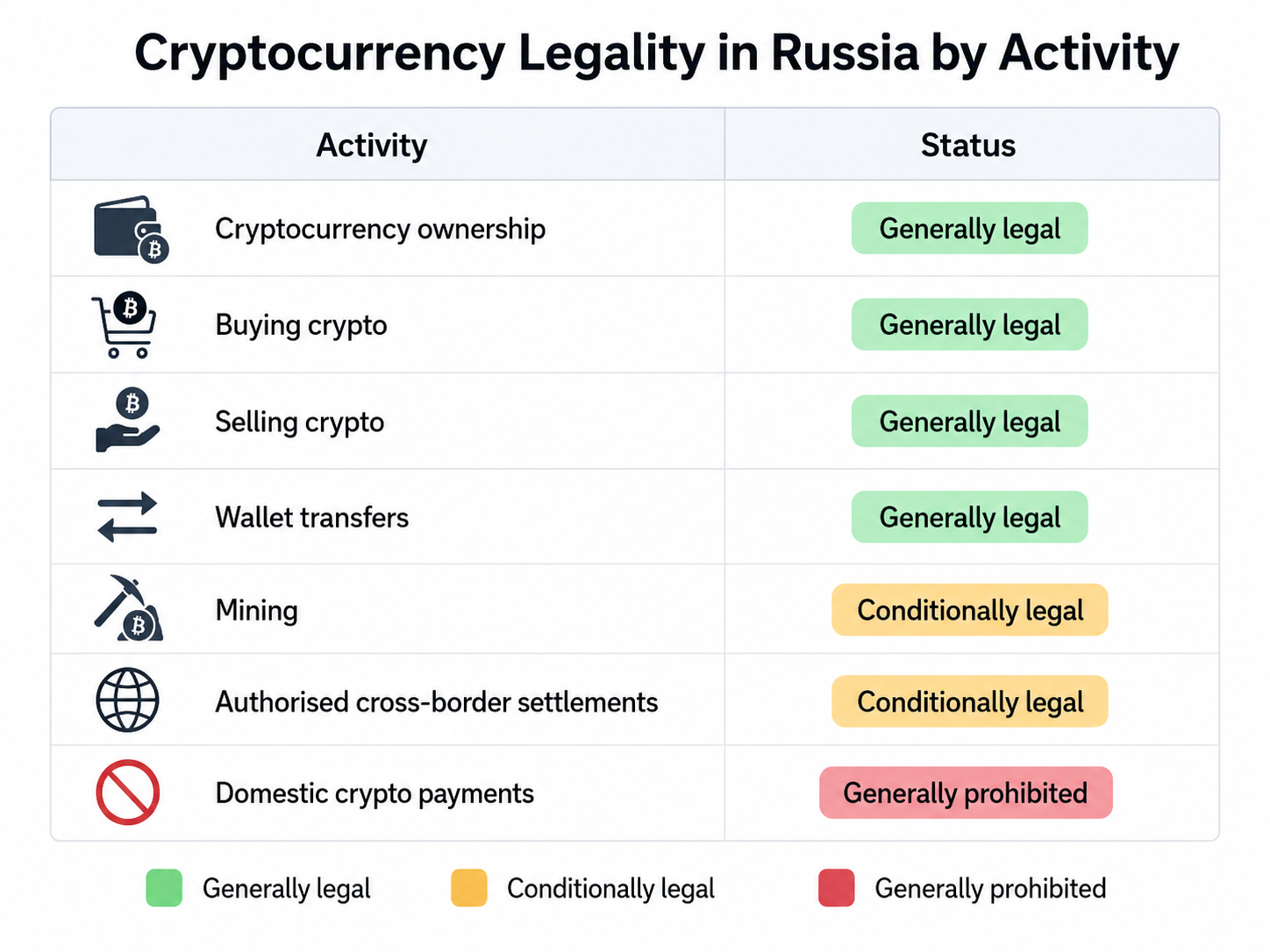
Russia Cryptocurrency Legality Matrix
| Cryptocurrency activity |
Current legal position |
Main condition or restriction |
| Owning Bitcoin or other crypto |
Generally legal |
Ownership does not make crypto legal tender |
| Buying cryptocurrency |
Generally permitted |
Transactions may be subject to platform, banking, identification and future investor-access rules |
| Selling cryptocurrency |
Generally permitted |
Income and gains may create tax-reporting obligations |
| Holding crypto in a private wallet |
Generally legal |
Users remain responsible for security and legal source-of-funds records |
| Crypto-to-crypto transfers |
Generally permitted |
Transfers linked to crime, sanctions violations or money laundering remain unlawful |
| Paying for domestic goods or services |
Generally prohibited |
Russian persons generally cannot accept digital currency as payment |
| Receiving salary in cryptocurrency |
Generally not permitted as an ordinary domestic wage payment |
Russian employment and payment rules normally require recognised monetary settlement |
| Cryptocurrency mining |
Legal under regulation |
Registration, electricity-use, reporting and regional restrictions may apply |
| Personal mining |
Conditionally legal |
Non-business individuals may mine without registration below the current 6,000 kWh monthly electricity threshold |
| Business or industrial mining |
Legal with registration |
Russian companies and individual entrepreneurs must enter the Federal Tax Service register |
| Cross-border trade settlement |
Permitted only in limited arrangements |
Use is possible through the experimental legal regime |
| Advertising crypto as a payment method |
Restricted |
Promotion cannot lawfully bypass the domestic payment prohibition |
The matrix shows why “crypto is legal in Russia” is incomplete. Legality depends on whether cryptocurrency is being held as property, traded as an asset, mined as an economic activity or offered as payment.
Can Russians Buy, Hold and Trade Bitcoin?
Russian residents can generally buy, hold and sell Bitcoin, although the market is not treated like an unrestricted retail payment system.
The Russia Bitcoin law framework has historically treated Bitcoin as digital currency rather than sovereign money. Investors may therefore hold Bitcoin as an asset, transfer it between compatible wallets or dispose of it, subject to tax, anti-money-laundering and platform-access requirements.
The Bank of Russia proposed a more structured investment-access system in December 2025. Its concept would allow both qualified and non-qualified investors to access approved cryptoassets under different limits and suitability requirements.
Bill No. 1194918-8, which would establish a wider framework for digital currency circulation and investor categories, passed its second and third State Duma readings on July 21, 2026. However, the State Duma’s official legislative record still classifies the bill as under consideration. The proposed rules should therefore not be described as fully effective until Federation Council approval, presidential signature and official publication are confirmed.
Can Cryptocurrency Be Used for Payments in Russia?
Cryptocurrency generally cannot be used to pay for goods, services or work inside Russia.
Russian law restricts residents and Russian legal entities from accepting digital currency as consideration for domestic goods or services. A shop cannot lawfully treat Bitcoin as an ordinary alternative to rubles merely because both parties agree to the transaction.
The Bank of Russia has consistently maintained that cryptocurrency should not operate as a domestic means of payment. Its 2025 regulatory proposal also called for liability where residents make crypto settlements outside an authorised experimental regime.
These crypto payment restrictions do not mean every transfer between wallets is illegal. The key question is whether the transfer represents an asset transaction or payment for a domestic obligation.
Is Cryptocurrency Mining Legal in Russia?
Cryptocurrency mining is legal in Russia, but it is now a regulated and reportable activity.
Russian companies and registered individual entrepreneurs must be included in the Federal Tax Service’s mining register before conducting commercial mining. Mining-infrastructure operators are subject to a separate registration framework.
Individuals who are not registered entrepreneurs may mine without entering the register when monthly electricity consumption for mining does not exceed 6,000 kWh. Mined cryptocurrency must still be reported, and resulting income may be taxable.
Mining may also be restricted in particular regions or during periods of electricity-system stress. Legal mining therefore depends on the miner’s status, energy consumption, location and compliance with reporting requirements.
Are Cross-Border Crypto Payments Allowed?
Cross-border cryptocurrency settlements may be permitted through Russia’s experimental legal regime, but they are not a general exemption for all residents.
The 2024 framework allows approved exporters and importers to use cryptocurrency in certain foreign-trade settlements under Bank of Russia supervision. The arrangement was designed as a controlled channel rather than an open right to settle any international invoice in crypto.
The changing sequence of Russian crypto legislation is outlined in the Russia crypto regulation timeline, including the recognition of digital currency, mining regulation and the development of controlled cross-border settlement rules.
What Should Crypto Users in Russia Check?
Crypto users should identify the exact activity before deciding whether it is lawful. Ownership, trading, mining and payment are separate legal questions.
Users should also:
-
retain transaction and acquisition records;
-
calculate possible tax liabilities;
-
verify whether a mining operation requires registration;
-
avoid describing crypto as a domestic payment method;
-
check whether a cross-border arrangement has formal experimental-regime approval;
-
recheck Bill No. 1194918-8 after the Federation Council, presidential and publication stages.
This article provides general education and is not Russian legal or tax advice. Regulations, enforcement practices and platform availability may change.
FAQs
Is Bitcoin banned in Russia?
No. Bitcoin is not completely banned in Russia. Residents may generally own, acquire and sell Bitcoin, but Bitcoin cannot ordinarily be used as domestic legal tender or payment for goods and services.
Can a Russian business accept cryptocurrency?
A Russian business generally cannot accept cryptocurrency as payment for domestic goods, services or other consideration. Limited cross-border settlements may be possible through an authorised experimental legal regime.
Is crypto trading legal for Russian citizens?
Crypto trading is generally permitted, but access may depend on the service used, identity checks, banking restrictions and evolving investor-classification rules. Trading profits or disposals may also have tax consequences.
Do Russian cryptocurrency miners pay tax?
Yes. Cryptocurrency obtained through mining may create taxable income, and miners have reporting obligations. Registration requirements depend on whether the miner is a company, an individual entrepreneur or a private individual operating below the electricity threshold.







