À medida que a procura de Web3 por uma "Camada de Dados Verificável" cresce, as soluções de armazenamento simples já não satisfazem os requisitos das aplicações. O modelo de token deve agora suportar o carregamento de dados, a execução de verificações e a disponibilidade a longo prazo. Assim, o IRYS posiciona-se como mais do que uma ferramenta de pagamento — torna-se a coluna vertebral económica das operações da rede.
Do ponto de vista da infraestrutura de blockchain e dados, a essência da tokenomics do IRYS está em transformar a "atividade de armazenamento de dados" num sistema económico sustentável, recorrendo a estruturas de taxas, mecanismos de incentivo e staking.
O papel do token IRYS no ecossistema Irys
Na Irys Network, o IRYS funciona como um "ativo base multifuncional", e não como um token de finalidade única. Serve como meio de pagamento e como elemento essencial da arquitetura de segurança da rede.
Em termos de utilização, o IRYS é a unidade de conta para todas as operações da rede. Seja para carregar dados, consultar ou executar dados programáveis, todas as taxas são pagas em IRYS. Assim, o IRYS atua como "Gas + ativo de liquidação" de toda a camada de dados.
No plano da segurança, o IRYS regula o comportamento dos nodos através do staking. Mineradores e validadores têm de fazer staking de tokens para participar na rede, estando sujeitos a penalizações (slashing) em caso de ações maliciosas.
O IRYS garante ainda a base económica para compromissos de dados a longo prazo. Através do Endowment (mecanismo de reserva), o protocolo assegura os custos futuros de armazenamento, estabelecendo uma base económica robusta para a "disponibilidade de dados a longo prazo".
Fonte: irys.xyz
Oferta de tokens IRYS: estrutura e mecanismo de emissão
O IRYS tem uma oferta máxima de 10 mil milhões de tokens, com um modelo de "pré-alocação + libertação gradual" para equilibrar o desenvolvimento inicial e a estabilidade a longo prazo.
No Token Generation Event (TGE), cerca de 20% dos tokens entram em circulação, sendo o restante libertado progressivamente através de vesting. Esta estratégia evita choques de oferta a curto prazo e reserva tokens para o crescimento do ecossistema.
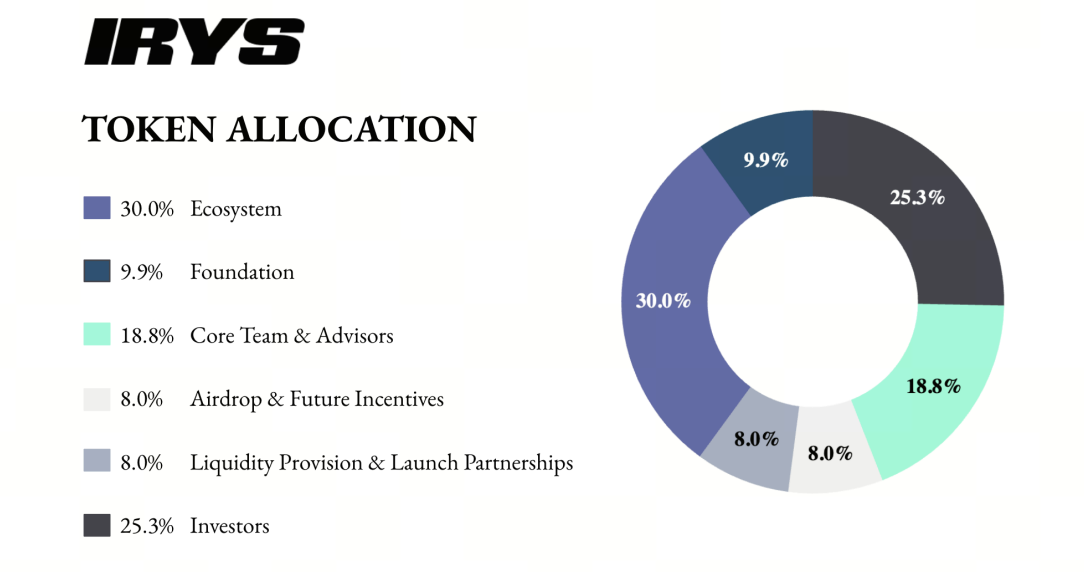
O IRYS adota um modelo de distribuição multidimensional: Ecossistema (30%), Investidores (25,3%), Equipa e Conselheiros (18,8%), Fundação (9,9%), Incentivos e Airdrops (8%), Liquidez (8%). Esta estrutura evidencia uma filosofia "ecossistema em primeiro lugar".
Em termos de emissão, o IRYS segue um modelo de inflação controlada. A inflação anualizada inicial ronda os 2%, reduzindo para metade a cada quatro anos até atingir cerca de 0,25%. Esta "curva de emissão decrescente" incentiva a participação inicial na rede e estabelece a transição para a estabilidade a longo prazo.
Mecanismo de taxas de armazenamento: como os utilizadores pagam pelo armazenamento de dados
O modelo de taxas da Irys diferencia-se das blockchains tradicionais por se focar na "precificação do armazenamento de dados".
Os utilizadores pagam IRYS para carregar dados, cobrindo custos de escrita, armazenamento e acessibilidade. Ao contrário das cadeias centradas em computação, estas taxas dependem diretamente do "tamanho dos dados e duração do armazenamento".
Destaca-se o mecanismo de preços indexados ao dólar, ajustado anualmente, que mantém os custos reais de armazenamento relativamente estáveis e minimiza o impacto da volatilidade do preço do token.
Esta abordagem aproxima a Irys da "precificação de infraestrutura", em vez de modelos especulativos de taxas, aumentando a previsibilidade para programadores e reduzindo a incerteza em projetos de longo prazo.
Mecanismo de incentivos aos nodos: impulsionar armazenamento e verificação
O modelo de incentivos aos nodos da Irys assenta em "armazenamento de dados + segurança da rede", sendo o principal motor do sistema.
Mineradores e validadores recebem IRYS através de recompensas de bloco, provenientes de tokens recém-emitidos, incentivando a participação no armazenamento de dados e no consenso.
Os nodos têm de fazer staking de tokens para aderir à rede, criando um sistema de "staking + recompensa" que equilibra responsabilidade e retorno.
Além disso, a Irys exige que os nodos prestem serviço contínuo através de validação de dados (como amostragem e provas de disponibilidade). Assim, os retornos dependem não só da participação, mas também da "contribuição efetiva".
Proposta de valor do IRYS: procura de dados e utilidade da rede
O valor do IRYS é essencialmente "impulsionado pela procura de dados", e não por um único fator.
À medida que aumenta o carregamento de dados e as operações computacionais, cresce a procura por IRYS — sustentada pela utilização real e não pela especulação.
Com a expansão das aplicações Web3 (NFT, dados de IA, camadas DeFi), o papel da Irys como infraestrutura de dados reforça ainda mais a função económica do token.
A longo prazo, o valor do IRYS assenta numa cadeia fundamental: utilização de dados → receitas da rede → procura do token → suporte de valor — um clássico "modelo orientado pela utilização".
Riscos da tokenomics: custo, incentivos e sustentabilidade
Apesar do desenho abrangente do IRYS, a sua tokenomics enfrenta desafios estruturais.
O primeiro é o equilíbrio entre inflação e incentivos. O crescimento inicial da rede é impulsionado por recompensas de emissão, mas se a procura genuína não acompanhar, podem surgir desequilíbrios entre oferta e procura.
O segundo é o risco do modelo de custos. Embora o preço seja indexado ao dólar, a sustentabilidade dos custos de armazenamento a longo prazo depende das condições de mercado e da evolução dos preços do hardware.
O terceiro é o risco de participação na rede. Incentivos insuficientes aos nodos podem comprometer a disponibilidade de dados, enquanto incentivos excessivos podem gerar ineficiências de recursos.
O desafio central do IRYS é manter o equilíbrio entre a procura de utilização, a força dos incentivos e os custos do sistema.
Resumo
A tokenomics do IRYS é, no essencial, um "sistema económico orientado por dados", transformando a atividade de armazenamento de dados numa estrutura de rede sustentável através de taxas, incentivos e staking.
A lógica central é: pagar dados com tokens → manter nodos com incentivos → impulsionar valor através da procura. À medida que a rede amadurece, o valor de longo prazo do IRYS dependerá cada vez mais da procura real de dados e não apenas da mecânica de emissão.
Perguntas frequentes
- Qual é a principal utilização do IRYS?
O IRYS serve para pagar taxas de armazenamento, participar em staking, ganhar recompensas e executar operações de dados on-chain.
- O IRYS é um token inflacionário?
Sim, mas a taxa de inflação é controlada e segue um ciclo de halving de quatro em quatro anos.
- Porque é que as taxas da Irys estão indexadas ao dólar dos EUA?
Para garantir custos de armazenamento estáveis e previsíveis, protegendo os utilizadores da volatilidade do preço do token.
- Como é que o IRYS assegura o armazenamento de dados a longo prazo?
Através do mecanismo Endowment e dos incentivos aos nodos, ficam cobertos os custos futuros de armazenamento.
- O que impulsiona o valor do IRYS?
Principalmente o carregamento de dados, o armazenamento e a procura de utilização — e não apenas a negociação ou especulação.