In terms of market influence, GBTC was one of the earliest Bitcoin investment products to enter the institutional investment landscape, while IBIT has become one of the most representative products of the spot Bitcoin ETF era. Although both are built around Bitcoin as an asset, their growth paths and market roles are clearly different.
As spot Bitcoin ETFs gradually become an important tool for traditional finance to allocate to digital assets, the comparison between IBIT and GBTC has also become a major topic of market attention.
IBIT’s Positioning
IBIT is a spot Bitcoin ETF launched by iShares, a BlackRock brand. Its core objective is to track the spot market price of Bitcoin and support the value of ETF shares by holding real Bitcoin assets.
The launch of IBIT marked the formal entry of the traditional asset management industry into the spot Bitcoin ETF market. As one of the world’s largest asset managers, BlackRock’s participation has further increased institutional interest in digital assets.
From an operating model perspective, IBIT uses a typical spot ETF structure. The fund supports its net asset value by buying and holding real Bitcoin, while using creation and redemption mechanisms to help maintain balance between the market price and net asset value.
With mature ETF operating experience and a broad institutional client base behind it, IBIT quickly became one of the Bitcoin ETFs with the largest inflows globally after its launch.
GBTC’s Positioning
GBTC is a Bitcoin investment product launched by Grayscale and is one of the longest standing institutional grade Bitcoin investment tools in the digital asset market.
Before spot Bitcoin ETFs were approved, GBTC was long viewed as an important channel for institutional investors to enter the Bitcoin market. Many traditional investment institutions first gained Bitcoin price exposure through GBTC.
Compared with the spot ETF era, GBTC has a longer development history. It was originally structured as a trust fund rather than a standard ETF. Investors participated in the Bitcoin market by purchasing trust shares, while the fund was responsible for holding the corresponding Bitcoin assets.
After spot Bitcoin ETFs were approved in the United States, GBTC gradually completed its product transition and entered the competitive landscape of the spot ETF market. As a result, GBTC carries important historical significance from both the Bitcoin trust era and the ETF era.
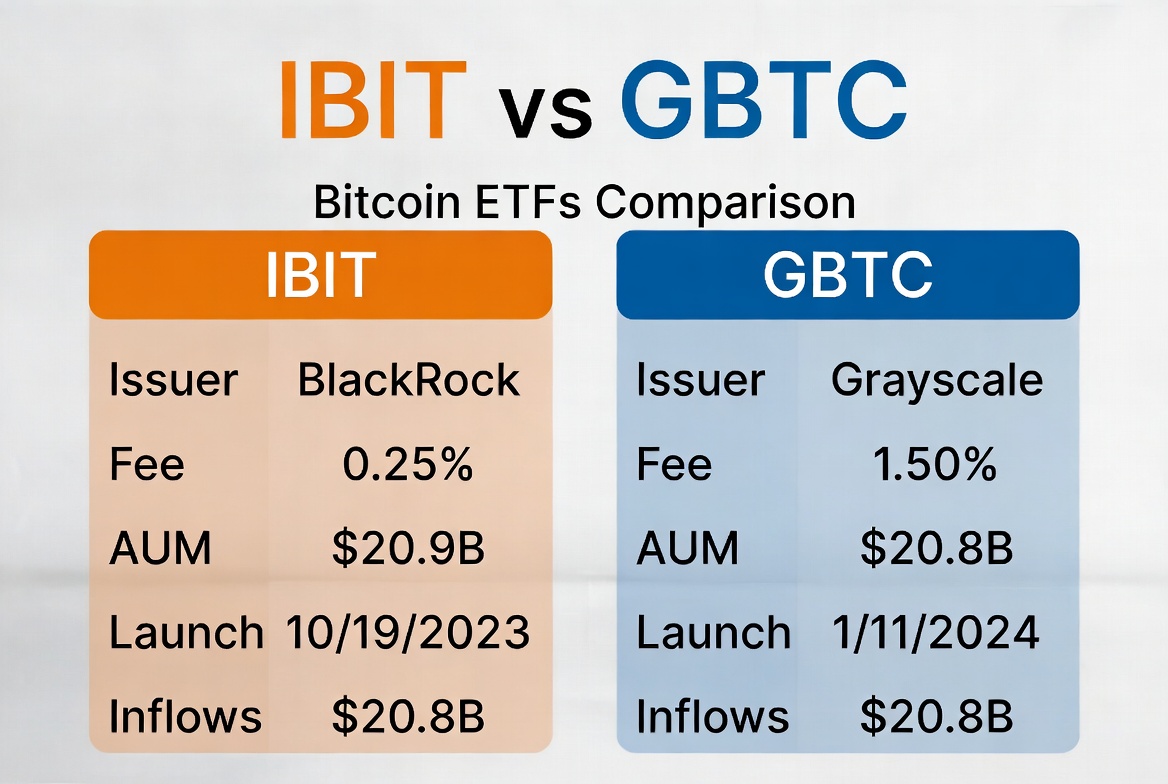
Product Structure Differences Between IBIT and GBTC
From the perspective of underlying assets, both IBIT and GBTC hold real Bitcoin, so both are spot Bitcoin investment tools.
However, their development paths are clearly different. IBIT adopted a spot ETF structure from the beginning, while GBTC went through a transition from a Bitcoin trust product into a spot ETF product.
This historical background creates differences in how the two products are perceived by the market and in the composition of their investor bases. IBIT is more representative of a new generation of spot ETFs, while GBTC still retains stronger characteristics from the early digital asset market.
From a market interpretation perspective, IBIT symbolizes the entry of traditional asset managers into the digital asset market, while GBTC represents an important achievement from the early financialization of crypto assets.
Fee Mechanism Differences Between IBIT and GBTC
Fees are one of the key factors investors consider when comparing ETF products because they directly affect the cost of long term holding.
For long term investors, even a small difference in expense ratios can accumulate over years of holding. As a result, management fees often become an important reference point for institutional investors when choosing ETF products.
As competition in the spot Bitcoin ETF market has intensified, issuers have tried to attract inflows by offering more competitive fee structures. Lower management fees can make a product more appealing and strengthen its long term competitiveness.
Beyond the basic management fee, investors also pay attention to trading costs, bid ask spreads, and market liquidity, since these costs also affect the actual investment experience.
Liquidity Differences Between IBIT and GBTC
Liquidity determines how easily investors can buy and sell an ETF, and it is also one of the key indicators of ETF market maturity.
In general, the higher the trading volume and the narrower the bid ask spread, the better the ETF’s liquidity. Strong liquidity helps investors complete trades at prices closer to the market price and reduces transaction costs.
After its launch, IBIT attracted substantial inflows from both institutional and retail investors, gradually building a high level of market activity. Growth in assets also further strengthened the ETF’s liquidity advantage.
GBTC also enjoys strong market attention because of its long accumulated investor base. However, as competition in the spot ETF market has intensified, fund flows and market activity have continued to shift.
For large institutions, liquidity is often directly tied to execution efficiency, so liquidity differences are an important dimension when comparing the two ETFs.
Market Positioning Differences Between IBIT and GBTC
Although IBIT and GBTC are both built around Bitcoin, their brand positioning in the market differs clearly.
IBIT places greater emphasis on the demand within the traditional financial system for digital asset allocation. BlackRock’s influence in the global asset management industry makes it easier for IBIT to be incorporated into existing asset allocation frameworks by institutional investors.
By contrast, GBTC is more closely tied to the development history of the digital asset industry. Many institutions that entered the Bitcoin market early were first introduced to digital assets through GBTC.
In terms of market image, IBIT is more like a digital asset ETF created by a traditional financial institution, while GBTC is more like a representative product that emerged from the growth of the digital asset industry and gradually integrated into the traditional financial system.
This difference in positioning does not imply that one is better than the other. Rather, it reflects the different development backgrounds and market strategies of the two institutions.
Use Cases for IBIT and GBTC in Different Market Environments
In institutional asset allocation scenarios, both IBIT and GBTC can serve as tools for gaining Bitcoin price exposure.
For institutions that emphasize standardized asset allocation and ETF management systems, IBIT is often easier to integrate into existing portfolio management frameworks. Large wealth management institutions, pension funds, and traditional fund managers tend to pay closer attention to product scale, brand influence, and market liquidity.
For investors familiar with the development history of the digital asset market, GBTC has strong industry representativeness. Some investors have tracked GBTC’s market performance for years, so they still regard it as an important Bitcoin investment tool.
| Comparison Dimension |
IBIT |
GBTC |
| Issuer |
BlackRock, iShares |
Grayscale |
| Product origin |
Spot Bitcoin ETF |
Bitcoin trust converted into ETF |
| Market image |
Traditional finance representative |
Crypto industry pioneer |
| Main investor focus |
ETF allocation demand |
Digital asset historical participants |
| Core function |
Bitcoin price exposure |
Bitcoin price exposure |
In essence, both products ultimately serve the same purpose: helping investors gain Bitcoin price exposure through the securities market. Different investors focus on different priorities, so their selection logic may also differ.
Conclusion
IBIT and GBTC are both important products in the spot Bitcoin investment market, and both provide investors with price exposure by holding real Bitcoin.
IBIT represents the role of traditional asset managers in bringing digital assets into the mainstream financial system, while GBTC represents the outcome of the digital asset industry’s early exploration of financialization. The two differ in product structure, fee mechanism, liquidity, and market positioning, but their ultimate goal is the same: to help investors participate in the Bitcoin market more conveniently.
As the spot Bitcoin ETF market continues to develop, IBIT and GBTC will remain important windows for observing institutional capital flows and the financialization of digital assets.
FAQs
Are IBIT and GBTC Both Spot Bitcoin ETFs?
At present, both are spot Bitcoin investment products that track BTC price performance by holding real Bitcoin assets.
What Is the Biggest Difference Between IBIT and GBTC?
The biggest difference lies in their development history. IBIT was a spot ETF from its inception, while GBTC began as a Bitcoin trust product and later gradually transitioned into the spot ETF market.
Why Do Investors Compare IBIT and GBTC?
Both are large and widely followed Bitcoin investment tools, so they are often compared in terms of fees, liquidity, market positioning, and other factors.
Why Is Liquidity Important?
Higher liquidity usually means narrower bid ask spreads and greater trading efficiency, which can help reduce investors’ transaction costs.
Do IBIT and GBTC Both Move with Bitcoin’s Price?
Yes. Since both hold real Bitcoin assets, their long term performance is usually highly correlated with the market price of Bitcoin.
How Can Investors Trade IBIT or GBTC?
IBIT and GBTC can usually be bought and sold through securities accounts that support U.S. stock trading. For example, Gate TradFi also offers related CFD products, allowing investors to participate in price movements without directly holding ETF shares.