Game development has consistently been one of the most intricate processes in the digital content industry. From initial concept to product launch, it typically demands long-term collaboration among planning, art, programming, testing, and operations teams. For individual developers or small teams, high development costs and steep professional requirements often pose major obstacles to bringing a product to market.
With the rise of generative AI and Agent technologies, new production models are emerging in game development. Portal integrates AI Agents into the game development pipeline, leveraging multiple intelligent agents that specialize in different tasks to serve as a game creation infrastructure within the AI Gaming track. Portal's goal is not merely to generate content, but to build a complete AI-native development workflow from concept to launch.
What Is the Portal AI Agent Workflow?
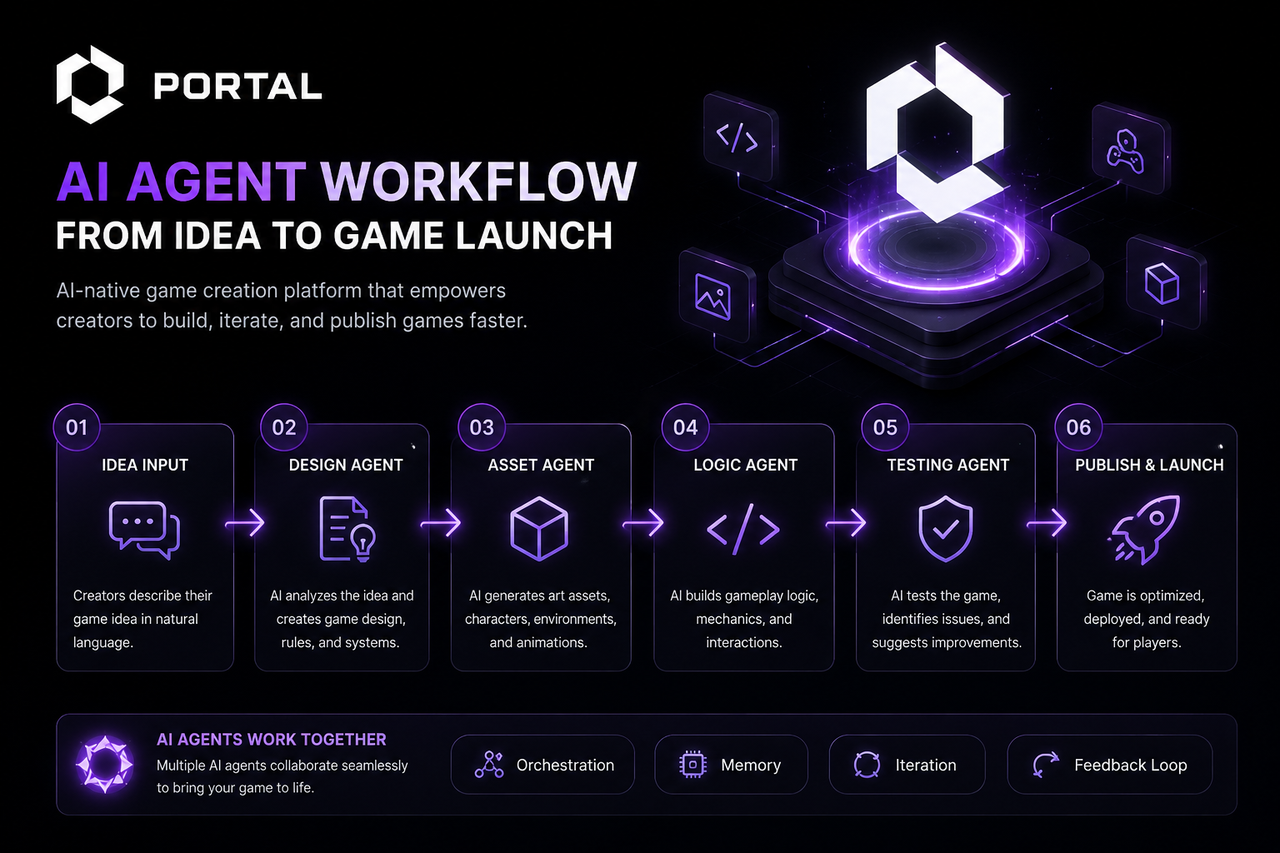
The Portal AI Agent workflow is an automated development system where multiple intelligent agents work together. Each agent has clearly defined responsibilities, including requirements analysis, content generation, logic development, quality testing, and resource management.
Unlike traditional AI tools that handle only single-instance generation, AI Agents emphasize sustained execution. Portal integrates multiple agents into a unified framework, enabling them to collaborate on the complete development process based on project needs.
This model resembles a digital development team, where different agents assume roles such as planning, art, programming, and testing, collectively driving the project forward.
What Happens After a User Submits an Idea?
The game development process typically begins with a creator's idea. In Portal, creators can input game concepts using natural language, covering aspects like genre, story background, character settings, and core gameplay.
Once an idea is submitted, the system performs requirements analysis. The AI identifies the game theme, target users, gameplay mechanics, and scene structure, then converts this information into development tasks.
After analysis, Portal automatically generates a project framework, including world-building, level planning, core loops, and a development roadmap, providing a clear execution guide for subsequent agents.
How the Design Agent Builds the Game Framework
The Design Agent is the first stage of the development process. Its primary responsibility is transforming abstract ideas into structured game plans.
The Design Agent generates game rules, quest flows, character relationships, and player growth paths. For complex projects, it can also break down different system modules and establish logical relationships between them.
This stage is analogous to planning in traditional game development, providing a foundational framework for resource generation and programming.
How the Resource Generation Agent Creates Game Content
The Resource Generation Agent is responsible for producing visual and content assets. Based on requirements from the Design Agent, the system automatically generates character images, scene maps, item resources, and some animation content.
In traditional development, art resources consume a significant portion of development time. By using generative AI, the Resource Generation Agent can quickly produce prototype content, helping development teams shorten production cycles.
Resource generation does not produce final versions directly; instead, it provides creators with base materials that can be rapidly iterated, thereby enhancing overall development efficiency.
How the Logic Development Agent Builds Gameplay Systems
After design and resource preparation, the Logic Development Agent constructs game interaction mechanics. This agent implements gameplay rules, quest systems, numerical logic, and player action feedback.
The Logic Development Agent can automatically generate partial code and interaction logic based on design documents, connecting different modules into a playable prototype. For simple projects, even basic gameplay can be built automatically.
This stage determines whether the game is playable, making it a core component of the entire workflow.
How the Testing Agent Finds and Fixes Issues
Testing is often one of the most time-consuming stages in game development. Portal's Testing Agent automates a wide range of repetitive detection tasks.
The Testing Agent simulates player behavior, checking game logic, level flow, resource loading, and system stability. When anomalies are detected, the system generates a problem report and feeds it back to the corresponding development agent.
Through automated testing, Portal can identify potential defects early, reducing subsequent maintenance costs.
What Steps Are Needed Before Game Launch?
After development and testing, Portal enters the content release phase. At this point, the system integrates resources and generates a deployment version suitable for the target platform.
The release phase also includes content review, performance optimization, and version management. Some agents continuously monitor user feedback and assist creators with subsequent updates and iterations.
This model transforms game launch from a one-time event into a continuous cycle of operation and optimization.
How Does the Portal AI Agent Workflow Differ from Traditional Development?
The biggest difference between the Portal AI Agent workflow and traditional development lies in the level of automation. Traditional models require manual collaboration across roles, whereas Portal delegates part of the work to AI Agents.
In resource production, AI quickly generates prototype materials; in logic development, AI automatically builds basic interaction systems; in testing, AI continuously identifies and fixes issues.
While complex projects still require human decision-making and optimization, AI Agents can handle a large volume of repetitive tasks, significantly improving overall development efficiency.
What Challenges Does the Portal AI Agent Workflow Face?
Although AI Agents improve production efficiency, they still have limitations. Complex narrative design, highly innovative gameplay, and large-scale multiplayer online game systems still require deep involvement from professional development teams.
Quality control of generated content is another critical challenge. AI outputs need human review and optimization to ensure they meet design objectives.
Additionally, collaboration efficiency between agents, computational resource costs, and model capability boundaries affect the overall development experience and the quality of final results.
Summary
Portal's AI Agent workflow is an AI-native development system covering game design, resource generation, logic development, automated testing, and content release. By enabling collaboration among multiple agents, Portal integrates work that traditionally required multiple specialized roles into a unified workflow, allowing creators to participate in game development with lower barriers. As AI Agent technology continues to evolve, this automated production model from concept to launch is becoming a key direction for AI Gaming infrastructure.
FAQs
What Is the Portal AI Agent Workflow?
The Portal AI Agent workflow is a game development system in which multiple AI agents collaboratively execute tasks across various development stages, including design, resource generation, logic development, testing, and release.
What Is the Difference Between Portal's AI Agent and Ordinary AI Tools?
Ordinary AI tools typically handle only single-instance generation, whereas AI Agents have sustained execution capabilities. They can manage complete task flows and collaborate with other agents to complete complex development work.
How Does Portal Turn Ideas into Games?
Portal first analyzes the user's natural language description. The Design Agent then creates a development framework, the Resource Generation Agent produces assets, the Logic Development Agent builds the gameplay system, and finally a playable game prototype is formed.
Can Portal's AI Agent Completely Replace a Development Team?
Portal's AI Agent can handle a large amount of repetitive development work, but complex gameplay design, creative decision-making, and large-scale system architecture still require human involvement. Therefore, it is best used as a collaboration tool rather than a complete replacement for a development team.
What Are the Advantages of AI Agents in Game Development?
AI Agents improve development efficiency, reduce resource costs, shorten testing cycles, and help individual developers quickly validate ideas, thereby lowering the barrier to entry into the game industry.