How Gate DEX Integrates On-Chain Spot, Perpetual, and Swap to Reshape the Decentralized Trading Workflow

Beginner
Quick Reads
Last Updated 2026-03-25 14:43:55
Reading Time: 1m
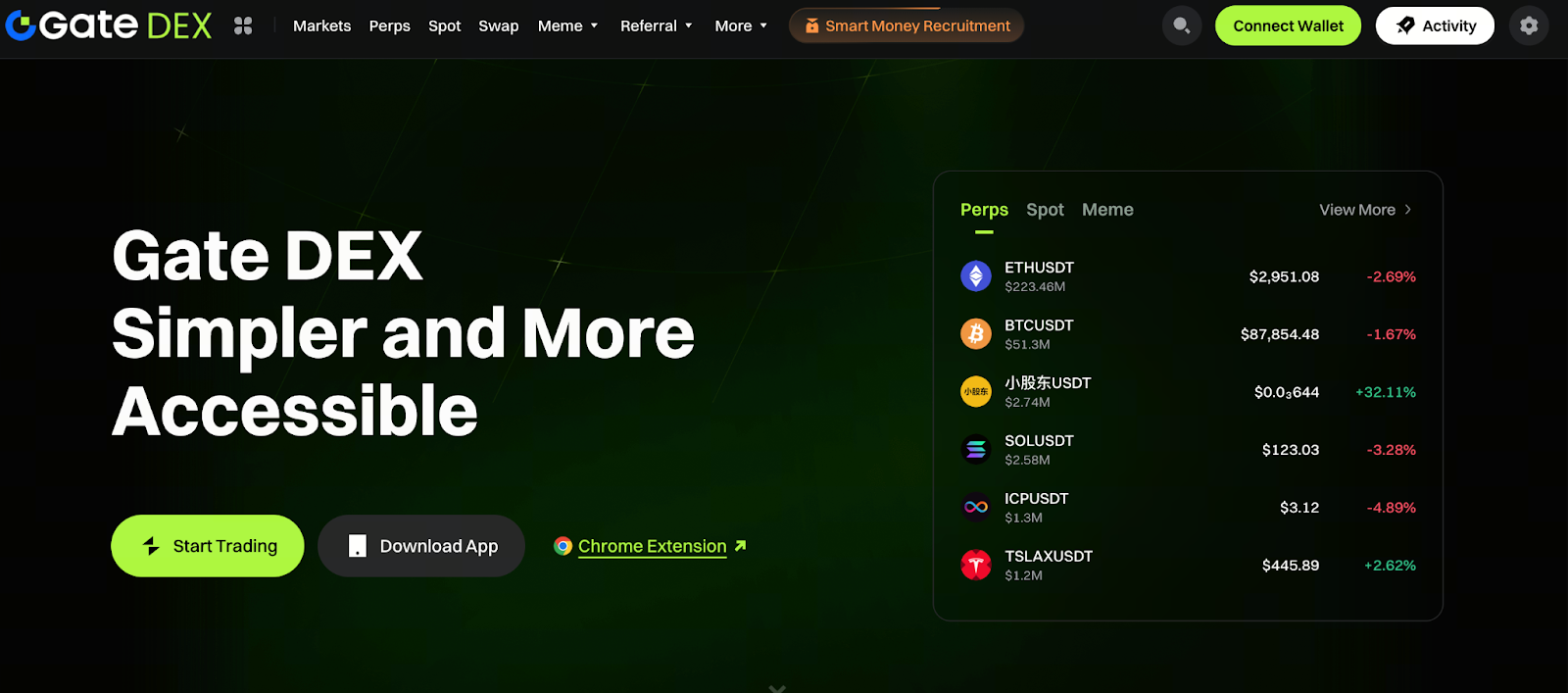
Gate DEX streamlines on-chain trading by unifying spot, futures, and swap trading features, delivering a cohesive transaction experience. This article explores Gate DEX's product design philosophy, focusing on its functional architecture and user journey.


Image: https://web3.gate.com/

Why On-Chain Trading Needs Process Restructuring

For years, decentralized trading’s main challenge has not just been performance or security—it’s the highly fragmented user experience. To complete a single transaction, users must constantly switch between multiple protocols, interfaces, and wallets.

This disjointed process keeps on-chain trading stuck at the “tool usage” stage, making it hard to build consistent, high-frequency trading habits. Gate DEX was developed to address this problem by restructuring the user journey at the process level.

Gate DEX’s Comprehensive Functional Architecture

Gate DEX is not just a single trading protocol. It offers a complete suite of features centered around trading, including:

  • On-chain spot trading
  • On-chain contract trading
  • Swap and cross-chain exchange
  • New asset discovery and on-chain tool modules

All these features are fully integrated into one product ecosystem, minimizing the switching costs for users operating in an on-chain environment.

On-Chain Spot Trading: Focusing on Asset Authenticity

With Gate DEX’s on-chain spot trading, users always retain direct ownership of actual on-chain assets. There are no custodial accounts involved—assets remain in the user’s wallet at all times.

Additionally, Gate DEX does not introduce leverage, liquidation, or funding rate mechanisms, keeping spot trading logic closely aligned with traditional spot markets. This makes it well-suited for medium- and long-term allocations and conservative trading strategies.

On-Chain Contracts: A New Frontier for DEXs

Contract trading is typically considered a strength of centralized exchanges. Gate DEX brings this feature on-chain, expanding the possibilities for decentralized exchanges.

By offering on-chain contract trading on a single platform, Gate DEX enables advanced users to execute complex trades and strategies without ever leaving the on-chain ecosystem.

The Role of Swap and Cross-Chain Exchange

In Gate DEX, Swap is not a standalone feature—it’s a core part of the trading process. Users can quickly swap assets and move liquidity across different blockchains.

This approach transforms Swap from a “temporary tool” into an essential component of the overall trading workflow, complementing spot and contract trading features.

Gate DEX’s Trading Pathway Design

Unlike traditional DEXs, Gate DEX prioritizes a seamless experience from platform entry through trade execution. The platform supports one-click login with a Gate account, Google account, or wallet, reducing onboarding friction.

During trading, Gate DEX minimizes disruptions from repeated signature requests and offers advanced order types like limit and sniping orders, making on-chain trading more consistent with centralized exchange habits.

How Gate DEX Changes the Game

By redesigning both the functional structure and trading pathway, Gate DEX aims to transform on-chain trading from a high-barrier process into a sustainable trading experience.

This transformation is not about a single innovative feature. Instead, Gate DEX integrates and streamlines the process, enabling more users to complete real, end-to-end trading activities on-chain.

Author: Max
Disclaimer
* The information is not intended to be and does not constitute financial advice or any other recommendation of any sort offered or endorsed by Gate.
* This article may not be reproduced, transmitted or copied without referencing Gate. Contravention is an infringement of Copyright Act and may be subject to legal action.

Related Articles

AI-Native Settlement Layers: How United Stables Is Building the Next Financial Rail
Beginner

AI-Native Settlement Layers: How United Stables Is Building the Next Financial Rail

Stablecoins were originally designed as dollar substitutes within exchanges, primarily used for asset pricing and trade settlement. As on-chain financial ecosystems have matured, their role has expanded beyond simple payments to include collateral assets, cross-chain liquidity mediums, and unified settlement units. In particular, as AI systems and automated agents begin to participate directly in economic activity, demand has risen sharply for programmable value units capable of instant settlement. This shift is pushing stablecoins toward the role of foundational financial infrastructure.
2026-03-25 03:16:17
The ve(3,3) Flywheel Explained: How AERO Tokenomics Powers Aerodrome’s DeFi Economy
Beginner

The ve(3,3) Flywheel Explained: How AERO Tokenomics Powers Aerodrome’s DeFi Economy

In the competition for DeFi liquidity, high-inflation mining alone is no longer enough to build lasting advantages. Aerodrome applies the ve(3,3) economic model to redesign token emissions, voting mechanisms, and revenue distribution, creating a liquidity flywheel centered on governance and cash flow. This article examines AERO tokenomics, the veAERO locking mechanism, and protocol revenue models to explain how Aerodrome builds a sustainable DeFi economic system.
2026-03-25 06:41:58
Aerodrome Tokenomics: How ve(3,3) Powers Base's Most Profitable DEX
Beginner

Aerodrome Tokenomics: How ve(3,3) Powers Base's Most Profitable DEX

AERO is the native token of Aerodrome Finance, a core decentralized exchange and liquidity protocol in the Base ecosystem. It is primarily used for liquidity incentives and ecosystem operations. veAERO is a governance NFT that users receive by locking AERO, representing both voting power and the right to share protocol revenue. Through a dual track structure of AERO as a utility token and veAERO as a governance credential, Aerodrome separates liquidity usage value from long term governance power, allowing participants to act as liquidity providers, governance decision makers, and revenue sharers within the same system.
2026-03-25 06:40:31
How Does PAXG Work? In-Depth Overview of the Physical Gold Tokenization Mechanism
Beginner

How Does PAXG Work? In-Depth Overview of the Physical Gold Tokenization Mechanism

PAXG (Pax Gold) is a tokenized asset backed by physical gold, issued by the fintech company Paxos and traded on the Ethereum blockchain as an ERC-20 token. The core concept is to tokenize physical gold on-chain, with each PAXG token representing ownership of a certain amount of gold. This structure enables investors to hold and trade gold in the form of a digital asset.
2026-03-24 19:12:51
How is the price of PAXG determined? Pegging mechanism, trading depth, and influencing factors
Beginner

How is the price of PAXG determined? Pegging mechanism, trading depth, and influencing factors

PAXG (Pax Gold) is a tokenized asset backed by physical gold reserves, launched by fintech firm Paxos and issued as an ERC-20 token on the Ethereum blockchain. The core concept is to digitally represent real-world gold assets, allowing investors to hold and trade gold via the blockchain network. Because each PAXG token corresponds to a specific quantity of physical gold, its price is theoretically expected to closely track the global gold market.
2026-03-24 19:11:40
DePIN Identity Network and Real World Applications: How Humanity Protocol Brings on-chain Identity Into the Physical World
Beginner

DePIN Identity Network and Real World Applications: How Humanity Protocol Brings on-chain Identity Into the Physical World

Most Web3 identity systems remain confined to on-chain environments and struggle to achieve meaningful adoption in real world settings. Through a DePIN architecture and physical verification hardware, Humanity Protocol aims to bring decentralized identity into access control systems, hospitality, public services, and offline events, allowing on-chain identity to function not just as a digital credential, but as foundational infrastructure for real world access.
2026-03-25 07:40:53





