As decentralized organizations continue to expand, DAOs are evolving beyond simple governance voting systems. Modern DAOs require more comprehensive infrastructure for organization creation, contributor management, governance coordination, treasury activities, and community operations.
However, many DAO ecosystems still rely on fragmented tools. Governance voting, member management, blockchain data tracking, and community activities are often handled through separate platforms, making DAO operations more complex.
DAOBase addresses these challenges by combining DAO creation tools, governance mechanisms, blockchain data aggregation, and AI-assisted capabilities into a unified infrastructure framework. Through this approach, DAOBase aims to simplify how communities create, operate, and analyze decentralized organizations.
The DAOBase ecosystem is also supported by BEE Token, Points, and NFT-based participation mechanisms, creating different pathways for users, contributors, and communities to engage with the platform.
What Modules Make Up the DAOBase Infrastructure?
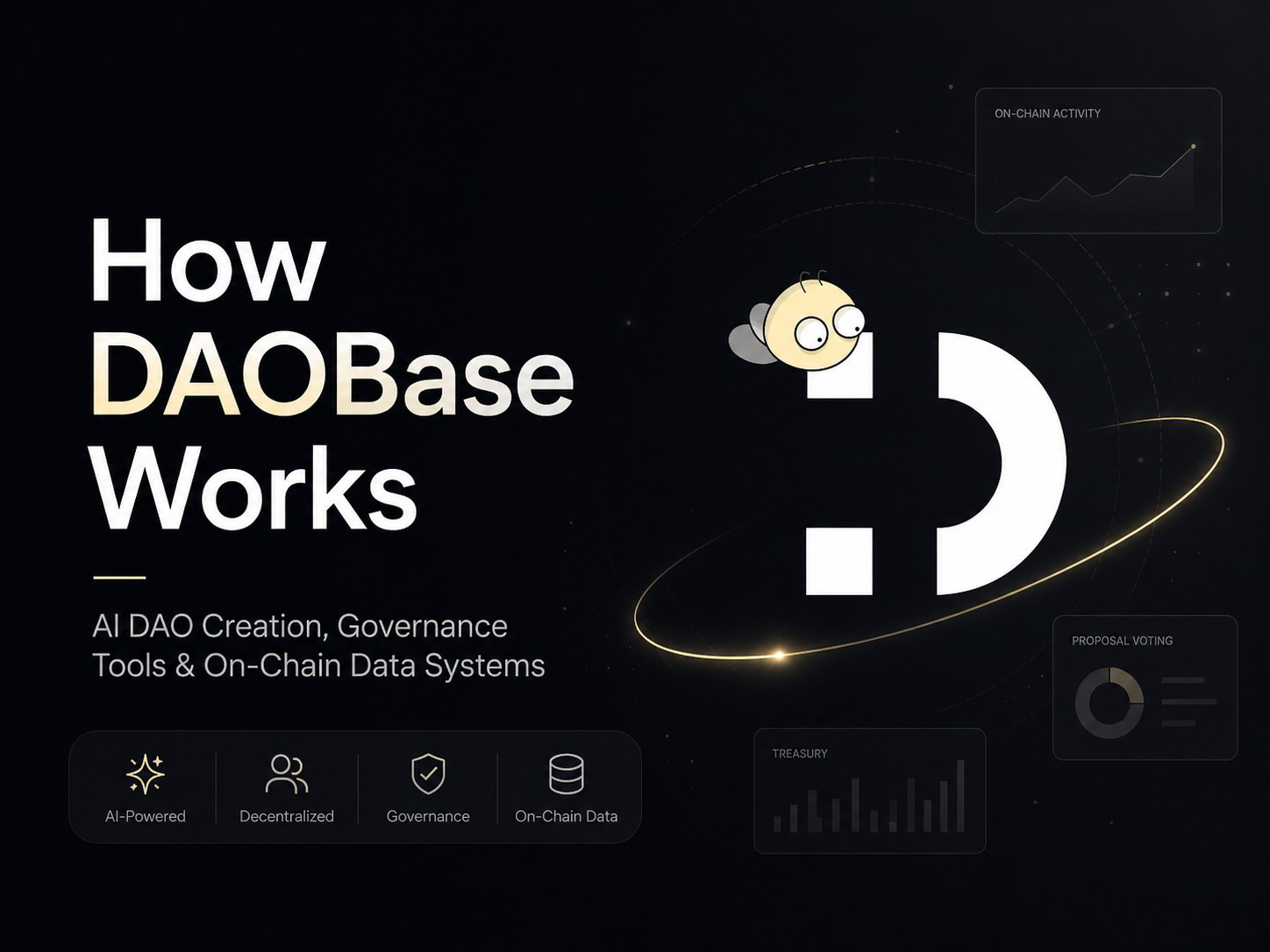
DAOBase consists of multiple infrastructure modules designed to support different stages of DAO development, including DAO creation, governance management, blockchain data analysis, and community participation.
The DAO Creation module helps users establish decentralized organizations, while governance tools provide frameworks for community decision-making. Meanwhile, on-chain data systems collect and organize blockchain information to help users better understand DAO activities.
Unlike single-purpose DAO tools that focus only on voting or organization deployment, DAOBase combines multiple components into one ecosystem.
| Module |
Function |
| DAO Creation |
Helps users establish and configure DAO structures |
| Governance Tools |
Supports proposals, decision-making, and community coordination |
| On-chain Data System |
Aggregates blockchain data for analysis |
| Community System |
Tracks participation and contributor activities |
| AI Tools |
Assists with information processing and DAO management |
By integrating these modules, DAOBase aims to provide a more complete infrastructure layer for decentralized organizations.
How Does DAOBase Build Ecosystem Analysis Through DAO Data Aggregation?
DAOBase builds ecosystem analysis capabilities by collecting and organizing DAO-related data from blockchain networks and community activities.
In traditional DAO environments, governance records, member activities, treasury information, and on-chain transactions are often distributed across multiple platforms. This makes it difficult for users to gain a complete understanding of how a DAO operates.
DAOBase addresses this issue by providing structured data analysis capabilities. By aggregating blockchain information, the platform helps users analyze DAO activities, governance participation, and ecosystem development trends.
The value of DAO data aggregation comes from improving transparency. Community members can better understand organizational behavior through publicly available blockchain information.
How Does DAO Creation Work on DAOBase?
DAOBase provides infrastructure tools designed to simplify the process of creating and managing decentralized organizations.
Building a DAO traditionally requires multiple technical steps, including smart contract deployment, governance framework design, membership management, and community coordination. These requirements can create barriers for communities without extensive technical resources.
DAOBase aims to reduce these barriers by providing standardized tools that allow users to establish DAO structures while focusing more on organizational goals rather than technical implementation.
A typical DAO creation process involves several stages:
| Stage |
Description |
| Organization Setup |
Establishes the DAO structure |
| Governance Configuration |
Defines decision-making mechanisms |
| Community Management |
Organizes members and contributors |
| Data Tracking |
Monitors DAO activities and participation |
Through this infrastructure approach, DAOBase helps communities move from initial DAO creation toward ongoing management and coordination.
DAOBase connects token mechanisms with DAO governance by using economic incentives to encourage community participation.
Within decentralized organizations, tokens often serve multiple purposes, including governance participation, contributor incentives, and ecosystem coordination. DAOBase uses BEE Token as its native Utility and Governance Token to support these functions.
BEE Token connects users, DAO creators, and contributors through a shared incentive framework. Combined with Points and NFT-based participation systems, DAOBase creates multiple ways for users to contribute to ecosystem growth.
This model allows DAO participation to extend beyond voting. Users can participate through community activities, ecosystem contributions, and governance-related interactions.
How Does DAOBase’s On-Chain Reputation System Help DAOs Identify Contributors?
DAOBase explores on-chain reputation mechanisms to help decentralized organizations better recognize contributors based on transparent blockchain activity and community participation.
In traditional online communities, contributor reputation is often evaluated through centralized systems or subjective judgments. For DAOs, where members may come from different regions and backgrounds, identifying meaningful contributions can be more challenging.
By combining blockchain data with community participation records, DAOBase can help organizations understand user engagement patterns, contributor activity, and participation history.
DAOBase’s reputation-related mechanisms include:
| Component |
Purpose |
| On-chain Data |
Records blockchain-based activities |
| Points System |
Tracks user participation and contributions |
| NFT Identity |
Represents community status and reputation |
| Community Activities |
Provides additional contribution records |
These mechanisms create a more transparent way for DAOs to recognize active participants. Instead of relying only on ownership or voting power, communities can evaluate broader contribution behaviors.
How Does AI Participate in DAO Management and Community Coordination?
DAOBase incorporates AI-assisted capabilities to improve information processing and management efficiency within decentralized organizations.
As DAOs grow, communities need to handle increasing amounts of information, including governance proposals, member activities, blockchain transactions, and ecosystem updates. Processing this information manually can become inefficient.
AI technologies can assist with organizing complex information, analyzing data relationships, and helping community members better understand DAO activities.
Within DAOBase’s infrastructure approach, AI functions as an assistance layer rather than an independent decision-maker. Governance decisions remain determined by community rules and participant involvement.
The combination of AI and blockchain data provides DAOs with new possibilities for improving coordination, transparency, and operational efficiency.
What Are the Current Limitations of DAOBase’s Mechanism?
DAOBase’s infrastructure model still faces challenges related to DAO adoption, ecosystem growth, and practical implementation.
Although DAOBase combines DAO creation tools, governance systems, on-chain data analysis, and AI-assisted capabilities, the effectiveness of these mechanisms depends on whether communities actively adopt and use decentralized organization models.
Another challenge is balancing automation with community decision-making. While AI and data tools can improve efficiency, DAOs still require active participation from members to maintain effective governance.
The long-term development of DAOBase will depend on ecosystem expansion, user adoption, and how decentralized organizations evolve in practical applications.
Summary
DAOBase works by combining DAO creation tools, governance infrastructure, on-chain data systems, AI-assisted capabilities, and community participation mechanisms into a unified platform.
Its infrastructure approach covers multiple stages of DAO operations, including organization creation, governance coordination, contributor recognition, and ecosystem analysis.
BEE Token, Points, and NFT-based participation systems further extend DAOBase’s ecosystem model by providing additional ways for users and contributors to participate.
By integrating blockchain data and AI-assisted tools, DAOBase aims to simplify decentralized organization management and provide infrastructure for the next generation of DAOs.
FAQ
How does DAOBase create a DAO?
DAOBase provides infrastructure tools that help users establish DAO structures, configure governance mechanisms, and manage community participation without building every component independently.
What is the role of AI in DAOBase?
AI in DAOBase is designed to assist with information processing, data analysis, and community coordination, helping users better understand and manage DAO-related activities.
How does DAOBase use blockchain data?
DAOBase uses on-chain data aggregation to organize blockchain activity information and provide insights into DAO governance, participation, and ecosystem behavior.
What are DAOBase Points used for?
DAOBase Points are used to record user participation and ecosystem contributions, helping create a transparent record of community engagement.
How do NFTs support DAOBase’s ecosystem?
DAOBase NFTs can represent user identity and contribution records, providing a reputation layer for community participation within the DAO ecosystem.
DAOBase combines DAO creation, governance management, on-chain data analysis, and AI-assisted capabilities, while many traditional DAO tools focus on only one specific function.