Unlike the Web3 era, where most users completed swaps and deposits/withdrawals on CEXs or standalone dApps, Hypercasual Finance transforms financial actions into shareable, spreadable social behaviors with minimal cognitive load: transfers, tipping, teaming up, completing tasks, and earning credits — all within the social environments where users already spend time. For public chains and SocialFi projects aiming to onboard the "next billion users," reducing entry friction and merging on-chain settlement with social distribution has become a critical competitive differentiator.
From the evolution of blockchain and digital assets, Hana Network builds on the Cosmos SDK with a PoS consensus and uses zero-knowledge proofs (ZKPs) to support non-custodial fiat on/off ramps. Its product lineup — Hana Gateway (launched January 2024), the Reunion task ecosystem, and the Hanafuda mainnet Phase 1 (launched October 2024) — forms a closed loop of "gateway + tasks + gamification." Below, we break down the definition of Hypercasual Finance, its technical architecture, Gateway and Hanafuda mechanics, SocialFi differences, barrier-lowering strategies, competitive advantages, and future directions.
What Is Hypercasual Finance?
Hypercasual Finance adopts the product logic of hypercasual games — "quick to learn, short sessions, high virality" — to transform crypto finance from a "professional trading terminal" into "lightweight actions within social contexts."
Hana Network's official materials tie it to Web4, emphasizing three traits:
- Strong interactivity: Users drive distribution and conversion via social relationship chains, not just ads or app stores.
- Mobile-first: The interface and flow are designed for short mobile sessions.
- Real-time: Livestream tipping, instant P2P transfers, and similar features require low-latency experiences.
Functionally, Hypercasual Finance covers:
- P2P trading market: Direct exchange of crypto assets or fiat pairs between users, reducing intermediary fees and account review risks.
- Casual earning: Earn credits or equity through tasks, deposits, card collection, etc., rather than complex DeFi strategies.
- Live social tipping: On-chain tipping in scenarios like X and Telegram.
- Trustless on/off ramp: Fiat-to-crypto conversion under non-custodial conditions.
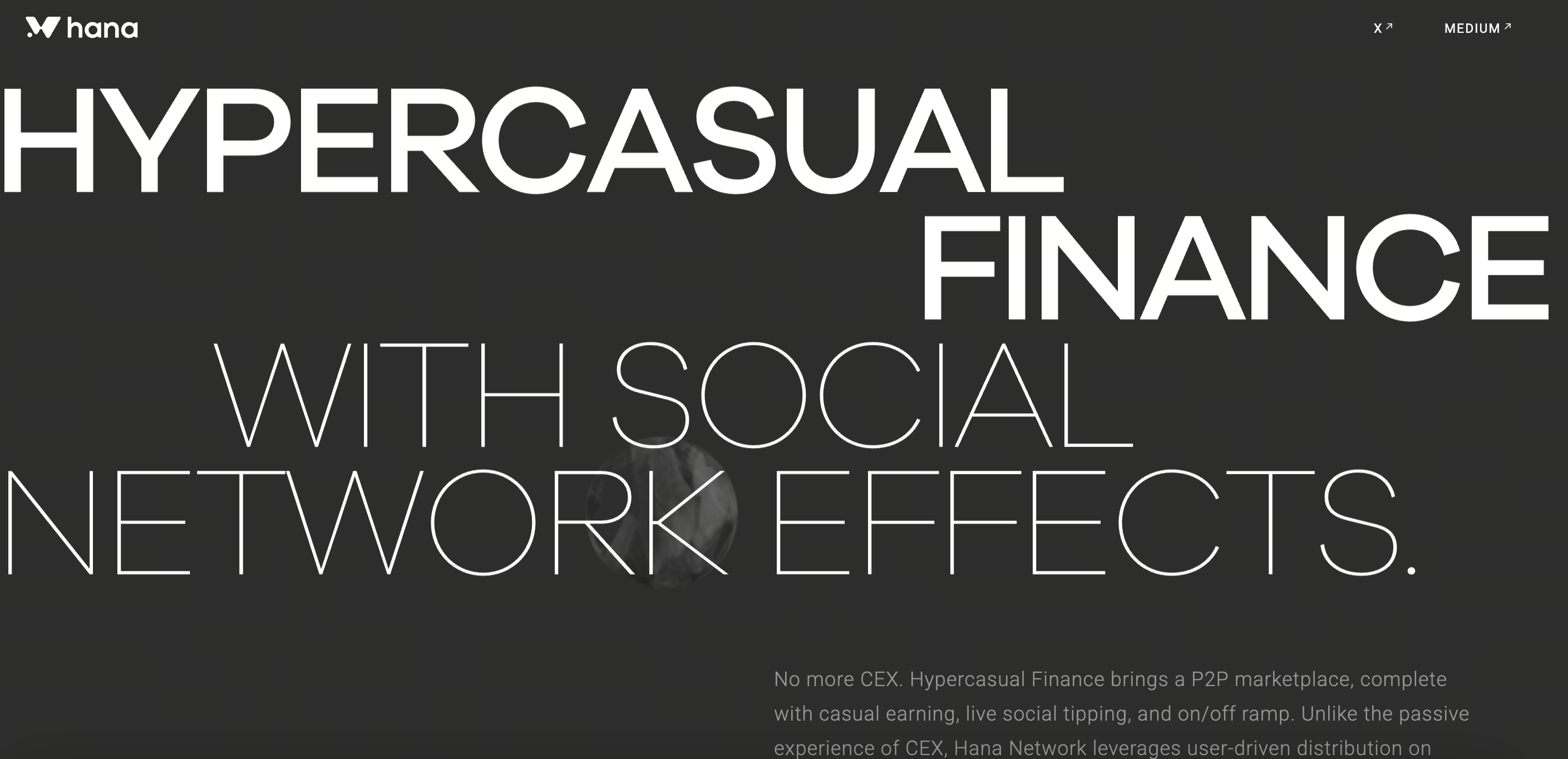
Compared to the long chain of "open account → deposit → trade → withdraw" on CEXs, Hypercasual Finance compresses key steps into social actions themselves, leveraging network effects to partially replace acquisition costs. This underpins Hana's "No More CEX" vision: when P2P liquidity, compliant on/off ramps, and social distribution are unified in one infrastructure, retail users no longer need to open a separate exchange app for a single transfer.
Core Technical Architecture of Hana Network
Hana Network's technical narrative has evolved from "Privacy Layer 0" to "Social Finance Layer 1," but its foundation remains centered on privacy, cross-chain capabilities, and modular execution.
Consensus and Main Chain
The chain is built on the Cosmos SDK and a Tendermint-style PoS consensus, with IBC ecosystem interoperability for connecting to Cosmos and adjacent DeFi and restaking protocols. Node implementation details are available in the open-source repository hana-node, with some EVM integration via Polaris (Berachain's EVM modular framework), balancing performance and configurability.
Privacy and Cross-Chain Layer (Early Architecture)
The project initially positioned itself as a Layer 0 for Privacy, with core components including:
| Component |
Role |
| Multi-asset zk-UTXO privacy computation layer |
Hides transaction details on-chain while maintaining verifiability |
| Hana Transporter Protocol |
Trust-minimized bridging connecting heterogeneous chains like EVM, Bitcoin, and Move |
| Hana SDK |
Provides privacy capabilities for wallets and dApps |
Cross-chain and privacy functions typically rely on zk-SNARKs and threshold signatures (TSS) to reduce single points of risk in custodial bridges. The team also discusses stronger privacy L2 directions like FHE (Fully Homomorphic Encryption) in its roadmap, but actual implementation is subject to official announcements.
Application Layer: Gateway-First
Rather than pursuing a "full-featured DeFi public chain," Hana's current product focus leans toward a gateway-type L1: using ZKPs to power Hana Gateway's non-custodial fiat channel, then funneling traffic through social and gamified products. This "infrastructure + consumer entry point" layered approach contrasts with many chains that first build dApps and add on/off ramps later.
How Hana Gateway Connects On-Chain and Social Ecosystems
Hana Gateway is the core product bridging real-world fiat and on-chain assets. Launched in January 2024, it has reportedly accumulated over 200,000 users. Its goal: provide a smooth CeFi-like experience while retaining self-custody.
Core Capabilities
- Trustless on/off ramp: Users can exchange fiat for BTC, ETH, USDC, and other major assets without long-term custody on the platform. ZKPs balance compliance and privacy, with rules varying by region and partner.
- P2P fiat-crypto trading: Buyers and sellers match via smart contracts or protocol layers, claiming permissionless, low-fee, anti-fraud design, reducing the trust overhead of traditional OTC groups.
- Low-barrier onboarding: Supports registration via familiar methods like Google Account, then guides users through transfers and ramps, shortening the Web2-to-Web3 path.
Connecting to Social Ecosystems
Gateway itself is not a "social app" but rather a financial API embedded in social scenarios:
- X (Twitter): For activity distribution, tipping, or brand collaboration tasks (e.g., social media contests with Osmosis in Reunion).
- Telegram, Discord: As a backend settlement layer for group transfers, gift-coin–style P2P, etc.
- Short-video platforms (TikTok): Enabling livestream tipping, creator monetization, and other Web4 use cases.
The on-chain layer handles finality and asset security; the social layer drives user acquisition and interaction frequency — the "social network effects" Hana describes: every share, tip, or completed task can generate new on-chain addresses and Gateway users.
How Hanafuda and On-Chain Interaction Systems Work
Hanafuda is officially described as a "Card Lego project": using Japanese Hanafuda card metaphors to turn the complex crypto world into a beginner-friendly "playground." It also serves as the launch vehicle for Hana Network Mainnet Phase 1 (starting October 2024).
User Path
- Deposit assets: Users deposit supported crypto into the protocol, accumulating Hana Points and Hanafuda cards.
- Collect and team up: Cards have collection and combination attributes; users can form teams to participate in competitions or events.
- Compete and earn tickets: Teams compete to earn special tickets for ecosystem benefits, event access, or airdrop-style incentives (subject to official rules).
On-Chain Interaction
Hanafuda is not a pure off-chain points game: deposits, points, and card states are anchored to the Hana mainnet or related contracts, forming a two-tier structure of on-chain state + gamified UI. Its strategic significance:
- Education: Familiar card visuals reduce the cognitive shock of "wallet → gas → contract."
- Retention: Team building and competitions increase session frequency, aligning with Hypercasual's short-cycle engagement.
- Cold start: Provides quantifiable active addresses and TVL for Mainnet Phase 1.
Combined with the Reunion task platform (covering restaking/DeFi protocols like Babylon, pSTAKE, Solv, and Osmosis), users progressively deepen into on-chain finance through the funnel: do tasks → earn points → play Hanafuda → use Gateway.
SocialFi (Social Finance) combines social relationships, content influence, and programmable assets. Traditional Web2 social platforms primarily monetize through ads and subscriptions, with users rarely owning on-chain assets or income rights directly.
| Dimension |
Traditional Social Platforms |
Hana-style SocialFi / Web4 |
| Asset ownership |
Balance within platform account; withdrawal subject to platform rules |
Non-custodial wallet; user holds private key |
| Tipping/transfers |
Platform virtual gifts or fiat channels |
On-chain instant settlement; composable across platforms |
| Creator economy |
Profit-sharing ratio set by platform |
Smart contract–enabled splits, NFTs, credits |
| Data and privacy |
Centralized database |
ZKP / privacy pools and other optional solutions |
| User acquisition |
In-app growth, app stores |
Social viral spread + on-chain incentives |
Hana Network's differentiator: It does not attempt to recreate a "crypto Twitter" but instead embeds financial capabilities into existing social graphs. Users don't need to migrate their social relationships — just complete their first on-chain transfer in a familiar context. This contrasts with the cold-start difficulties of many standalone SocialFi dApps.
However, risks must be acknowledged: scam links, fake customer service, and phishing ramps can be amplified in social environments. Non-custodial means users are responsible for their own keys and transaction confirmations; the educational burden shifts from "learning DeFi" to "learning secure social finance."
How Hana Network Lowers Web3 Adoption Barriers
Hana's barrier-lowering strategy can be summarized in five paths:
- Account abstraction: Web2-friendly methods like Google Sign-In reduce registration friction, then gradually guide users to self-custody or smart accounts (depending on version).
- Gateway integration: Swaps, deposits/withdrawals, and transfers within a single product, eliminating multi-app switching.
- Gamified onboarding: Hanafuda replaces obscure terms like "staking → mining → governance" with cards and points.
- Task guidance: Reunion breaks down complex restaking ecosystems into step-by-step quests, reducing one-time cognitive load.
- Social distribution: Leverages KOLs, group chats, and livestreams for trust transfer — replacing 'white paper education' with 'friends use it.'
From a regulatory perspective, non-custodial ramps still face KYC/AML requirements by region. Hana must continuously balance its "permissionless narrative" with local compliance — a challenge common to all gateway-type projects.
Hana Network's Competitive Advantage in On-Chain Social
Based on public information and ecosystem partnerships, Hana Network's competitive advantages include:
- Investment and brand credibility: Runner-up at ETH Global zkDay 2023, reinforcing ZK and privacy technology credibility.
- First-mover user scale: Over 200,000 users within a year of Hana Gateway's launch, providing a data moat in the "social + ramp" segment.
- Ecosystem alliances: Partnerships with restaking/liquidity protocols such as Babylon, Solv, Kelp DAO, pSTAKE, Osmosis, and Morph; Reunion tasks generate cross-referral traffic.
- Regional expansion: Investment from Pacific Meta and others in 2024 supporting localized operations in Japan and other Asian markets — aligning with Hypercasual and mobile finance adoption in the region.
- Narrative differentiation: The "Web4 + Hypercasual Finance + Replace CEX" story is clear and easy to spread. Hanafuda provides a visual and product identity distinct from pure DeFi chains.
Weaknesses and uncertainties remain: SocialFi is a highly competitive space; CEXs and compliant stablecoin channels still dominate retail; after Mainnet Phase 1, Hana needs to prove the long-term sustainability of TVL, fees, and tokenomics (HANA).
Future Development Direction of Hypercasual Finance
In the near to medium term, Hypercasual Finance may evolve along these lines:
- Deeper social embedding: Native integration with X API, Telegram Mini Apps, and TikTok e-commerce/livestream tools, enabling tipping, shopping, and crowdfunding with one-click on-chain settlement.
- AI + social finance: Smart customer support, transaction risk alerts, and personalized task recommendations to reduce novice error rates (an industry trend, not exclusive to Hana).
- Enhanced privacy: Combining FHE, privacy pools, and Proof of Compliance to meet regulatory expectations for both institutions and retail users.
- Unified cross-chain liquidity: Through Transporter and IBC, aggregating liquidity from Ethereum, Bitcoin, and Cosmos ecosystems into the Gateway order book or P2P network.
- From hypercasual to hyperretention: After gamified user acquisition, retain users with real returns (restaking yields, stable earnings, creator splits) to avoid the "claim airdrop → churn" cycle.
For Hana Network, the key metrics will be whether it can convert Gateway users into long-term participants in Hanafuda and the mainnet ecosystem, and turn social spread into sustainable P2P liquidity — proving that Hypercasual Finance is more than just a concept.
Summary
Hana Network, under the banner of Hypercasual Finance, aims to rewrite how retail users interact with crypto finance in the Web4 context: use Hana Gateway for trust-minimized on/off ramps and P2P trading, use Hanafuda and Reunion to solve cognition and engagement, and leverage the distribution power of Twitter and Telegram for growth. Its technical foundation rests on Cosmos PoS, ZKP privacy, and cross-chain transport protocols; its business narrative directly challenges the passive holding model of CEXs, shifting toward social-driven active participation.