As the Ethereum DeFi ecosystem scales up, MEV has evolved from a technical concept into a key force shaping the entire on-chain economy. Arbitrage, liquidations, and transaction ordering all generate MEV Rendite, while the intricate collaboration between Builders, Relays, and Validators has increasingly concentrated block production. The introduction of ePBS is widely regarded as Ethereum’s major effort to govern MEV at the protocol level—a move that goes beyond pure technical upgrades to address the network’s long-term openness and censorship resistance.
From a blockchain infrastructure perspective, ePBS represents a more native and transparent approach to block building. By embedding PBS directly into the protocol layer, Ethereum aims to boost network efficiency while establishing a fairer value distribution mechanism. This creates a stable, long-term foundation for DeFi, stablecoins, RWAs, and the next generation of on-chain applications.
Why Is ePBS the Core Upgrade of Glamsterdam?
Among the many proposals discussed as part of the Glamsterdam upgrade, ePBS is widely considered one of the most critical. The reason is simple: it directly impacts Ethereum’s most fundamental process—how blocks are produced.
In recent years, the rapid growth of DeFi, DEXs, and on-chain derivatives has massively expanded the scale of MEV. Countless arbitrage bots compete for transaction ordering rights, profiting through front-running, sandwich attacks, or liquidation trades. To capture this value more efficiently, Ethereum gradually adopted a PBS system where Builders, Relays, and Validators each play specialized roles.
While this division of labor improved efficiency, it also created new issues. A handful of large Builders began to dominate, Relay nodes grew increasingly important, and concerns arose that block production was becoming increasingly centralized.
Glamsterdam isn’t just about boosting TPS—it’s about making Ethereum’s core infrastructure more open, fair, and transparent. ePBS was proposed against this backdrop and has become a key Seite for Ethereum’s protocol evolution.
How Does Ethereum’s Current PBS and MEV Market Operate?
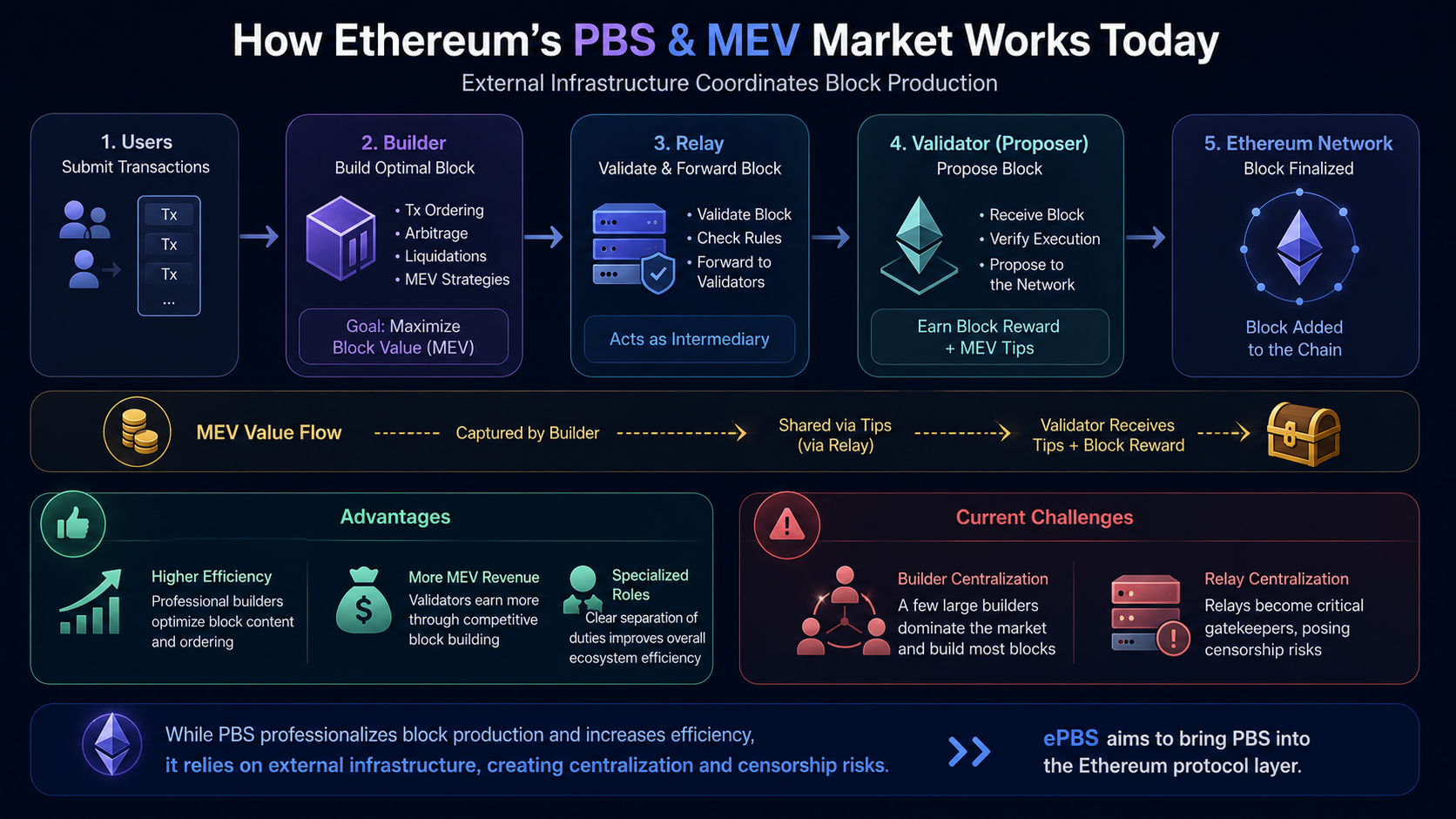
To understand ePBS, you first need to grasp Ethereum’s current PBS mechanism.
In the traditional proof-of-stake model, Validators were responsible for both selecting transactions and building blocks. But as the MEV market grew, block building evolved into a highly specialized task.
Here’s how the current process typically works:
After users submit transactions, Builders construct optimal blocks based on transaction ordering, arbitrage opportunities, and liquidation profits. Relays then verify and forward these blocks, and finally, Validators propose new blocks and receive rewards.
This setup offers clear advantages. Professional Builders can optimize block content using algorithms, improving overall network efficiency while generating more income for Validators. However, problems have emerged:
- The Builder market is trending toward centralization, with a few large Builders producing the vast majority of blocks.
- Relays have become critical intermediaries for block transmission. If they become centralized or engage in censorship, Ethereum’s openness could be compromised.
In short, while PBS made block production more specialized, it also outsourced the building process to external infrastructure, moving it away from the protocol itself. That’s exactly what ePBS aims to change.
How Does ePBS Restructure Block Building?
ePBS stands for Enshrined Proposer Builder Separation. “Enshrined” means that PBS is formally written into the Ethereum protocol.
In simple terms:
- Current PBS operates outside the protocol, relying on third-party Relays, with Builders and Validators coordinating through an external market.
- ePBS directly coordinates Builders and Validators through the protocol, reducing the role of Relays, with block-building rules uniformly defined by the protocol.
The biggest shift is bringing block production back on-chain, from off-chain. In the new model, Builders still construct blocks, but their submission, bidding, and profit distribution are managed by the protocol. Validators no longer depend entirely on third-party Relays; they can select the best block directly through the protocol.
This means:
- Greater transparency in block production
- More open MEV profit distribution
- Reduced reliance on external infrastructure
- Stronger network censorship resistance
Architecturally, ePBS doesn’t eliminate Builders—it standardizes them as a protocol role.
This design is widely seen as a major evolution in Ethereum’s block production mechanism.
How Will ePBS Change Ethereum’s MEV Market?
MEV isn’t inherently negative. Arbitrage, liquidations, and transaction ordering are all normal market functions. The real question is how these values are extracted and who captures them. In the current model, MEV profits flow primarily to large Builders and certain infrastructure providers. As competition intensifies, the market has become increasingly concentrated at the top.
ePBS aims to change this dynamic.
- The protocol directly manages the Builder bidding process, reducing information asymmetry.
- Validators can access MEV profits more fairly, without relying on a few third-party service providers.
More importantly, ePBS helps reduce censorship risk. The community has repeatedly discussed block censorship in recent years. If certain Relays or Builders refuse to include specific transactions, both user experience and network openness suffer. By incorporating key processes into the protocol, ePBS can theoretically minimize this risk, making block production more decentralized.
Long term, this means the MEV market could shift from being dominated by a few players to a more open and transparent competitive environment.
What Does ePBS Mean for Validators, Builders, and Users?
For Validators: ePBS reduces dependence on external Relays while providing more stable and transparent income. Since the block bidding mechanism runs directly on the protocol layer, Validators can more easily choose the best block, improving overall Rendite efficiency.
For Builders: The competitive landscape will change. Previously, Builders relied heavily on off-chain infrastructure and private network advantages. In the future, protocol-layer bidding may lower entry barriers, allowing more participants to compete and increasing market vibrancy.
For everyday users: The impact of ePBS may not be immediately visible in the interface, but over time, the network’s fairness and openness are expected to improve.
Users can expect:
- Lower censorship risk
- More transparent transaction ordering
- Fairer block competition
- A more stable network environment
These improvements will enhance the overall Ethereum user experience.
Will ePBS Completely Solve the MEV Problem?
The answer is no. MEV arises from the market itself—as long as transaction ordering exists on-chain, value extraction opportunities will persist. Therefore, ePBS’s goal is not to eliminate MEV but to regulate it.
The Ethereum community widely agrees that MEV is a phenomenon that cannot be entirely removed. The key is to use protocol design to make value distribution fairer and reduce negative impacts on network security and openness. Through protocol-layer PBS, open bidding, and transparent profit distribution, ePBS aims to transform MEV from a market controlled by a few into a more open and decentralized ecosystem.
This is also a core philosophy of the Glamsterdam upgrade.
ePBS and Ethereum’s Long-Term Roadmap
ePBS is not an isolated upgrade. It is closely tied to Glamsterdam’s Block Access Lists, parallel execution, and the future Stateless Ethereum roadmap. The Ethereum of tomorrow aims to achieve simultaneously:
- Higher TPS
- Lower transaction costs
- Fairer block construction
- Stronger censorship resistance
- A more open validator network
ePBS’s role is to redefine block production, bringing the network’s core processes back to the protocol itself. From this perspective, ePBS doesn’t just affect how blocks are built—it shapes the value distribution model of Ethereum’s entire future economy.
As DeFi, stablecoins, and RWAs continue to expand, a more transparent and open block production mechanism will become a cornerstone of Ethereum’s long-term competitiveness.
Summary
ePBS is one of the most important protocol innovations in the Ethereum Glamsterdam upgrade, with significance far beyond block construction. By formally embedding PBS into the protocol layer, Ethereum is working to create a more transparent, fair, and open MEV market, while reducing dependence on external infrastructure and strengthening network decentralization.
As blockchain infrastructure matures, MEV governance has become an unavoidable topic for Ethereum. ePBS won’t eliminate MEV, but it can change how MEV operates—striking a better balance between value creation and value distribution, and further cementing Ethereum’s long-term position as a global open financial infrastructure.







