As the multi-chain DeFi landscape shifts into an "efficiency-first" era, standalone cross-chain bridges or single-point products can no longer sustain a durable competitive edge. The real question is whether a token model can continuously drive liquidity retention, protocol revenue growth, and governance effectiveness—key factors that determine a project’s ability to endure market cycles. CLO’s significance goes beyond its exchange price; it lies in whether it can transform Yei Finance’s lending, trading, and cross-chain liquidation capabilities into a sustainable on-chain economy.
From an infrastructure perspective, the CLO tokenomics model mirrors the value layers of a "cross-chain DeFi operating system": the base layer provides liquidity and execution efficiency, the middle layer manages protocol cash flow and parameter governance, and the top layer drives ecosystem expansion and network effects. The following sections break down CLO’s functional design, allocation and release schedule, governance and staking logic, value capture path, key risk factors, and long-term potential, offering a comprehensive research framework.
Core Functions and Uses of CLO Token
CLO serves three primary roles: governance rights, incentive medium, and ecosystem settlement anchor.
- Governance: CLO is the governance token for the Clovis protocol, enabling holders to vote on key proposals such as asset listings, risk parameter adjustments, fee structures, and incentive budget allocations.
- Incentives: CLO fuels ecosystem incentives, including liquidity provision rewards, early user bonuses, and partner growth programs, converting short-term traffic into long-term engagement.
- Settlement Anchor: CLO unifies value across Yei Finance and Clovis, acting as a common value carrier during lending, trading, and cross-chain liquidation expansion, thus reducing dilution and coordination costs inherent in multi-token systems.
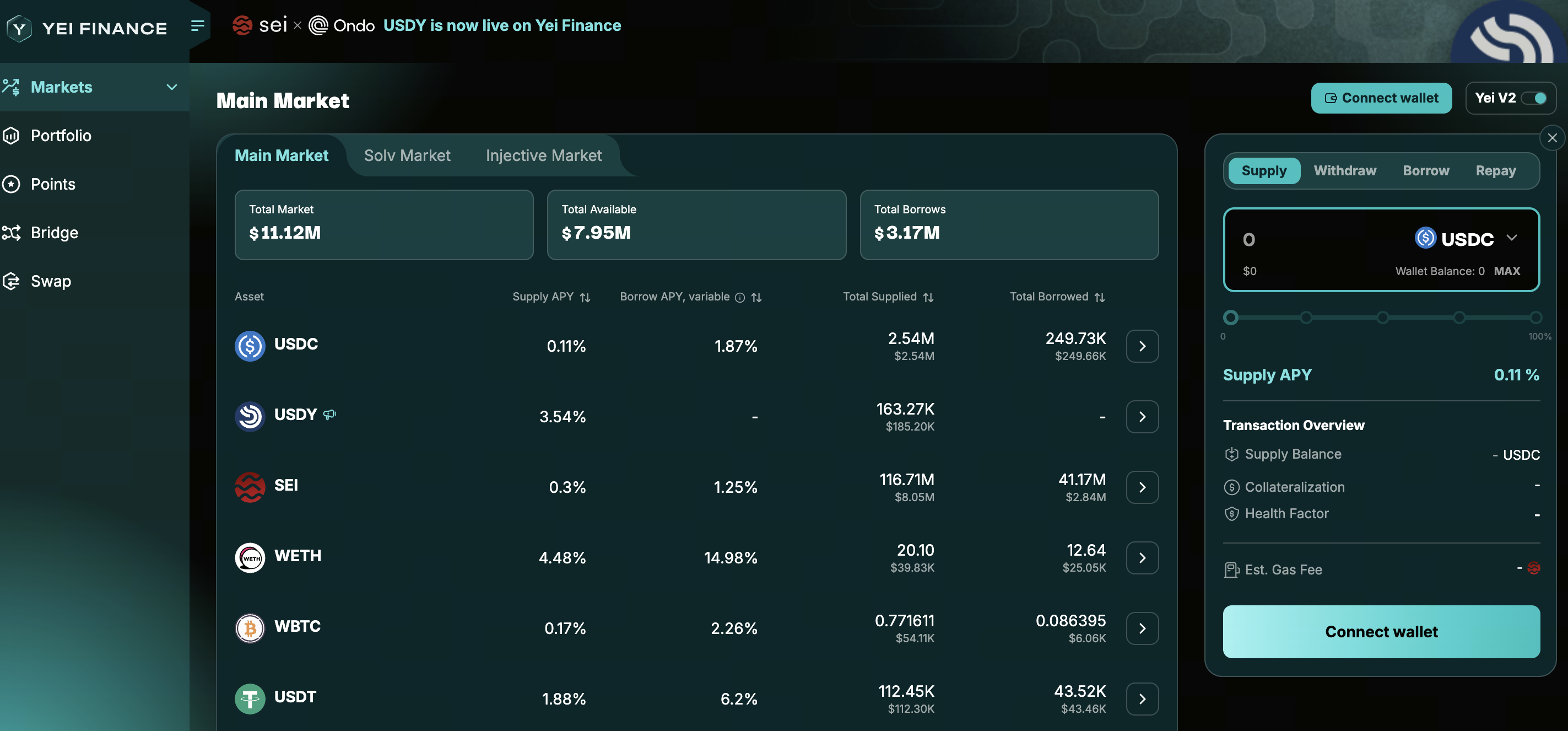
From a product perspective, Yei Finance first validated the YeiLend, YeiSwap, and YeiBridge model on Sei, then evolved it into Clovis’s cross-chain liquidation and settlement layer. CLO is therefore not an isolated fundraising token—it is the core economic interface that bridges single-chain validation with multi-chain expansion.
CLO Token Allocation and Release Mechanism
Per the official Tokenomics, CLO has a fixed total supply of 1 billion tokens. The TGE occurred in October 2025, with an initial circulating supply of approximately 12.91%. The remaining tokens will be released gradually through September 2029. The fixed supply provides a clear long-term supply ceiling, though mid-term price performance will be influenced by the unlocking schedule.
The public allocation breakdown is as follows:
- Ecosystem Incentives: 30.0%
- Treasury: 20.5%
- Team: 15.0%
- Investors: 10.0%
- Marketing & Growth: 6.5%
- Airdrop: 5.0%
- Advisors: 5.0%
- Liquidity: 4.0%
- Exchange: 3.0%
- IDO: 1.0%
For release mechanics: team and investor tokens have a 12-month cliff followed by linear vesting. Ecosystem and Treasury allocations follow longer release cycles. Marketing and Liquidity have higher initial availability at TGE. This structure reflects a common strategy: bootstrap market liquidity first, then gradually release governance and development funds. For investors, the key metric is not total supply alone, but whether newly circulating tokens at each stage align with on-chain demand.
Role of CLO in the Governance System
Governance effectiveness determines whether a token holds genuine "productive rights." In the CLO model, governance delivers value through three decision categories:
- Risk Governance: setting collateral ratios, liquidation thresholds, lending pool parameters, and cross-chain asset risk weights.
- Economic Governance: determining fee allocation, incentive budgets, staking reward rates, and ecosystem fund deployment.
- Expansion Governance: prioritizing new chain integrations, approving partnership whitelists, and shaping developer support and grant strategies.
If governance remains purely formal, token rights will be discounted by the market. But if governance consistently produces high-quality decisions, CLO’s valuation will shift from a "narrative asset" to a "cash flow and control rights asset." Ongoing monitoring should focus on proposal frequency, voter turnout, execution transparency, and on-chain outcomes following parameter changes.
CLO Staking Mechanism and Yield Source Analysis
Staking CLO ties token holding to protocol growth. According to public information, stakers earn protocol-related incentives, with potential yield sources including:
- Lending market spreads and associated fees (YeiLend / Clovis Market)
- Trading fees and liquidity activity yields (YeiSwap / Clovis Exchange)
- Cross-chain routing or settlement fees (Clovis Transport)
- Phased subsidies from the ecosystem incentive pool
Two yield types must be distinguished:
- Real Yield: derived from the protocol’s business cash flow.
- Inflationary Yield: generated by additional token issuance.
Real yield determines long-term sustainability; inflationary yield is a growth tool for the bootstrapping phase. When evaluating CLO staking value, focus on the rising share of protocol revenue—not just short-term APRs.
How CLO Captures Protocol Value
CLO’s value capture follows a chain: Usage → Revenue → Allocation → Token Demand.
- Cross-chain lending, trading, and bridging generate fees and capital turnover.
- The protocol channels a portion of this value back into staking, incentives, or the Treasury, forming a governance budget.
- Governance decides the rules for value return and reinvestment, influencing ecosystem expansion efficiency.
- As business scale grows, demand for CLO for governance and staking increases, transitioning the token from a pure trading asset to a productive asset.
Some market sources mention a buyback/burn narrative for CLO. However, specific ratios, trigger conditions, and execution frequency must be verified through official governance and on-chain records. It’s crucial to separate implemented mechanisms from planned ones to avoid overestimating unrealized value capture.
Main Factors Influencing CLO Token Value
CLO’s mid-to-long-term performance is driven by these variables:
- Protocol Fundamentals: TVL, lending volume, trading volume, cross-chain traffic, and real revenue.
- Supply Dynamics: unlocking schedule, staking lock-up rate, and secondary market depth.
- Product Delivery: progress on Clovis cross-chain DEX, messaging layer, and non-EVM expansion.
- Ecosystem Synergy: ability to cross-pollinate traffic with Sei and multi-chain partners.
- Market Structure: exchange liquidity, derivatives leverage activity, and volatility amplification.
- Governance Quality: whether parameter changes improve capital efficiency and risk control.
In simple terms, the valuation anchor is not a single narrative but "growth quality": revenue growth outpacing incentive expenditure, and user retention exceeding short-term subsidy-driven acquisition.
Risks to Consider When Investing in CLO
- Unlock and Selling Pressure: A significant proportion of tokens will unlock between 2026–2029. Without sufficient demand, price pressure increases.
- Cross-Chain Security: Multi-chain interactions and messaging add complexity, exposing smart contracts, bridges, and liquidation mechanisms to potential attacks.
- Execution Risk: Roadmap items like cross-chain expansion, product iteration, and developer ecosystem development may face delays.
- Competition: The cross-chain liquidity space is crowded. Without clear differentiation, incentive efficiency may decline.
- Liquidity and Volatility: New tokens in high-leverage environments can experience sharp price swings, with short-term prices deviating from fundamentals.
- Regulatory Risk: Evolving DeFi and token regulations across jurisdictions may affect capital inflows and trading channels.
A prudent approach is to maintain a dynamic tracking checklist: monthly unlock data, TVL quality, protocol revenue composition, governance proposal execution, security incidents, and new chain launch performance.
Long-term Potential of the CLO Ecosystem
CLO’s long-term potential stems from two dimensions:
- Technology & Product: Yei Finance has already proven the lending + trading + cross-chain combination on Sei. If Clovis achieves unified liquidation and capital reuse across more chains, network effects will strengthen significantly.
- Economics: If CLO can consistently bind protocol revenue, governance rights, and staking yields while reducing reliance on short-term subsidies, it will move closer to a "cash-flow-driven asset."
As of now, CLO has completed its TGE and is listed on major trading platforms. The project has transitioned from single-chain growth to cross-chain expansion. The key metrics to watch are not short-term price movements but three hard indicators: net cross-chain TVL growth, real protocol revenue increase, and stable governance decision quality.
Summary
The core of the CLO tokenomics model is not about a visually appealing allocation chart—it’s about whether it can sustainably propel Yei Finance from a single-chain DeFi product into a cross-chain liquidity infrastructure. A fixed total supply, phased release, governance participation, and staking yields provide the framework. The real determinant of long-term value is whether protocol business growth and the value return mechanism form a closed loop.
For researchers and investors, the most effective analysis path is to treat the token as a "mirror of protocol performance": watch revenue, retention, unlocks, and governance. Only when these four dimensions improve together can CLO achieve a stable long-term valuation across cross-chain DeFi cycles.