Among practical questions tied to mainstream crypto card types, “Can it withdraw cash?” is one of the strongest search intents. The answer is not a simple yes or no. It depends on card type, regional support, account risk controls, payment network, and how the cash-out path is designed. What matters most is not an abstract label but whether the chain from digital assets to spendable balance—and then to card payment or cash—can complete reliably under the user’s region and account conditions.
Can a U Card Withdraw Cash? Common Spending and Cash-Out Methods
U cards commonly produce three types of outcomes. First, online payments—for subscriptions, e-commerce, and digital tools. Second, in-store card payments through POS networks at physical merchants. Third, some products support ATM withdrawal, converting card balance into cash. Not every U card offers all three. Withdrawal capability is often the most constrained, limited by payment network rules, regional policy, and account status.
Judging whether a U card can withdraw cash requires more than checking whether marketing copy mentions “cash access.” The relevant rules include supported countries or regions, KYC requirements, per-transaction and daily limits, whether only a physical card qualifies, and which party charges each fee. When those conditions are unclear, actual experience often diverges from expectations.
Some products are spend-only: they route converted balance through card networks for merchant payments but do not connect to ATM cash-out rails. Others allow limited ATM access on physical cards only. Virtual-only products may never expose a cash path even when online checkout works normally. Network branding (Visa, Mastercard, or regional equivalents) does not by itself guarantee ATM compatibility; issuer configuration and local acquirer support still matter.
What Should Be Prepared Before Using a U Card to Cash Out?
Before entering a cash-out flow, at least four conditions should be in place. First, fundable assets—typically stablecoins or other tokens the platform accepts. Second, the correct top-up network and deposit path. Third, account status that satisfies spending or withdrawal rules. Fourth, residence or usage location within the product’s service area. If any condition fails, the process may stall at top-up, FX conversion, card payment, or withdrawal.
Card type also shapes preparation. Virtual vs physical U cards differ in online payment availability and real-world payment capability. When the goal is ATM withdrawal, physical card issuance, payment-network compatibility, and local ATM support usually matter more than “balance exists on the account.” A funded virtual card may still be unable to dispense cash if the issuer never enabled ATM rails for that product tier.
Identity verification depth is another gate. Basic KYC may unlock online spending while higher tiers unlock higher limits or ATM access. Top-up source documentation—where assets originated and through which chain they arrived—can affect whether converted balance becomes spendable or withdrawable. Regional mismatch between registration country and transaction location is a frequent trigger for holds or declines.
What Is the Flow From Crypto Top-Up to U Card Balance?
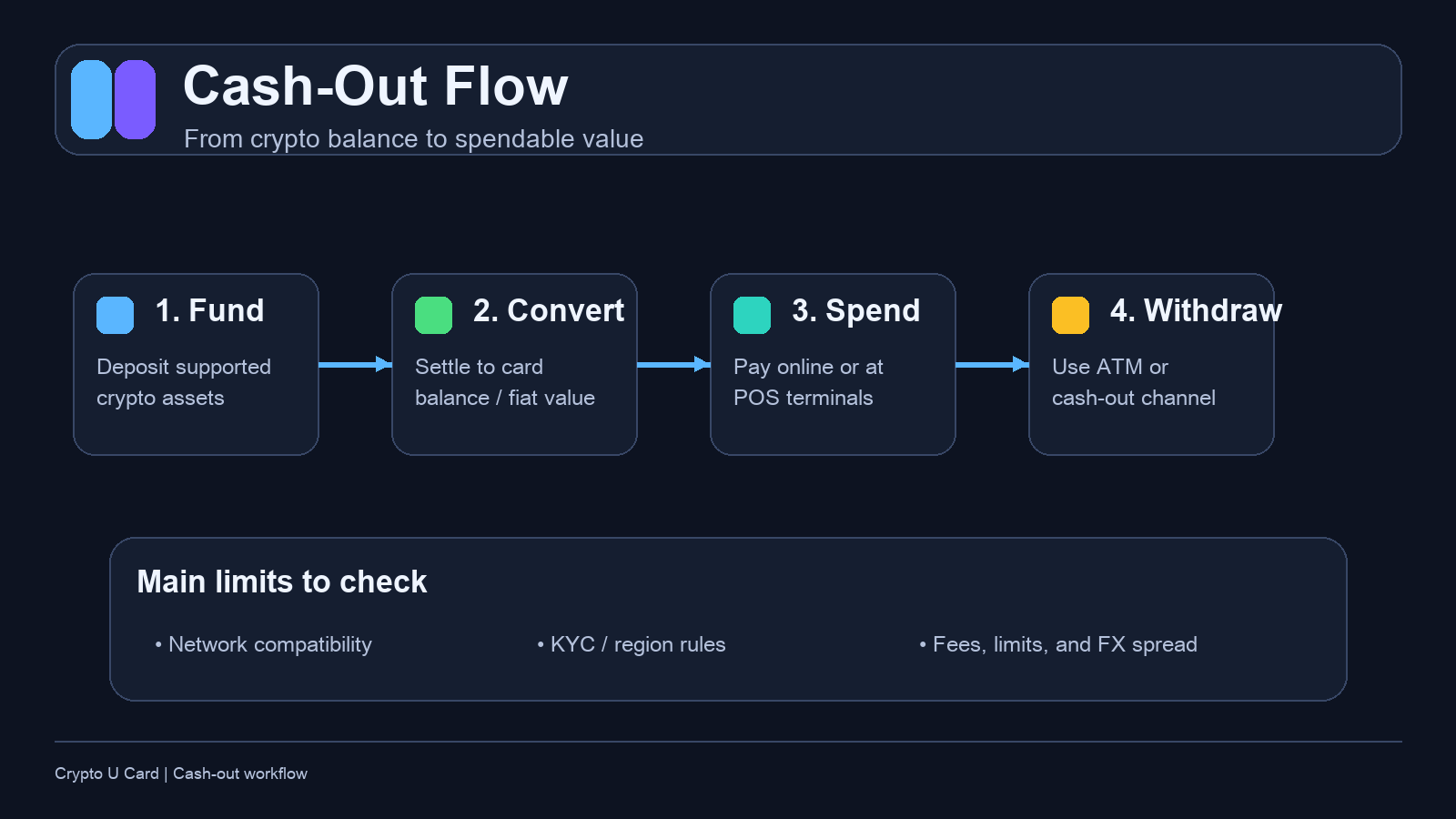
The core value of a U card lies in converting digital assets into spendable balance. That process generally passes through top-up, balance conversion, payment readiness, and execution. The first two stages occur inside the account and platform; the last two occur on payment networks and at merchants or ATMs. Mapping these stages helps isolate where a failure occurs.
| Stage |
Description |
Key constraints |
| Asset top-up |
Transfer stablecoins or other assets into supported channels |
Network compatibility, minimum deposit |
| Balance conversion |
Convert into card-usable balance |
Exchange rate, spread, FX fee |
| Payment readiness |
Confirm spendable or withdrawable status |
Risk controls, region, KYC |
| Execution |
Online pay / in-store swipe / ATM |
Limits, merchant support, network compatibility |
Successful top-up does not guarantee successful withdrawal or payment. Completed FX does not guarantee the payment network will accept the transaction. Each stage carries independent limits, so cash-out is not a single button but a full chain. A decline at execution may reflect insufficient converted balance, a merchant category block, an ATM that does not support the card network, or a risk hold applied after conversion.
Conversion mechanics vary by issuer. Some products maintain a fiat-denominated ledger after stablecoin top-up; others keep multi-currency buckets. Spread may be embedded in the quoted rate rather than listed as a separate line item. Users comparing “balance after top-up” against market mid-rates can estimate conversion drag before attempting payment or withdrawal.
How Do U Cards Work for In-Store Spending and ATM Withdrawal?
In-store spending and ATM withdrawal both occur on real-world payment networks, but requirements differ. In-store payments depend heavily on merchant acceptance and network compatibility. When card status is normal and balance is available, swipe or tap success rates are often relatively high. ATM withdrawal emphasizes physical card support, local ATM network compatibility, cash limits, and additional fees—so constraints tend to be stricter.
The safer mental model treats “spending” and “withdrawal” as two paths. Spending resembles everyday payments; withdrawal resembles extracting cash from the payment network. A U card may work online and in-store yet fail at ATMs because of limits, card issuance region, risk conditions, or clearing rules. Cross-border ATM use adds FX on the withdrawal leg and possible foreign ATM surcharges from the machine operator, separate from issuer fees.
Merchant declines may still occur when balance is sufficient: certain categories are blocked on some products. ATM failures may show as “transaction not permitted” when daily caps are reached or when cash access is disabled for the user’s verification tier.
What Fees and Limits Appear Most Often During Cash-Out?
Common costs on U card cash-out paths include top-up fees, FX conversion fees, payment-network charges, ATM withdrawal fees, and FX spread that is easy to overlook. Frequent small withdrawals or cross-currency settlement can stack these costs quickly. Total path cost usually matters more than any single published rate.
Limits are equally important: per-withdrawal caps, daily aggregate limits, supported countries, required identity tier, and whether specific merchants or ATMs refuse the card. Reviewing costs effectively means walking through top-up, FX, payment, and withdrawal stages against U card fees: top-up, FX, and ATM rather than comparing headline numbers alone.
ATM operators may charge a local surcharge displayed on-screen before confirmation; issuer fees may post separately on statements. Dynamic currency conversion at overseas ATMs—choosing to be charged in home currency rather than local currency—often widens effective spread. Daily and monthly caps can force splitting large cash needs across days, multiplying fixed per-transaction fees.
What Risks and Precautions Apply to U Card Cash-Out?
The most common risks start with account and risk controls. Unusual top-up sources, usage regions that do not match registration, or dense short-interval transaction patterns can trigger restrictions. FX and fee drag pose a second risk: even when every step succeeds, final value received may fall below expectations after layered costs.
Execution-environment risks include merchant non-acceptance, ATM incompatibility, lost physical cards, or failed withdrawals. Compliance and service-boundary risks also apply: attitudes toward crypto-linked payment cards differ by jurisdiction, so the same card may work in one country and fail in another. Checking account and regional conditions against U card compliance and risk before initiating cash-out reduces surprises at payment or ATM stages.
Cash-out paths are not bank wires. Many U cards are built around card-network spending and ATM access, not direct transfer to a traditional bank account. Users whose goal is landing funds in a checking account should confirm whether the product offers a dedicated off-ramp; otherwise the realistic options may be merchant spending, ATM cash, or converting through separate exchange and bank channels. U card cross-border payments vs bank wire clarifies when card payment fits and when bank transfer remains the appropriate rail.
Risk holds may pause both spending and withdrawal until identity or source-of-funds review completes—behavior common across payment products but encountered more often where crypto-linked funding triggers stricter monitoring.
Summary
Whether a U card can withdraw cash is a practical flow question, not an abstract yes/no. Breaking the path into top-up, conversion, payment readiness, and execution clarifies most doubts. What matters is whether the user’s region, card type, fee structure, and account status support completing that chain reliably—not whether a product theoretically advertises cash access.
FAQ
Can a U card withdraw cash?
Some U cards support withdrawal, but not all products offer the same capability. ATM cash access usually depends on card type, payment network, regional support, and account risk controls. Physical cards generally align more often with real-world withdrawal paths than virtual-only products.
What is the U card cash-out flow?
The typical sequence includes four steps: top up crypto through a supported path, convert assets into spendable balance, confirm account status and payment conditions, then execute online payment, in-store card use, or ATM withdrawal. Each step has independent limits, so conditions should be checked stage by stage.
Are U card withdrawal fees high?
Total cost depends on whether top-up fees, FX fees, withdrawal fees, and spread stack together. A single published rate is insufficient; the full path’s combined cost determines whether withdrawal is economical. Frequent small withdrawals usually raise unit cost because fixed fees repeat.
Can a U card withdrawal be frozen or blocked?
Yes. Unusual login activity, region mismatch, unclear top-up sources, or high-frequency abnormal transactions can trigger risk controls that limit payment or withdrawal. Freezes are not unique to U cards, but cross-border and crypto-linked contexts make compliance conditions especially worth verifying in advance.
Can a U card withdraw to a bank account?
That depends on whether the specific product offers a bank-transfer channel. Many U cards focus on card-network spending and ATM cash rather than acting as a bank wire tool. Users targeting a traditional bank account should confirm a dedicated off-ramp exists before assuming card balance can move directly to checking or savings.