In most public blockchain native token models, supply is typically dependent on private placements, public offerings, or fixed inflation emissions. c8ntinuum (CTM) utilizes a Public Generation mechanism: users permanently lock whitelisted counterparty assets into the protocol treasury to mint CTM, bypassing traditional ICO allocations. As more CTM is minted, the minimum generation threshold dynamically increases, ensuring new supply remains proportional to treasury assets. Counterparty assets are accepted via Generation contracts across multiple chains—ETH, BNB, SOL. For details on asset locking and three-way allocation, see CTM Generation Flow.
From a digital asset perspective, CTM tokenomics integrates two closed loops: an external value loop (cross-chain re-staking yield buybacks) and an internal value loop (on-chain execution fee incentives). This framework unifies validators, active stakers, interactive staking participants, and contract deployers under a single allocation model. Cross-chain message fees are also routed through the buyback and burn channel, connecting to the fee layer of trustless bridge infrastructure discussed in Differences in Trust Models Between c8ntinuum and Committee Cross-Chain Bridges.
What roles does CTM serve in the ecosystem?
Within the c8ntinuum ecosystem, CTM fulfills three primary functions: network security validation, governance decision-making, and ecosystem incentives. Validators must stake CTM to participate in CometBFT consensus, safeguarding Chain-level block finality. CTM holders can vote on protocol upgrades and ecosystem grant proposals on-chain. The external value loop allocates buyback CTM to active stakers, interactive staking participants, and contract deployers, aligning contributors with the protocol's growth trajectory.
How does the supply cap and mint-burn equilibrium operate?
CTM is capped at 8,888,888,888 tokens (approximately 8.888 billion), governed by a mint-burn equilibrium dynamic supply mechanism. New CTM can only be minted via Public Generation: users permanently lock whitelisted assets like ETH, BNB, and SOL into the protocol treasury and receive CTM based on a dynamic pricing curve. These locked assets are non-redeemable.
The “burn” side of the mint-burn equilibrium is driven by multi-channel buyback and burn: external chain re-staking yields are used to buy back CTM via liquidity pools; 50% of protocol execution fees, cross-chain message fees, and staking rewards are also funneled into the buyback and burn channel, creating supply room for future Generation.
| Supply Side (Minting) |
Burn/Return Side |
| Permanent counterparty asset lock → mint CTM |
External re-staking yield → buy back CTM |
| Minted volume increases → minimum generation threshold rises |
Execution fees, cross-chain message fees → buyback and burn |
| 40% liquidity pool / 10% invitation / 50% re-staking |
50% staking rewards → buyback and burn |
The table above outlines the two main supply dynamics for CTM: Generation-driven minting and treasury expansion, counterbalanced by buyback, burn, and validator distribution.
How is the external value loop allocated?
The external value loop manages multi-chain counterparty assets within the protocol treasury. During Generation, 50% of locked assets are re-staked by the protocol across external chains. Yields from external network staking inflation are used to buy back CTM via liquidity pools, then distributed at fixed ratios to four participant categories.
| Allocation Target |
Percentage |
Role |
| Validators |
30% |
Maintain network security and consensus |
| Active Stakers |
30% |
Incentivize sustained staking participation |
| Interactive Staking |
10% |
Reward active contract-interacting users |
| Contract Deployers |
30% |
Incentivize application development |
Validators and active stakers each receive 30%, interactive staking receives 10%, and contract deployers receive 30%, together forming the complete allocation for external loop CTM buybacks.
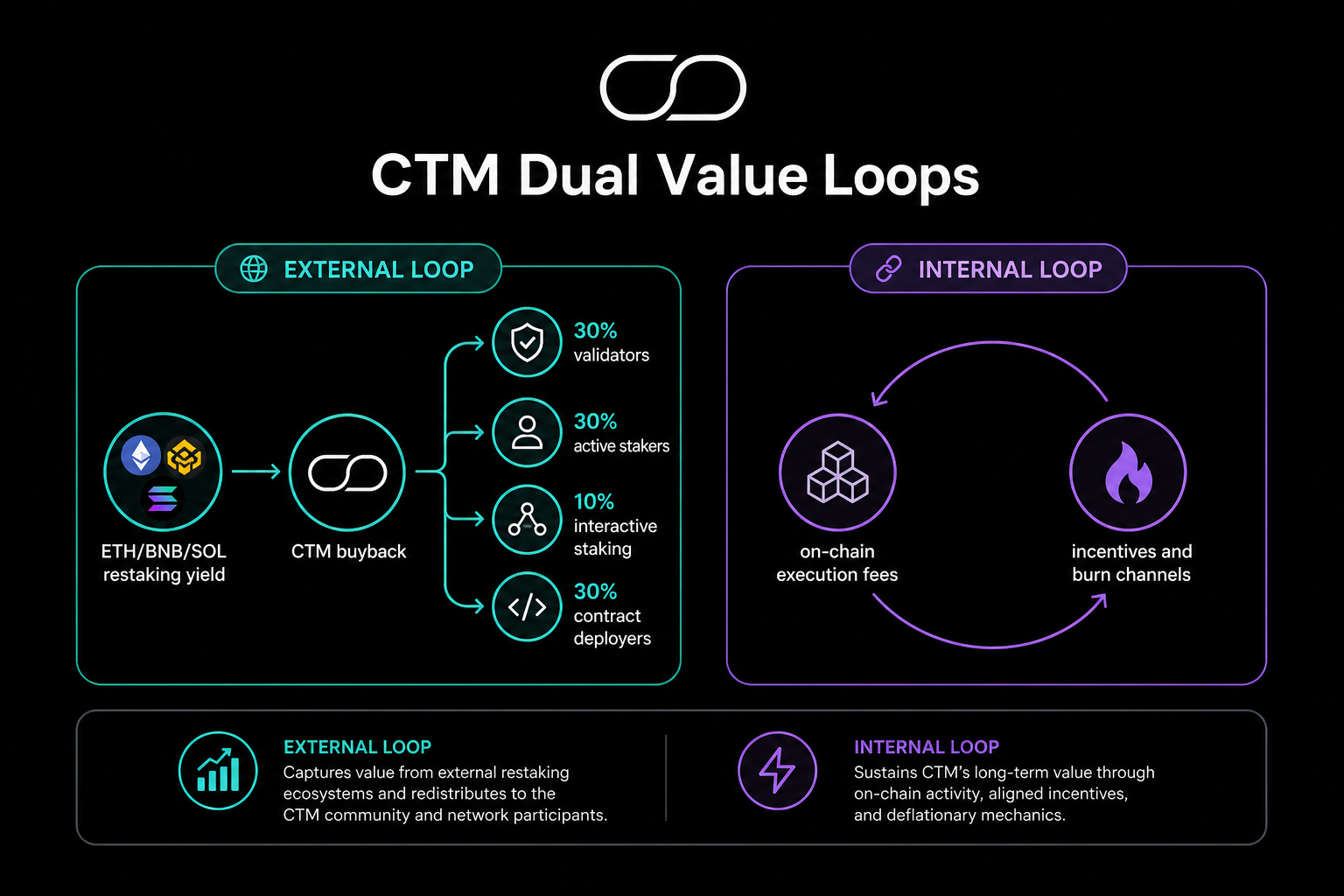 Figure 1. CTM dual value loops: external loop links multi-chain re-staking with four-way allocation; internal loop is driven by execution fees to incentivize interactive staking.
What is the purpose of the internal value loop and execution fees?
The internal value loop is powered by on-chain protocol execution fees, rewarding ecosystem participation through network activity. Execution fees from transactions, contract calls, and SuperApp operations are allocated to the engagement channel, with interactive staking as the primary recipient. Cross-chain message fees are also included in buyback and burn, corresponding to Infrastructure layer B2B cross-chain capabilities.
How does interactive staking differ from regular staking?
Interactive staking requires users to stake CTM and actively interact with ecosystem smart contracts—passive lock-up alone does not qualify for rewards. Regular staking (active staking) centers on continuous CTM lock-up and corresponds to the 30% allocation for active stakers in the external loop; interactive staking receives a dedicated 10% pool, demanding greater activity.
| Comparison Dimension |
Regular Staking (Active Staking) |
Interactive Staking |
| Core Action |
Lock CTM for staking |
Stake + interact with contracts |
| Reward Source |
30% external loop active staker |
10% external loop interactive |
| Participation Threshold |
Continuous staking |
Ongoing contract interaction |
| Design Intent |
Network security and basic participation |
Reward tied to on-chain activity |
SuperApp transactions, Launchpad participation, Tasks/Quests, and other on-chain activities count as interactive behavior; extended periods without contract interaction may result in forfeited interactive staking rewards.
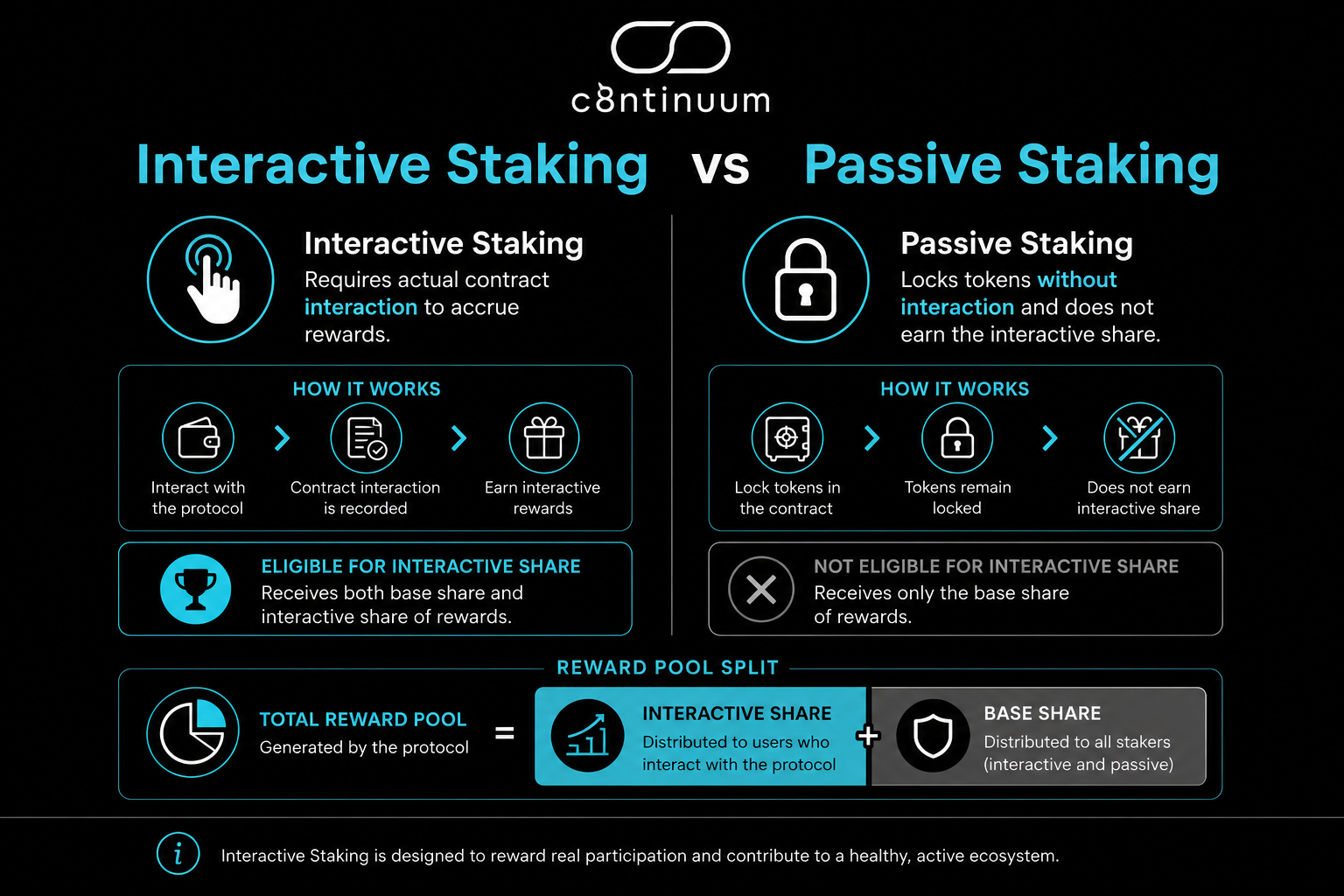 Figure 2. Interactive staking vs regular staking: the former requires contract interaction and receives 10% external loop allocation; the latter receives 30% active staker share.
How does the 50% buyback and burn + 50% validator allocation rule work?
Beyond the four-way external loop allocation, CTM staking rewards follow a dedicated 50% buyback and burn, 50% validator split, targeting network security incentives. Half of staking rewards are used for market buyback and permanent CTM burn; the other half is allocated to c8ntinuum validators as an incentive for maintaining CometBFT consensus.
This rule forms another adjustment axis for mint-burn equilibrium alongside Generation minting: the burn side slows supply growth, while the validator side ensures network robustness. This rule is independent of the external loop’s 30/30/10/30 allocation, applying specifically to the staking rewards pool. The buyback and burn portion, combined with external loop buybacks and cross-chain message fee buybacks, constitutes the “burn” force.
What risks should users understand before participating in CTM staking and Generation?
CTM tokenomics offers structural transparency and multi-role incentives, but participants should remain aware of mechanism-level risks. The following are objective descriptions:
Irreversible lock-up: Generation requires permanent locking of counterparty assets in the treasury, with no redemption via the original path. Confirm lock-up terms and your liquidity needs before participating.
Interactive staking activity requirements: Continuous contract interaction is required; prolonged inactivity may prevent reward allocation, with higher operational and monitoring costs than passive staking.
Smart contract and multi-chain risks: Generation contracts are deployed across ETH, BNB, SOL, and other chains. Verify contract addresses and token authenticity to avoid counterfeit CTM or unofficial entry points.
External re-staking and governance dependency: The external loop relies on re-staking yields from counterparty assets on external networks. Allocation ratios, generation thresholds, and other parameters may be adjusted via on-chain governance proposals.
Regulatory uncertainty: Crypto asset regulatory frameworks differ by jurisdiction; holding and participation methods may face compliance restrictions.
Summary
CTM tokenomics is built on a hard cap of 8,888,888,888 tokens and mint-burn equilibrium, connecting multi-chain treasuries through permanent ETH, BNB, and SOL lock-up minting. The external loop distributes buyback CTM via four-way 30/30/10/30 allocation; the internal loop is driven by execution fees and cross-chain message fees for engagement. Interactive staking requires contract interaction, and staking rewards follow a separate 50% buyback and burn, 50% validator rule.
FAQ
What is the purpose of the CTM token?
CTM is the native functional token of c8ntinuum, serving validator staking, on-chain governance voting, and ecosystem incentives. Validators use CTM to maintain CometBFT consensus; holders participate in protocol upgrade and ecosystem grant voting; active stakers, interactive staking participants, and contract deployers receive allocations from the dual internal and external value loops.
What is c8ntinuum’s interactive staking?
Interactive staking requires users to hold and stake CTM while actively interacting with c8ntinuum ecosystem smart contracts; passive lock-up does not qualify for rewards. In the external value loop, 10% of buyback CTM is dedicated to interactive staking participants, directly linking rewards to user on-chain activity, distinct from the 30% allocation for active staking.
How are CTM staking rewards allocated? Are they burned?
Staking rewards are split 50% buyback and burn, 50% validator: half is used for market buyback and permanent CTM burn, and half is allocated to CometBFT validators. Additionally, buyback CTM from the external value loop is allocated 30% to validators, 30% to active stakers, 10% to interactive staking, and 30% to contract deployers. Cross-chain message fees and execution fees are also included in the buyback and burn channel, maintaining mint-burn equilibrium alongside Generation minting.
What is the total CTM supply? How is it minted?
CTM is capped at 8,888,888,888 tokens. Users can mint CTM by permanently locking whitelisted assets such as ETH, BNB, and SOL into the protocol treasury, allocated as 40% liquidity pool, 10% invitation incentives, and 50% protocol re-staking. As minted volume increases, the minimum generation threshold dynamically rises.
How do you generate CTM with ETH, BNB, or SOL?
Invoke the Generation contract on the relevant chain and permanently lock whitelisted counterparty assets into the protocol treasury to receive CTM. Locked assets are allocated 40% to the liquidity pool, 10% to invitation incentives, and 50% to protocol re-staking. Lock-up is irreversible—verify contract addresses before proceeding.
What are the main risks of participating in CTM staking?
Key risks include: irreversible lock-up in Generation, requirement for ongoing contract interaction in interactive staking, multi-chain smart contract and counterfeit token risks, volatility in external re-staking yields, potential changes in governance parameters, and regulatory uncertainty across jurisdictions. These are mechanism-level risk factors only and do not constitute value judgments.







