XRP Price Prediction: Ripple’s $1 Billion Treasury Move Could Spark a 1000x Surge in XRP Value

Beginner
Quick Reads
Last Updated 2026-03-28 06:44:47
Reading Time: 1m
Ripple has announced a $1 billion acquisition of a corporate treasury management firm, officially stepping into the enterprise treasury services market. This strategic initiative deepens Ripple’s cross-border payments ecosystem. It has also ignited vigorous discussion about the potential revaluation of XRP.

Ripple Commits $1 Billion to Expand Into the Corporate Treasury Sector

Ripple is once again in the spotlight, with multiple sources reporting that the company is acquiring a corporate treasury management firm for $1 billion. This move marks Ripple’s official entry into the corporate treasury services market, further solidifying its cross-border payments ecosystem and prompting renewed debate over the potential revaluation of XRP.

As news broke, some market educators and analysts began making more bullish price projections. Crypto researcher “X Finance Bull” models that if Ripple successfully integrates XRP into corporate treasury solutions, XRP’s price could start at $2–$3 in the short term, target $5–$10 in the medium term, and potentially reach the $20–$100 range in the long term.
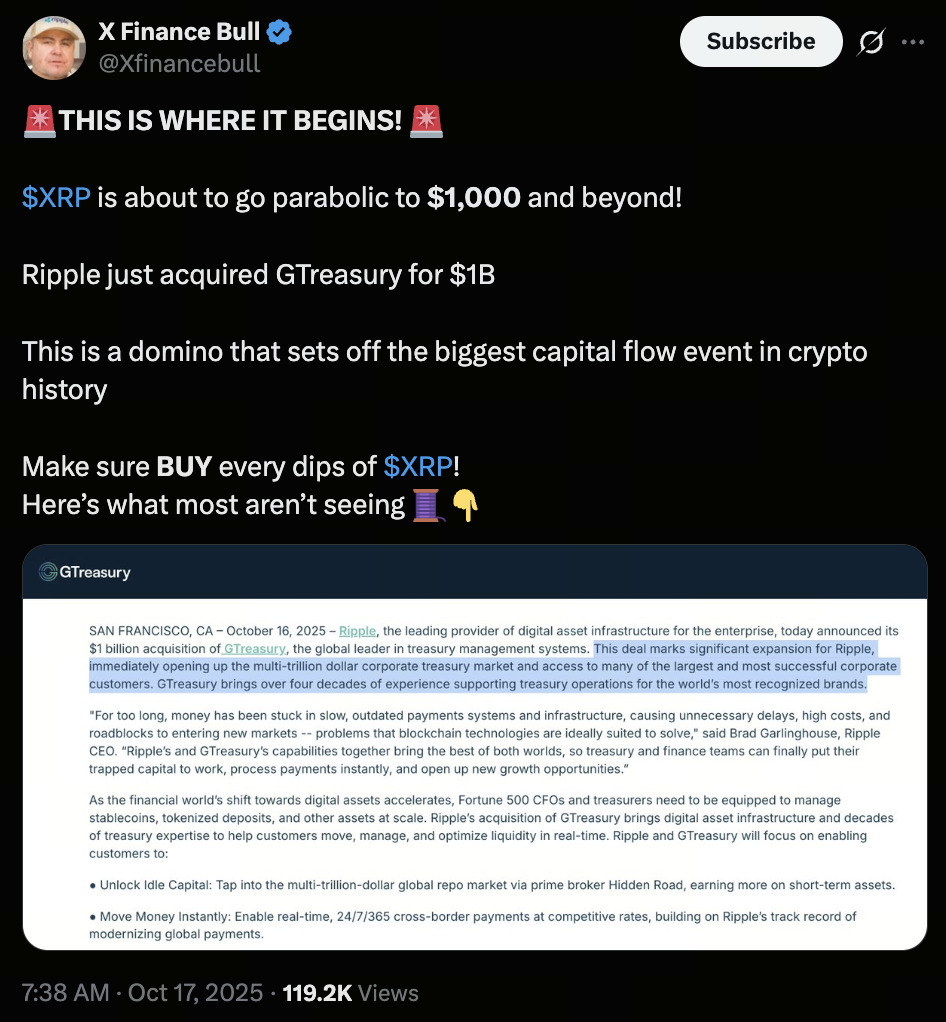

(Source: Xfinancebull)

In the most optimistic scenario, if XRP secures a significant share of global corporate treasury flows, its price could theoretically surpass $1,000.

Corporate Treasury Integration

What makes this move a pivotal turning point? Treasury management sits at the heart of daily corporate operations, encompassing cash flow management, foreign exchange settlement, liquidity allocation, and cross-border fund transfers. If Ripple enables large enterprises to incorporate XRP into their treasury workflows, the resulting increase in on-chain liquidity demand would be transformative.

Industry observers note that capital flows at the enterprise level far exceed those in typical payment applications. If Ripple successfully enters this space, real-world use cases and demand for XRP could fundamentally shift. Experts caution that Ripple must address regulatory clarity, enterprise adoption rates, and transaction volume challenges for this scenario to materialize.

Multi-Stage Price Forecasts

According to the projections from “X Finance Bull,” XRP may follow three distinct upward phases:

  • Short-term: $2–$3, reflecting the initial market reaction to Ripple’s treasury strategy;
  • Medium-term: $5–$10, representing the gradual adoption of RippleNet technology and XRP settlement by large enterprises;
  • Long-term: $20–$100+, assuming XRP becomes the standard liquid asset for multinational corporate treasury operations.

Some analysts consider the widely cited $1,000+ price prediction a “theoretical ceiling.” If XRP captures a substantial portion of global treasury settlements, such valuations could become feasible. However, achieving this would require significant changes, such as supply contraction, inflation control, or innovative economic models.

Regulatory and Integration Details Remain Key Variables

Shifts in regulatory policies will directly impact enterprise willingness to adopt XRP. Currently, regulatory positions in the United States, the European Union, and parts of Asia are becoming clearer, which bodes well for Ripple and XRP. Furthermore, integration details are critical, including:

  • Whether enterprises will hold XRP long-term as a liquid asset;
  • How Ripple’s treasury software will integrate with legacy ERP systems;
  • How enterprises will evaluate XRP liquidity risks and custody strategies.

These factors will ultimately determine XRP’s role in corporate financial infrastructure. They will also influence its market performance.

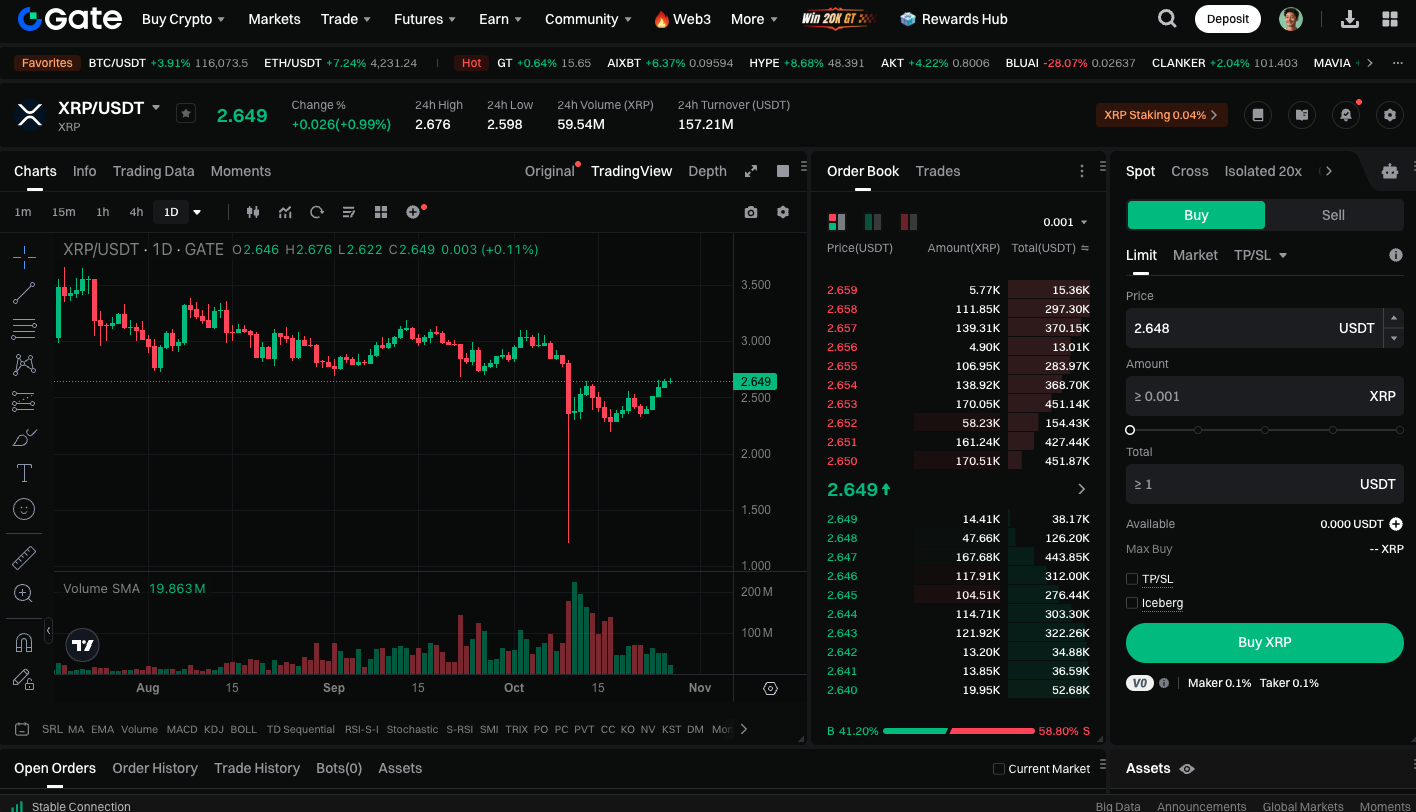
Ready to trade XRP spot? https://www.gate.com/trade/XRP_USDT
Summary

This $1 billion acquisition highlights Ripple’s long-term strategic ambition to transform XRP from a simple payment instrument into the core liquidity bridge for global corporate treasury operations. While the $1,000 price forecast for XRP remains theoretical, deepening enterprise adoption and regulatory improvements are steadily increasing the likelihood of a sustained upward trajectory. For investors, this corporate treasury transformation could be the catalyst for XRP’s next major growth phase.

Author: Allen
Disclaimer
* The information is not intended to be and does not constitute financial advice or any other recommendation of any sort offered or endorsed by Gate.
* This article may not be reproduced, transmitted or copied without referencing Gate. Contravention is an infringement of Copyright Act and may be subject to legal action.

Related Articles

AI-Native Settlement Layers: How United Stables Is Building the Next Financial Rail
Beginner

AI-Native Settlement Layers: How United Stables Is Building the Next Financial Rail

Stablecoins were originally designed as dollar substitutes within exchanges, primarily used for asset pricing and trade settlement. As on-chain financial ecosystems have matured, their role has expanded beyond simple payments to include collateral assets, cross-chain liquidity mediums, and unified settlement units. In particular, as AI systems and automated agents begin to participate directly in economic activity, demand has risen sharply for programmable value units capable of instant settlement. This shift is pushing stablecoins toward the role of foundational financial infrastructure.
2026-03-25 03:16:17
The ve(3,3) Flywheel Explained: How AERO Tokenomics Powers Aerodrome’s DeFi Economy
Beginner

The ve(3,3) Flywheel Explained: How AERO Tokenomics Powers Aerodrome’s DeFi Economy

In the competition for DeFi liquidity, high-inflation mining alone is no longer enough to build lasting advantages. Aerodrome applies the ve(3,3) economic model to redesign token emissions, voting mechanisms, and revenue distribution, creating a liquidity flywheel centered on governance and cash flow. This article examines AERO tokenomics, the veAERO locking mechanism, and protocol revenue models to explain how Aerodrome builds a sustainable DeFi economic system.
2026-03-25 06:41:58
Aerodrome Tokenomics: How ve(3,3) Powers Base's Most Profitable DEX
Beginner

Aerodrome Tokenomics: How ve(3,3) Powers Base's Most Profitable DEX

AERO is the native token of Aerodrome Finance, a core decentralized exchange and liquidity protocol in the Base ecosystem. It is primarily used for liquidity incentives and ecosystem operations. veAERO is a governance NFT that users receive by locking AERO, representing both voting power and the right to share protocol revenue. Through a dual track structure of AERO as a utility token and veAERO as a governance credential, Aerodrome separates liquidity usage value from long term governance power, allowing participants to act as liquidity providers, governance decision makers, and revenue sharers within the same system.
2026-03-25 06:40:31
How Does PAXG Work? In-Depth Overview of the Physical Gold Tokenization Mechanism
Beginner

How Does PAXG Work? In-Depth Overview of the Physical Gold Tokenization Mechanism

PAXG (Pax Gold) is a tokenized asset backed by physical gold, issued by the fintech company Paxos and traded on the Ethereum blockchain as an ERC-20 token. The core concept is to tokenize physical gold on-chain, with each PAXG token representing ownership of a certain amount of gold. This structure enables investors to hold and trade gold in the form of a digital asset.
2026-03-24 19:12:51
How is the price of PAXG determined? Pegging mechanism, trading depth, and influencing factors
Beginner

How is the price of PAXG determined? Pegging mechanism, trading depth, and influencing factors

PAXG (Pax Gold) is a tokenized asset backed by physical gold reserves, launched by fintech firm Paxos and issued as an ERC-20 token on the Ethereum blockchain. The core concept is to digitally represent real-world gold assets, allowing investors to hold and trade gold via the blockchain network. Because each PAXG token corresponds to a specific quantity of physical gold, its price is theoretically expected to closely track the global gold market.
2026-03-24 19:11:40
DePIN Identity Network and Real World Applications: How Humanity Protocol Brings on-chain Identity Into the Physical World
Beginner

DePIN Identity Network and Real World Applications: How Humanity Protocol Brings on-chain Identity Into the Physical World

Most Web3 identity systems remain confined to on-chain environments and struggle to achieve meaningful adoption in real world settings. Through a DePIN architecture and physical verification hardware, Humanity Protocol aims to bring decentralized identity into access control systems, hospitality, public services, and offline events, allowing on-chain identity to function not just as a digital credential, but as foundational infrastructure for real world access.
2026-03-25 07:40:53





