WLFI Price Prediction: Trump’s Crypto Empire Earns Over $1 Billion, WLFI Could Rise to $0.1359

Last Updated 2026-03-28 11:12:20
Reading Time: 1m
President Donald Trump and his family have adopted Web3, generating more than $1 billion in pre-tax profits over the past year through various digital asset ventures. The Trump family established a diversified portfolio in the cryptocurrency sector, including NFTs, meme coins, stablecoins, and DeFi platforms.

The Trump Family’s Crypto Empire

Former U.S. President Donald Trump was once skeptical of cryptocurrencies, but he and his family have now fully embraced Web3. Over the past year, they have amassed more than $1 billion in profits through a range of digital asset ventures. They have created a comprehensive ecosystem that spans NFTs, meme coins, stablecoins, and DeFi platforms.

Data from Wu Blockchain shows the Trump family’s crypto-related revenue primarily comes from three main segments: TRUMP and MELANIA tokens, the WLFI token, and the USD1 stablecoin.

WLFI: The Leading Revenue Driver

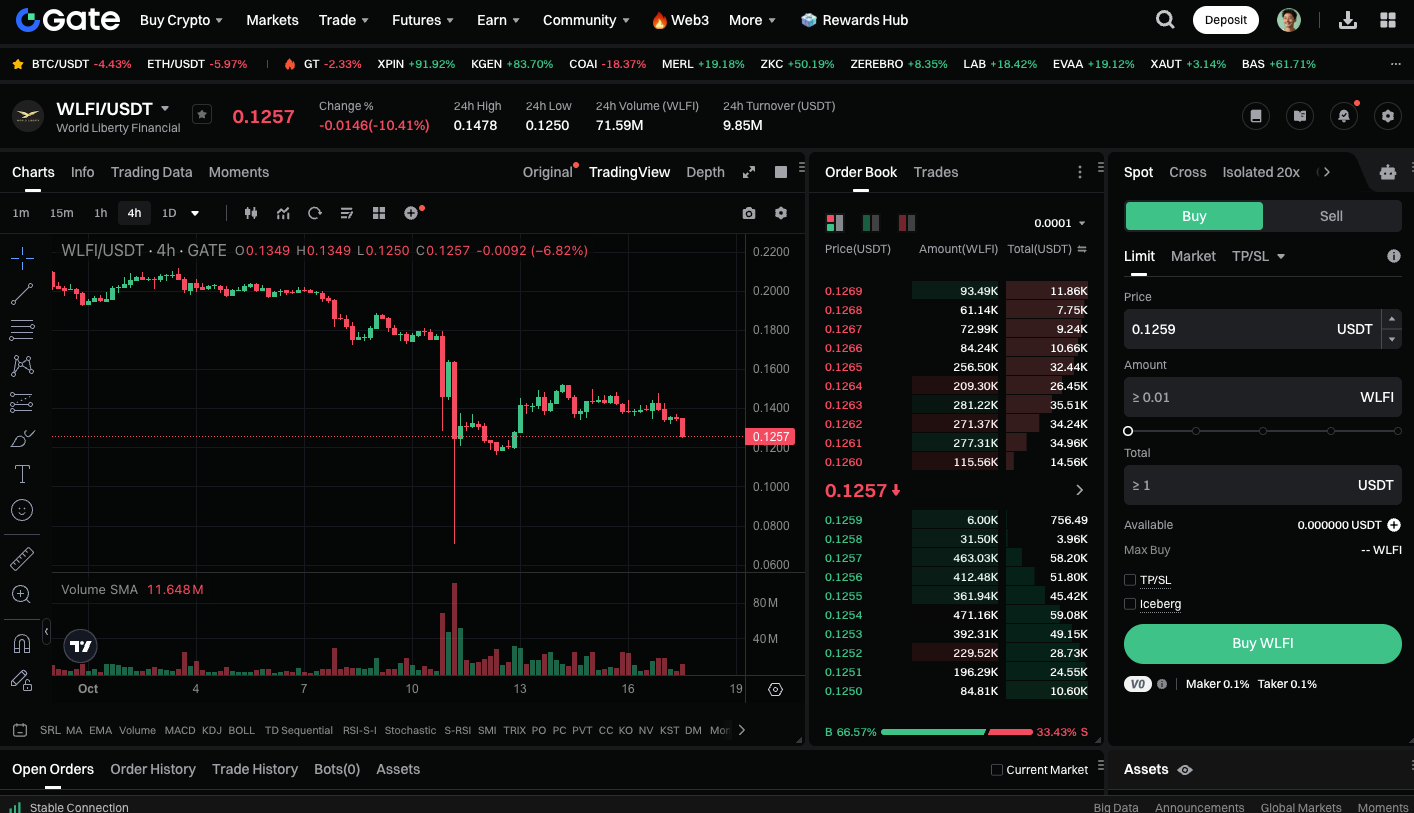
Since the WLFI token began trading publicly in September 2025, its price has dropped around 70% from its peak, yet it has still generated approximately $550 million in net profit. WLFI serves as the core asset of the World Liberty Financial (WLF) platform, founded by the Trump family at the end of 2023 to merge traditional finance with DeFi models. Donald Trump, his sons Donald Jr. and Eric, and business partner Steve Witkoff collectively own about 60% of WLF shares. The platform’s major income streams include token sales, staking, and lending.

Coincodex’s latest forecast predicts WLFI will trade between $0.0949 and $0.1359, with an average price near $0.1073—which represents an estimated annualized return of 7.40%.

USD1 Stablecoin: A Market Standout

In addition to WLFI, the Trump family’s USD1 stablecoin has quickly become a focal point. Just months after its launch, sales have surpassed $2.7 billion as its political branding has attracted a large user base and sparked a new trend of segmentation in the stablecoin market. The TRUMP and MELANIA tokens have also delivered more than $427 million in revenue as community engagement and trading volume soared, further solidifying the Trump family’s position in the crypto industry.

Trump’s Reach Extends to Mining and Financial Markets

Beyond DeFi, the Trump family invested in American Bitcoin Corp. (ABTC), a Bitcoin mining company established by Trump’s sons and business allies. ABTC went public on Nasdaq in May 2025, with its stock price surging over 110% post-listing—resulting in hundreds of millions of dollars in unrealized gains for the family trust. This move placed Trump among the top U.S. crypto asset investors, alongside figures like Michael Saylor and the Winklevoss twins.

You can trade WLFI spot at: https://www.gate.com/trade/WLFI_USDT
Summary

The Trump family’s involvement makes WLFI a key example of the intersection between politics and blockchain. While market fluctuations remain significant, its robust community and strong capital backing position it for long-term growth. If WLFI reaches its projected price of $0.1359, it could become one of the most prominent assets of 2025.

Author: Allen
Disclaimer
* The information is not intended to be and does not constitute financial advice or any other recommendation of any sort offered or endorsed by Gate.
* This article may not be reproduced, transmitted or copied without referencing Gate. Contravention is an infringement of Copyright Act and may be subject to legal action.

Related Articles

AI-Native Settlement Layers: How United Stables Is Building the Next Financial Rail
Beginner

AI-Native Settlement Layers: How United Stables Is Building the Next Financial Rail

Stablecoins were originally designed as dollar substitutes within exchanges, primarily used for asset pricing and trade settlement. As on-chain financial ecosystems have matured, their role has expanded beyond simple payments to include collateral assets, cross-chain liquidity mediums, and unified settlement units. In particular, as AI systems and automated agents begin to participate directly in economic activity, demand has risen sharply for programmable value units capable of instant settlement. This shift is pushing stablecoins toward the role of foundational financial infrastructure.
2026-03-25 03:16:17
The ve(3,3) Flywheel Explained: How AERO Tokenomics Powers Aerodrome’s DeFi Economy
Beginner

The ve(3,3) Flywheel Explained: How AERO Tokenomics Powers Aerodrome’s DeFi Economy

In the competition for DeFi liquidity, high-inflation mining alone is no longer enough to build lasting advantages. Aerodrome applies the ve(3,3) economic model to redesign token emissions, voting mechanisms, and revenue distribution, creating a liquidity flywheel centered on governance and cash flow. This article examines AERO tokenomics, the veAERO locking mechanism, and protocol revenue models to explain how Aerodrome builds a sustainable DeFi economic system.
2026-03-25 06:41:58
Aerodrome Tokenomics: How ve(3,3) Powers Base's Most Profitable DEX
Beginner

Aerodrome Tokenomics: How ve(3,3) Powers Base's Most Profitable DEX

AERO is the native token of Aerodrome Finance, a core decentralized exchange and liquidity protocol in the Base ecosystem. It is primarily used for liquidity incentives and ecosystem operations. veAERO is a governance NFT that users receive by locking AERO, representing both voting power and the right to share protocol revenue. Through a dual track structure of AERO as a utility token and veAERO as a governance credential, Aerodrome separates liquidity usage value from long term governance power, allowing participants to act as liquidity providers, governance decision makers, and revenue sharers within the same system.
2026-03-25 06:40:31
How Does PAXG Work? In-Depth Overview of the Physical Gold Tokenization Mechanism
Beginner

How Does PAXG Work? In-Depth Overview of the Physical Gold Tokenization Mechanism

PAXG (Pax Gold) is a tokenized asset backed by physical gold, issued by the fintech company Paxos and traded on the Ethereum blockchain as an ERC-20 token. The core concept is to tokenize physical gold on-chain, with each PAXG token representing ownership of a certain amount of gold. This structure enables investors to hold and trade gold in the form of a digital asset.
2026-03-24 19:12:51
How is the price of PAXG determined? Pegging mechanism, trading depth, and influencing factors
Beginner

How is the price of PAXG determined? Pegging mechanism, trading depth, and influencing factors

PAXG (Pax Gold) is a tokenized asset backed by physical gold reserves, launched by fintech firm Paxos and issued as an ERC-20 token on the Ethereum blockchain. The core concept is to digitally represent real-world gold assets, allowing investors to hold and trade gold via the blockchain network. Because each PAXG token corresponds to a specific quantity of physical gold, its price is theoretically expected to closely track the global gold market.
2026-03-24 19:11:40
Aster vs Hyperliquid: Which Perp DEX Will Prevail?
Beginner

Aster vs Hyperliquid: Which Perp DEX Will Prevail?

Aster and Hyperliquid are the two representative protocols of the "purpose-built L1 path" within the current decentralized perpetual exchange (Perp DEX) sector. As a pioneer in the field, Hyperliquid has built a deep liquidity moat through its highly mature order book architecture and strong community consensus. Conversely, Aster, as a rising challenger, seeks to leapfrog the competition in high-performance trading through more aggressive multi-chain aggregation logic, private transaction modules, and an underlying execution environment optimized for 2026 market demands.
2026-03-24 11:58:33





