Will Uniswap v4 and the “UNIfication” Upgrade Ignite a New Price Cycle for UNI?

Beginner
Quick Reads
Last Updated 2026-03-27 00:40:04
Reading Time: 1m
Uniswap v4 and the governance upgrade known as "UNIfication" are creating fresh momentum for UNI. In this article, we examine UNI's potential short- and medium-term price movements and associated risks by considering recent price trends, major holder activity, and the underlying token mechanics.

Uniswap v4: A Comprehensive Ecosystem Upgrade


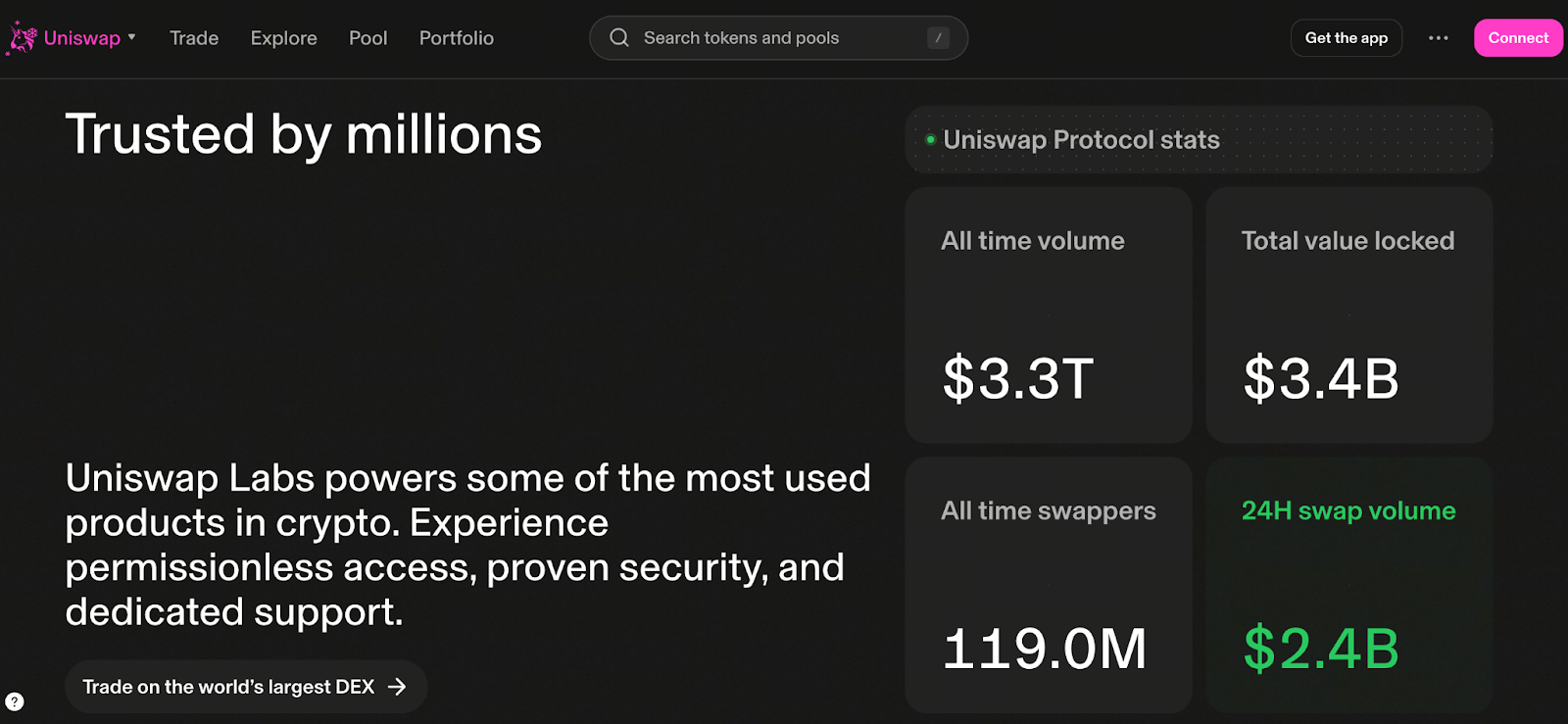
Image: https://app.uniswap.org/

The release of Uniswap v4 signals the protocol’s evolution from a basic DEX trading platform to a modular liquidity platform. The centerpiece of v4 is its new hooks mechanism, which empowers developers to integrate custom logic and build more flexible, highly tailored AMM functionalities.

This innovation paves the way for advanced features on Uniswap, such as dynamic fee pools, custom market-making strategies, automated liquidation modules, and even cross-chain liquidity management. As the platform becomes more open:

  • The number of ecosystem developers is likely to increase
  • Market-making efficiency for new assets will improve
  • Trading volumes could rise
  • Fee revenue may become more stable

v4 is not just a technical upgrade—it’s a strategic move to strengthen Uniswap’s network effects and lay the groundwork for UNI’s long-term value.

The Importance of the UNIfication Governance Proposal

UNIfication stands out as a pivotal proposal aimed at overhauling UNI’s tokenomics. Its key objectives include:

  1. Activating the Fee Switch: allowing protocol revenue to flow to token holders or fund token burns.
  2. Token buybacks and burns: reducing circulating supply to bolster value from the supply side.
  3. Adjusting incentive mechanisms: potentially providing long-term lock-up incentives for liquidity providers to enhance TVL stability.
  4. Enhancing user and developer rewards: boosting ecosystem participation and protocol usage.

If implemented, UNI would transition from a pure governance token to one that captures real protocol value, fundamentally shifting its valuation model.

UNI’s Recent Price Action and Whale Behavior

UNI has recently traded around $5, with several periods of simultaneous surges in both price and volume. Three main trends stand out:

  • Whale accumulation at lower levels: On-chain data reveals some addresses have increased holdings during price pullbacks.
  • Rising net outflows from exchanges: As governance upgrades gain attention, some addresses are withdrawing UNI from exchanges, reducing overall selling pressure.
  • Improved short-term trading sentiment: The market has turned bullish, driven by macro tailwinds and a recovering crypto ecosystem.

These factors provide short-term support, but whale activity could also trigger sharp price swings.

Short- and Mid-Term Outlook: Opportunities and Risks

Potential Growth Drivers:

  • Ecosystem expansion following the official rollout of v4
  • UNIfication proposal approval, directly reshaping UNI’s supply-demand dynamics
  • Major institutions entering DeFi blue-chip assets
  • Rising risk appetite in the market (especially as BTC and ETH trend upward)

Key Risks to Monitor:

  • Regulatory uncertainty: DEX regulatory changes could shift market expectations at any time.
  • Delays or failures in governance proposals: Unmet expectations could trigger sell-offs.
  • Macroeconomic tightening: Shifts in US Treasury yields or broader liquidity could impact crypto markets.
  • Sudden large-scale whale sell-offs: These can spark short-term panic.

Overall, the medium-term outlook remains cautiously optimistic, but expect continued high short-term volatility.

Actionable Investment Advice

  • Short-term traders: Monitor the $4.8–$5.0 support range, key governance proposal milestones, and large on-chain transfers.
  • Medium- to long-term investors: Consider a phased entry strategy and closely track developments in token burn and revenue return mechanisms.
  • Always manage risk: Set stop-losses, avoid chasing price spikes, and steer clear of heavy positions during whale sell-offs.

Conclusion

Uniswap is at a pivotal crossroads of technology upgrades and tokenomics reform. v4 brings new ecosystem expansion opportunities, while successful implementation of UNIfication could fundamentally enhance UNI’s value capture. In the near term, UNI’s price will likely remain volatile with market sentiment, but over the medium and long term, protocol upgrades provide a solid foundation for future growth.

Author: Max
Disclaimer
* The information is not intended to be and does not constitute financial advice or any other recommendation of any sort offered or endorsed by Gate.
* This article may not be reproduced, transmitted or copied without referencing Gate. Contravention is an infringement of Copyright Act and may be subject to legal action.

Related Articles

AI-Native Settlement Layers: How United Stables Is Building the Next Financial Rail
Beginner

AI-Native Settlement Layers: How United Stables Is Building the Next Financial Rail

Stablecoins were originally designed as dollar substitutes within exchanges, primarily used for asset pricing and trade settlement. As on-chain financial ecosystems have matured, their role has expanded beyond simple payments to include collateral assets, cross-chain liquidity mediums, and unified settlement units. In particular, as AI systems and automated agents begin to participate directly in economic activity, demand has risen sharply for programmable value units capable of instant settlement. This shift is pushing stablecoins toward the role of foundational financial infrastructure.
2026-03-25 03:16:17
The ve(3,3) Flywheel Explained: How AERO Tokenomics Powers Aerodrome’s DeFi Economy
Beginner

The ve(3,3) Flywheel Explained: How AERO Tokenomics Powers Aerodrome’s DeFi Economy

In the competition for DeFi liquidity, high-inflation mining alone is no longer enough to build lasting advantages. Aerodrome applies the ve(3,3) economic model to redesign token emissions, voting mechanisms, and revenue distribution, creating a liquidity flywheel centered on governance and cash flow. This article examines AERO tokenomics, the veAERO locking mechanism, and protocol revenue models to explain how Aerodrome builds a sustainable DeFi economic system.
2026-03-25 06:41:58
Aerodrome Tokenomics: How ve(3,3) Powers Base's Most Profitable DEX
Beginner

Aerodrome Tokenomics: How ve(3,3) Powers Base's Most Profitable DEX

AERO is the native token of Aerodrome Finance, a core decentralized exchange and liquidity protocol in the Base ecosystem. It is primarily used for liquidity incentives and ecosystem operations. veAERO is a governance NFT that users receive by locking AERO, representing both voting power and the right to share protocol revenue. Through a dual track structure of AERO as a utility token and veAERO as a governance credential, Aerodrome separates liquidity usage value from long term governance power, allowing participants to act as liquidity providers, governance decision makers, and revenue sharers within the same system.
2026-03-25 06:40:31
DePIN Identity Network and Real World Applications: How Humanity Protocol Brings on-chain Identity Into the Physical World
Beginner

DePIN Identity Network and Real World Applications: How Humanity Protocol Brings on-chain Identity Into the Physical World

Most Web3 identity systems remain confined to on-chain environments and struggle to achieve meaningful adoption in real world settings. Through a DePIN architecture and physical verification hardware, Humanity Protocol aims to bring decentralized identity into access control systems, hospitality, public services, and offline events, allowing on-chain identity to function not just as a digital credential, but as foundational infrastructure for real world access.
2026-03-25 07:40:53
How is the price of PAXG determined? Pegging mechanism, trading depth, and influencing factors
Beginner

How is the price of PAXG determined? Pegging mechanism, trading depth, and influencing factors

PAXG (Pax Gold) is a tokenized asset backed by physical gold reserves, launched by fintech firm Paxos and issued as an ERC-20 token on the Ethereum blockchain. The core concept is to digitally represent real-world gold assets, allowing investors to hold and trade gold via the blockchain network. Because each PAXG token corresponds to a specific quantity of physical gold, its price is theoretically expected to closely track the global gold market.
2026-03-24 19:11:40
How Does PAXG Work? In-Depth Overview of the Physical Gold Tokenization Mechanism
Beginner

How Does PAXG Work? In-Depth Overview of the Physical Gold Tokenization Mechanism

PAXG (Pax Gold) is a tokenized asset backed by physical gold, issued by the fintech company Paxos and traded on the Ethereum blockchain as an ERC-20 token. The core concept is to tokenize physical gold on-chain, with each PAXG token representing ownership of a certain amount of gold. This structure enables investors to hold and trade gold in the form of a digital asset.
2026-03-24 19:12:51